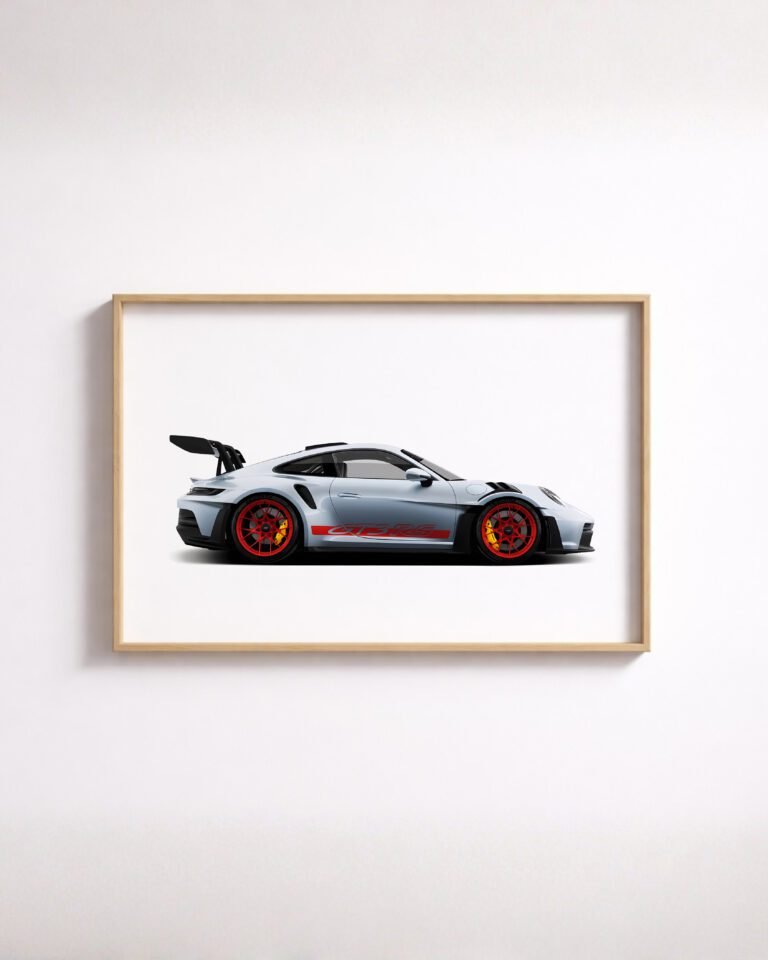
The Porsche 911 GT3 RS explained simply: it is not a faster GT3. It is a different car built around a wing, a radiator and a diet, and Porsche’s own naming code says so before any spec sheet does. The company’s model-naming guide states plainly that RS stands for RennSport — racing sport — and names “a street-legal model that has been derived from the motor racing version”. A GT3 is already close to a race car. The RS is the point where Porsche stops pretending it isn’t one.
What RS has meant since 1972
The modern RS bloodline starts with the 911 Carrera RS 2.7, which Porsche describes as “the first series production model with front and rear spoilers” — a car we cover in full in the piece on the 930’s whale tail, since the same wind-tunnel programme that built the ducktail later scaled up into the Turbo’s wing. Every RS since has followed the same instruction: remove weight, add aerodynamics, and sell whatever motorsport will allow onto the street.
Porsche 911 GT3 RS explained: what actually changes
The 911 GT3 itself is already unusual. It launched in March 1999 at the Geneva Motor Show, and Porsche describes the first car’s 3.6-litre naturally aspirated engine as producing “100 PS per litre” — 265 kW (360 PS) — and being the first road-approved series-production car to lap the Nürburgring Nordschleife in under eight minutes. The RS version takes that car and changes four things a standard GT3 does not have:
- A rear wing tall enough that its upper edge sits above the roofline — a first for a production Porsche.
- A central-radiator layout drawn from the Le Mans-class-winning 911 RSR and 911 GT3 R race cars.
- A front splitter in place of a spoiler, doing a different aerodynamic job.
- A kerb weight of 1,450 kg (DIN), held down despite all of the above.
A wing that outgrew the roof
On the current car, Porsche’s own figures are specific: 409 kg of total downforce at 200 km/h, rising to 860 kg at the car’s top speed of 296 km/h — roughly double the immediate predecessor and three times a standard 911 GT3. Most of that comes from Porsche Active Aerodynamics, a system of continuously adjustable elements on the front axle and the two-part rear wing, which is swan-neck-supported so nothing obstructs the airflow underneath it. The upper edge sitting above the roofline is not styling. It is the wing being allowed to work in cleaner air.

Parts borrowed from a car that won Le Mans
The central-radiator concept did not start on a road car. Porsche states it directly: the layout is drawn from the 911 RSR and 911 GT3 R, its Le Mans-class-winning race cars. The suspension follows the same logic — the front axle uses teardrop-shaped profiles that Porsche says are otherwise used “only in high-end motorsport applications”, adding around 40 kg of downforce to the front axle alone at top speed. None of this is badge engineering. It is a parts bin shared with cars that actually race.

What it weighs, and why
A wider body, a taller wing and a front splitter all add mass, which is why the weight figure matters as much as the aerodynamics: 1,450 kg, DIN kerb weight. Porsche holds that number down with extensive carbon fibre and a naturally aspirated 4.0-litre flat six producing 386 kW (525 PS), enough for 0–100 km/h in 3.2 seconds. The engine is the other half of what “RS” protects. While the Turbo line spent fifty years adding forced induction — the story we tell separately — the GT3 RS has stayed naturally aspirated, on the position that an engine that only makes power by revving is a different kind of engine to drive.
Which print
The store’s only GT3 RS listing, the GT3 RS side-profile print, is an illustration rather than a photograph, drawn in a clean side-on line. That suits this car specifically: a side profile is where the wing height, the front splitter and the wide rear haunches all read at once, without a photograph’s angle deciding which one you notice first.
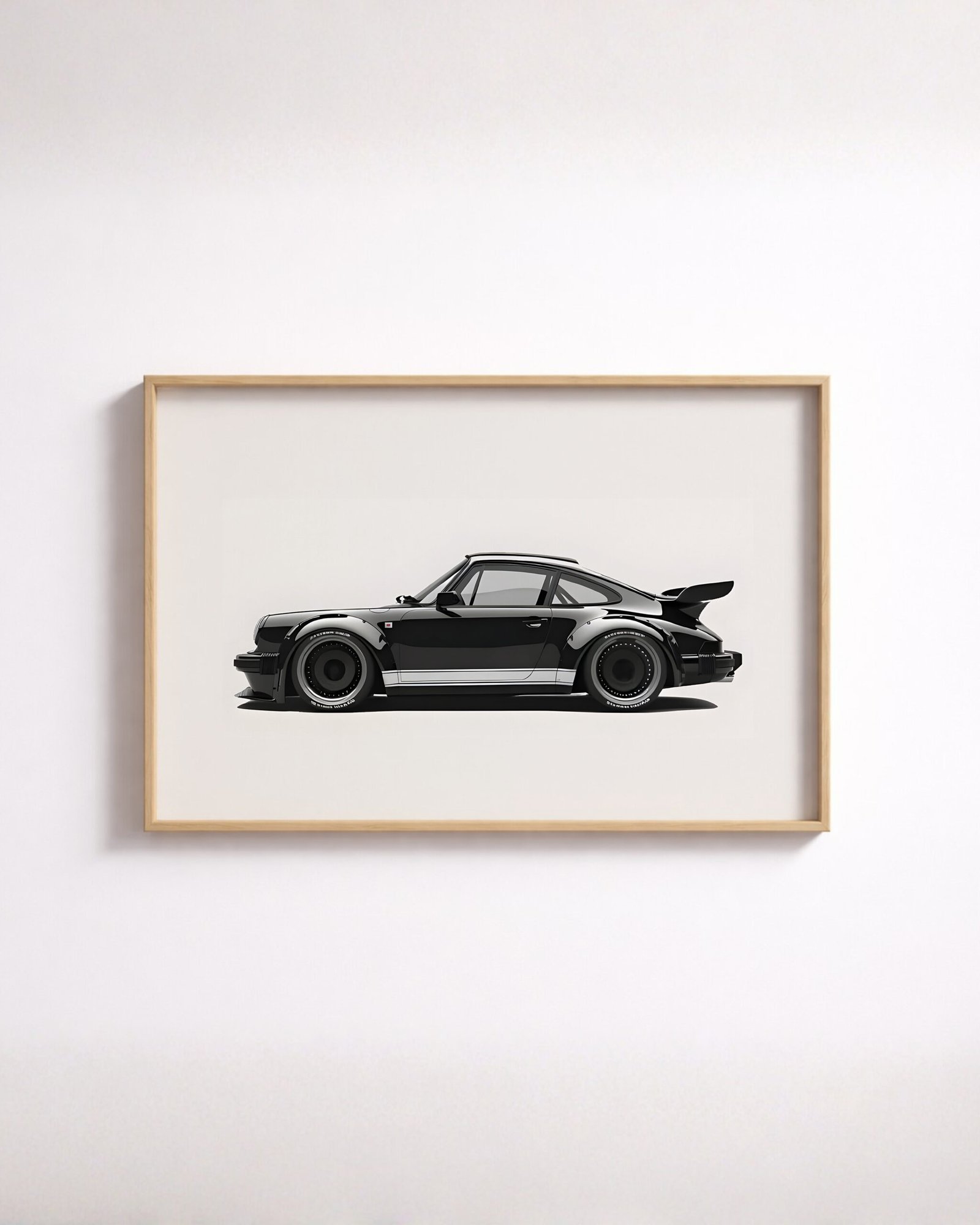
If the naturally aspirated story is the one that interests you, that is the print to buy. If you would rather have the turbocharged half of the same engineering culture, the 911 Turbo (930) illustration is drawn in the same style, and the two work as a pair on a wall — naturally aspirated and turbocharged, the two ways Porsche has answered the same question since the 1970s.
Both are made to order on 200gsm archival matte paper, pigment giclée at 300 dpi, with the full size ladder on each product page.
Related reading: sixty years of the same silhouette, and why the 930’s wing was never just decoration.
Common questions
What does RS mean on a Porsche?
RS stands for RennSport, German for racing sport. Porsche's own naming guide describes it as a street-legal model derived from the motor racing version - a badge reserved for the sharpest version of whatever it is attached to, not a trim level or an options package.
What is the difference between the 911 GT3 and the GT3 RS?
On the current car, the RS adds a swan-neck rear wing taller than the roofline, a front splitter instead of a spoiler, a central-radiator layout drawn from Porsche's Le Mans-class-winning race cars, and roughly three times the downforce of the standard GT3, in a car that weighs about the same.
How much downforce does the Porsche 911 GT3 RS make?
The current 911 GT3 RS generates 409 kg of downforce at 200 km/h, rising to 860 kg at its top speed of 296 km/h, according to Porsche - roughly double its immediate predecessor and triple a standard 911 GT3, most of it from an adjustable front axle and a two-part rear wing.
Is the Porsche 911 GT3 RS a road car or a race car?
It is sold as a road-legal car, which is what the RS badge has meant since Porsche began using it - a motor-racing derived model built for the street. Its parts and aerodynamics are drawn directly from Porsche's factory endurance racers.