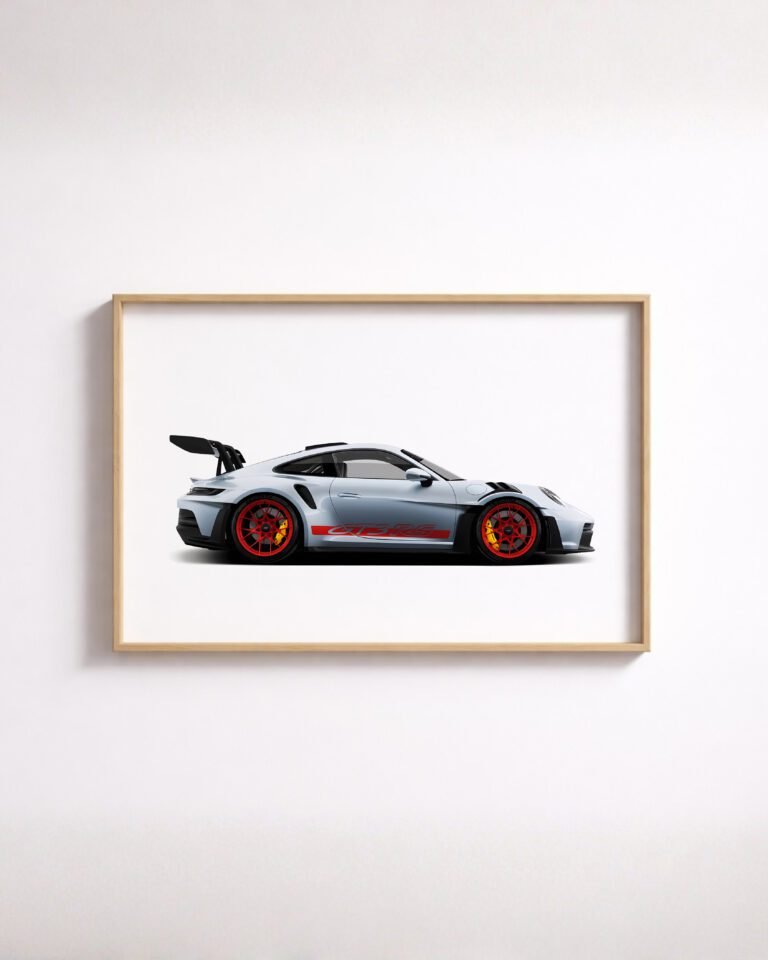
Almost every picture of this car is taken from three-quarters, low and close, and almost every one of them hides the same thing. Porsche 911 GT3 RS wall art is one of the few cases where the boring angle is the correct one: side-on, flat, no perspective. It is the only view in which the car’s defining proportion is measurable rather than implied.
The proportion that only shows in profile
Porsche’s own announcement of the current car is unusually direct about it. In the world premiere material for the 911 GT3 RS, the company states that for the first time on one of its production vehicles the upper edge of the rear wing is higher than the car’s roof.
Read that again as a viewer rather than a buyer. It means the tallest thing on the car is not the cabin. That is a genuinely strange silhouette for a road car, and it is invisible from the front, invisible from behind, and mostly invisible from three-quarters, where perspective flattens the difference. In profile it is the first thing your eye does.
The rest of the same document explains why the wing had to get that big. The car makes 386 kW — 525 PS — and generates 409 kg of total downforce at 200 km/h, which Porsche notes is twice what the previous generation produced. The rear wing is swan-neck mounted and comes in two parts: a fixed main element and a hydraulically adjustable upper one. There is a drag reduction system, a first on a production Porsche, which flattens the wings at the push of a button. At the front there is no spoiler at all any more, but a splitter that divides the air passing over and under the car.

Why Porsche 911 GT3 RS wall art works as a drawing
The GT3 RS side-profile poster is an illustration rather than a photograph, and for this particular car that is the stronger choice.
A photograph of a GT3 RS is always a photograph of a place as well — a pit lane, a road, a paddock, a reflection of whatever was standing to the left of the camera. All of that competes with the shape. A drawing on a plain ground removes every one of those variables and leaves the outline: the length of the roof, the drop of the rear glass, the louvred openings over the front wheels, the wing sitting above all of it.
It also behaves better on a domestic wall. A graphic on a flat ground sits next to other graphics, or next to nothing, without turning the room into a themed space. A photograph of a racing car in a paddock does not have that flexibility.
Two smaller details in the same profile are worth finding once you know they are there. The front wheel arches carry louvred openings, which vent air out of the arch rather than letting it build up inside it. And what sits under the nose is a splitter rather than a spoiler — it divides the air going over the car from the air going under it. Neither is decoration, and neither is visible from the front.
A line that goes back to 1999
The RS badge is not a trim level. Porsche dates the 911 GT3 to March 1999, when the model was unveiled at the Geneva Motor Show as a road-legal track car that took over the position the 911 Carrera RS had held in the range — the point where series production meets motorsport. Everything visible on the current car, including the wing that is taller than the roof, sits on the end of that twenty-five-year argument.
The wing is not styling that got out of hand. It is the shape of 409 kilograms of downforce, drawn at full size.
If you want the older shape instead
The GT3 RS is the modern extreme of the 911, and some people want the other end of it. Two pieces in the catalogue cover that.
The black and white 930 poster is the 1970s answer to the same question: a wide body and a large rear wing, shot from above so the width reads as geometry. Where the GT3 RS is a drawing about proportion, this is a photograph about mass.
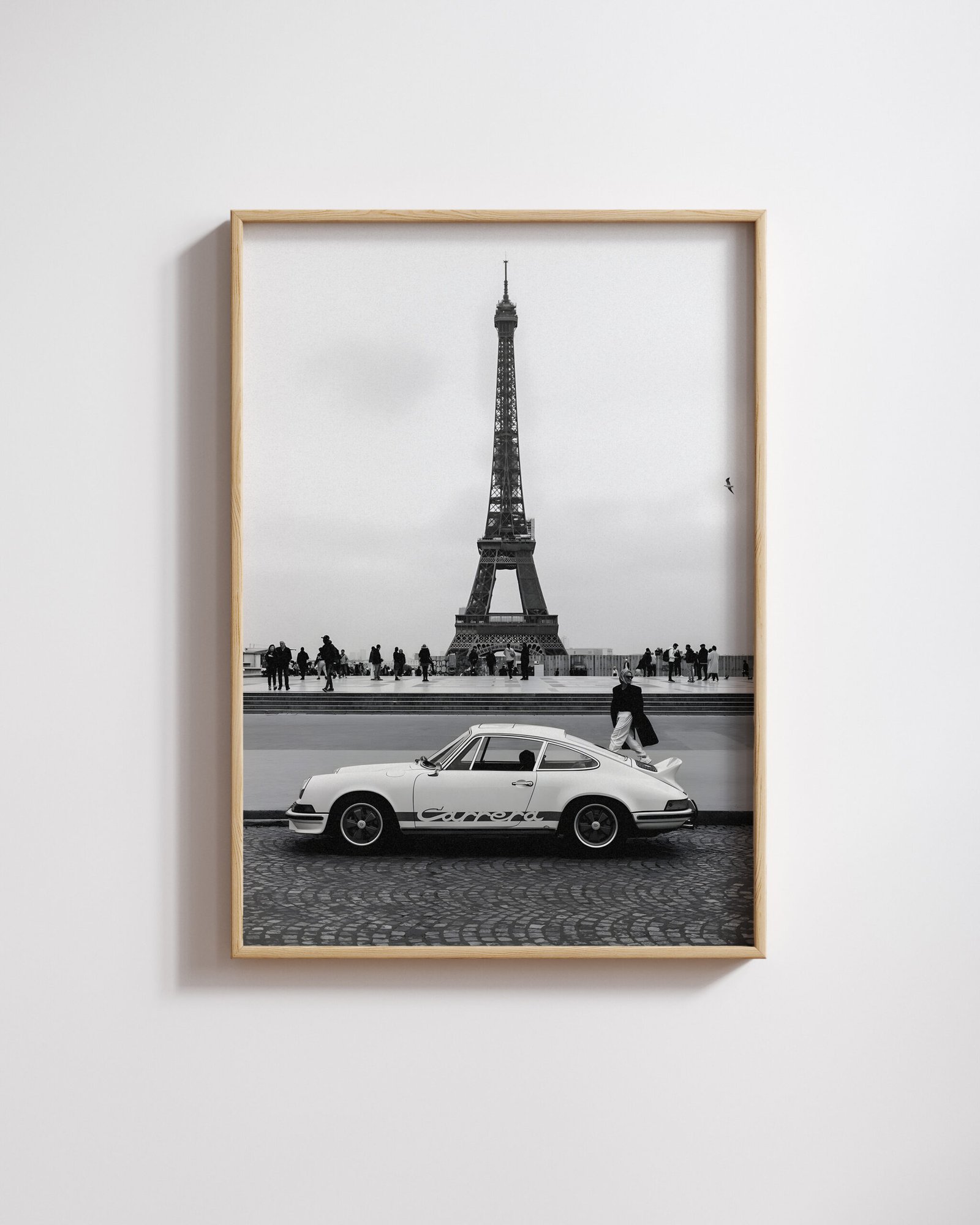
The Porsche 911 in Paris wall art is the quiet option — a white 911 in front of a tall iron lattice tower, monochrome, with the architecture carrying as much of the frame as the car. It is the one to choose if you want a 911 in the room without the room becoming about the 911.
Hanging it
The GT3 RS piece is landscape and it is a wide subject inside that landscape, so it needs horizontal run — over a desk, along a hallway, above a low unit. Hung too small it loses the proportion that is the whole reason to own it, because the wing and the roofline stop being separable at a glance.
It is also a piece that benefits from a plain wall. There is a lot of white space in the composition and it does the work of a mount; putting it on a busy or patterned wall throws that away.
Everything is made to order and ships worldwide at no extra cost. If you want the engineering rather than the picture, we have written about what the GT3 RS actually is, and about why the 911 outline has survived every generation of it.
Common questions
Why is a side profile the right view of a GT3 RS?
Because the car's defining feature is a height relationship you cannot see from any other angle. Porsche states that on the current GT3 RS the upper edge of the rear wing sits higher than the roof - a first for one of its production cars. From the front or the rear three-quarter that is invisible. In profile it is the first thing you notice.
What does RS stand for?
Rennsport - German for racing. Porsche dates the 911 GT3 line to March 1999, when the model was unveiled at Geneva as a road-legal track car replacing the 911 Carrera RS in the range.
Is the illustration accurate to a particular generation?
The piece is an illustration of a GT3 RS in profile rather than a technical drawing of one specific model year, and we are not going to attach a generation code to it that we cannot support. What it gets right is the thing that matters on a wall: the proportion.
Does it work outside a garage?
Better than most car art, because it is a drawing on a plain ground rather than a photograph of a scene. It reads as a graphic, and graphics hang comfortably in offices, studios and hallways where a photograph of a car in a paddock would look out of place.