Vintage Porsche 911 racing started before most of the famous liveries existed. Before the whale tail, before Rothmans colours, before any of the posters this shop sells were taken, Porsche had already stripped a 911 down to 800 kilograms and sent it out to beat cars with twice its budget. That is where the competition history actually starts, and it runs in an almost unbroken line to the present day.
Vintage Porsche 911 racing: where it actually started
In autumn 1966, Porsche engineer Rolf Wütherich set the brief for what became the 911 R in blunt terms: build “a vehicle… superior to the current competition in its power-to-weight ratio”. Four prototypes followed in 1967, built by exploiting every allowance in the homologation rules — glass-fibre front lid, wings, doors and bumpers, windscreen glass thinned to 4mm, plexiglass in the other windows, two of five instruments removed along with the ashtrays and the passenger sun visor. The result weighed 800 kg with 210 hp, a power-to-weight ratio Porsche’s own account puts at under 4 kg per hp. It was too extreme to homologate as a standard Gran Turismo, so Porsche entered it in the 2-litre GT prototype class instead, and built only 19 in total.
The Carrera RSR takes over
By 1973, the works effort had moved to the 911 Carrera RSR 2.8 — a 2,992cc flat six producing 228 kW (310 hp), 270 km/h flat out. Brumos Racing won the 24 Hours of Daytona outright with one in February 1973, and a factory car competed at the Targa Florio and in the GT category at Le Mans that June. The RSR’s aerodynamics grew directly out of the ducktail spoiler Porsche had developed the year before for the road-going Carrera RS 2.7, a story told in full elsewhere on this site — the racing and the road cars were never really separate projects.

The only 911-based car to win Le Mans outright
The 911’s biggest result at Le Mans is also its least expected. In 1979, a Porsche 935 K3 built by the Kremer brothers’ team, driven by Klaus Ludwig and brothers Don and Bill Whittington, won the 24 Hours of Le Mans overall — not in class, outright, against prototypes purpose-built for the job. Porsche’s own account calls it “the first rear-engine vehicle to do so” and, more to the point for this article, “the only race car based on the 911” ever to take overall victory there. Its 3.0-litre twin-turbocharged flat six produced around 800 PS, with none of the driver aids a modern prototype would carry.
It never really stopped
The current factory racer, the 911 RSR, has kept the record current. A works car won the GTE-Pro class outright at Le Mans in 2018, and again in 2019, when its drivers also took the FIA World Endurance Championship title. More than fifty years separate that result from the 911 R’s first outing, and the badge on the back of both cars reads the same.

Which print
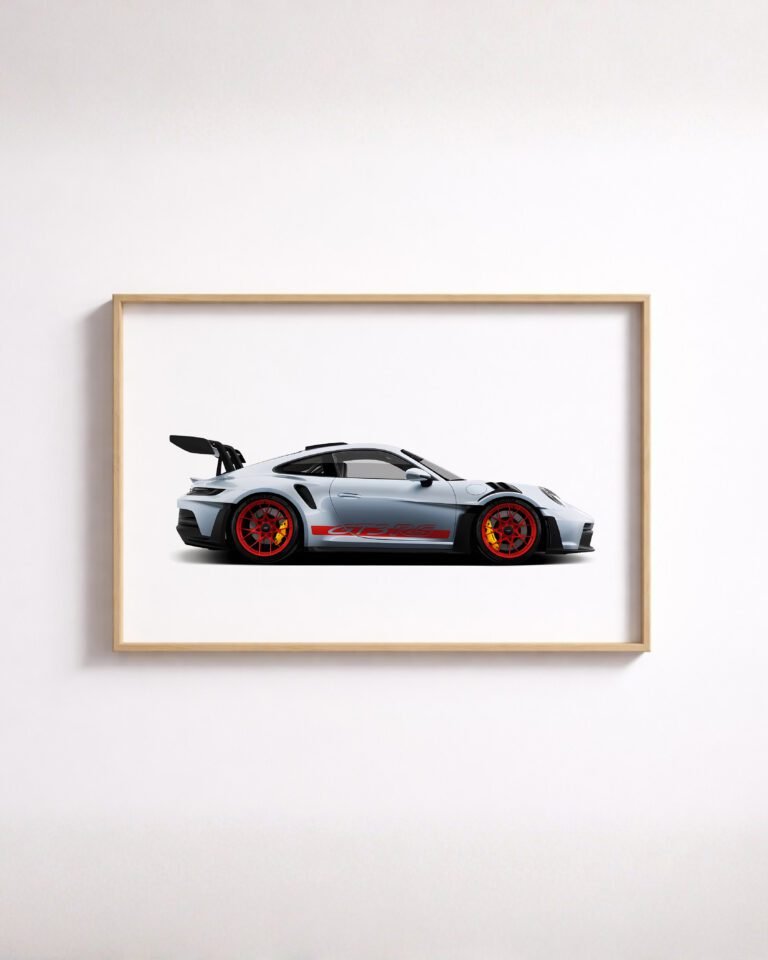
The store’s racing 911s print does not identify the cars, the drivers, the year or the circuit in its own product data, so this article has stayed with what can actually be sourced — the general history above, not a claim about the specific photograph. Read as a picture of the idea rather than a specific race, it stands in for any of the decades this piece covers.
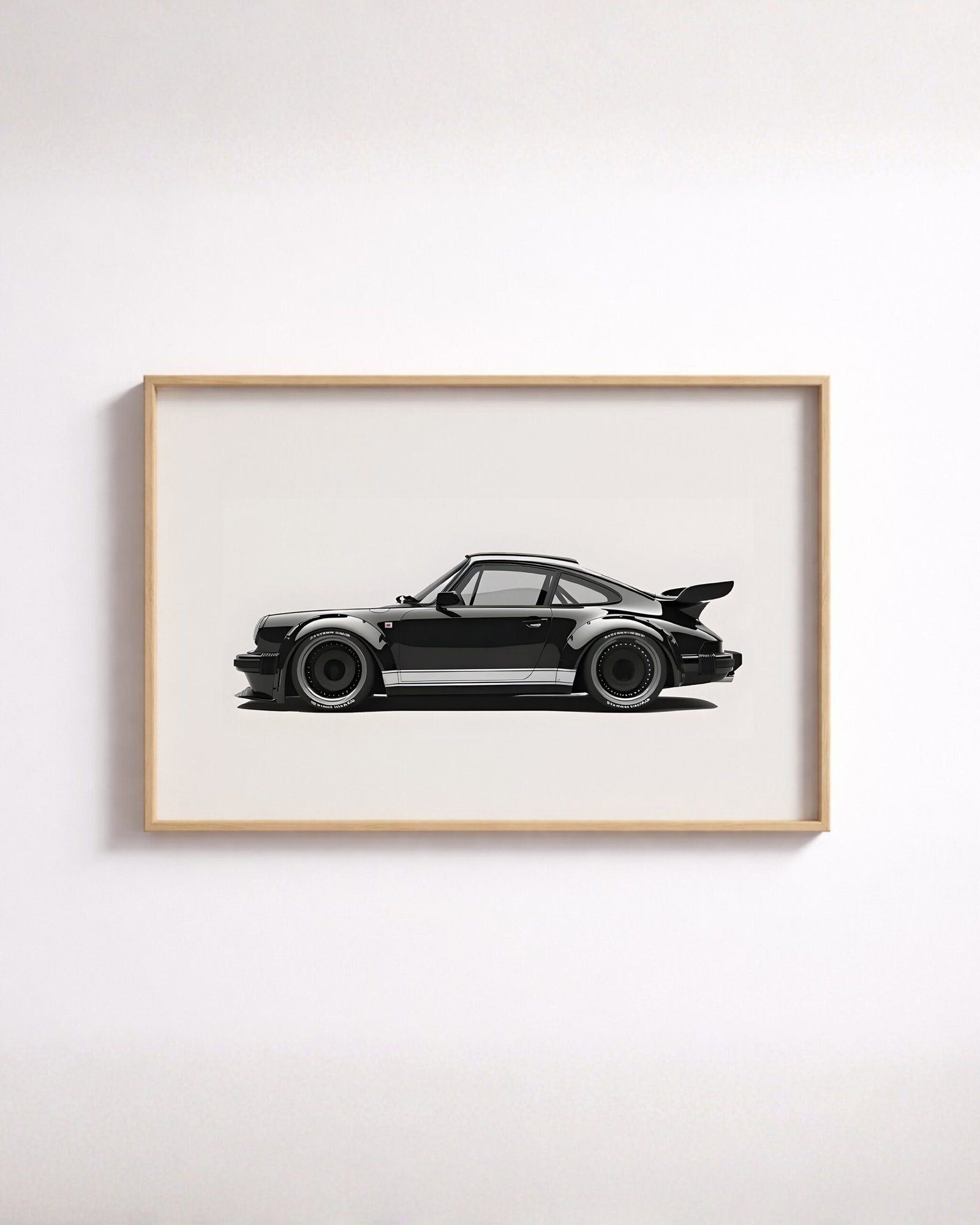
If you would rather have a car whose model is actually recorded, the 911 Turbo (930) illustration is the road-going descendant of the same turbocharging work Porsche developed for its Can-Am and endurance racers.
Both are made to order on 200gsm archival matte paper, pigment giclée at 300 dpi, with the full size ladder on each product page.
Related reading: sixty years of the same silhouette, and why the 930’s wing was never just decoration.
Common questions
What was the first Porsche 911 built specifically for racing?
The 911 R, built in 1967. Porsche's own account describes the goal as beating the competition on power-to-weight ratio; four prototypes used glass-fibre body panels and a stripped interior to reach 800 kg, and only 19 were ever built, most for the works team itself.
Has a Porsche 911 ever won the 24 Hours of Le Mans outright?
Yes, once. The Kremer-built Porsche 935 K3 - a 911-derived race car with a 3.0-litre twin-turbo engine producing around 800 PS - won Le Mans overall in 1979, which Porsche describes as the only 911-based car and the first rear-engined car to do so.
Does the Porsche 911 still race at Le Mans?
Yes, in the GTE-Pro category as the 911 RSR. A factory car won the class outright at Le Mans in both 2018 and 2019, the latter also securing the FIA World Endurance Championship title for its drivers, more than fifty years after the 911 R's first outing.
What is a Porsche 911 Carrera RSR?
A 1970s competition version of the 911, built for endurance racing, distinct from the road-going Carrera RS it shares aerodynamic ideas with. The 2.8-litre version won the 1973 24 Hours of Daytona outright and raced in the GT class at the Targa Florio and Le Mans the same year.