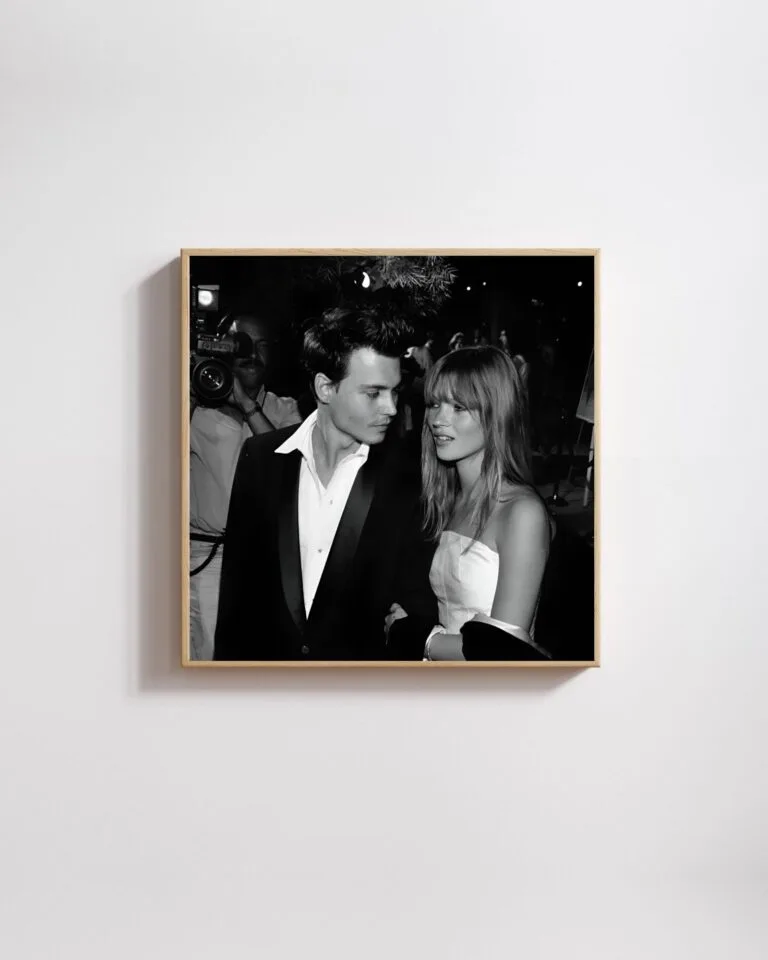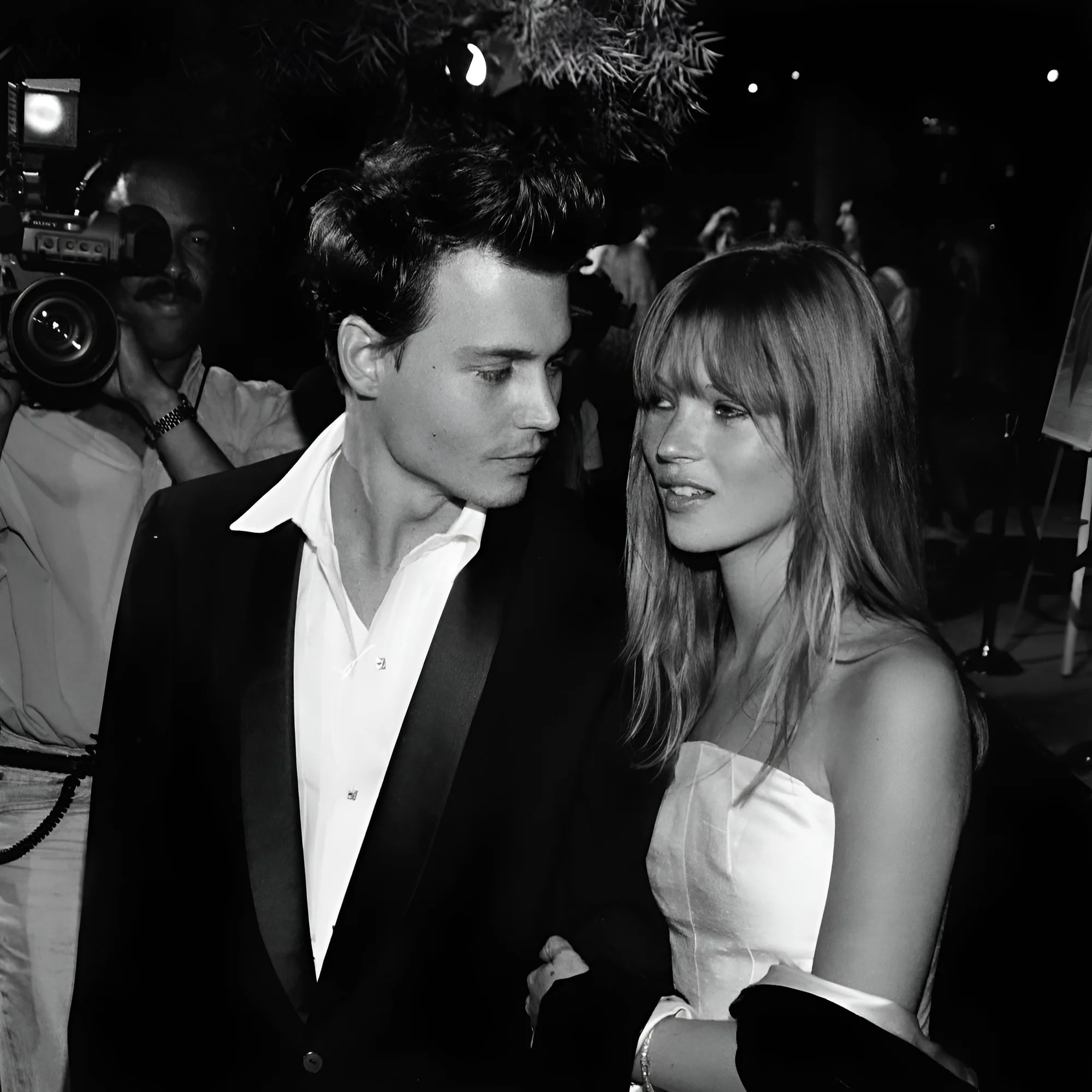
Every decade gets the red carpet couple it deserves, and the nineties got this: two young people so entirely uninterested in the machinery around them that the machinery becomes the background. Flashbulbs, a television camera shoulder-high at the edge of the frame, a crowd held back somewhere in the dark — and in the middle of it, a conversation, carried on as if the carpet were a kitchen and the cameras were weather.
The print is The Red Carpet Couple: a man in a dinner jacket with his white shirt open at the neck, a woman in a white strapless dress with long straight hair and a fringe, caught mid-arrival at a premiere at night. He is looking down at her. She is saying something, mid-sentence, mouth half open, utterly unposed. Neither of them has found the lens. The lens had to find them.
Cool is a refusal
It is worth defining the thing this photograph is full of, because it is constantly mislabelled. Nineties cool was not an outfit, though the outfits were excellent — the open shirt in the dinner jacket, the plain white dress against all that black. It was a refusal: of effort, of eagerness, of the pleading smile the red carpet traditionally demanded. The generation before had arrived at premieres like ambassadors. This one arrived like it was meeting someone at a bar, and the effect on the cameras was electric. Indifference, properly worn, photographs like electricity.
The press photographers understood instantly and shot accordingly — harder flash, closer crops, grain left in. Their pictures from those nights have a rawness the managed imagery of today rarely permits itself, and this frame has it in full: the cameraman caught in the picture, the lights blown to white dots in the dark, the couple sharp and the empire of publicity behind them dissolved into noise.
The couple as composition
Notice, too, how the two of them are built as a picture. Black jacket, white shirt; white dress, dark hair in two different registers. They are a matched pair of tonal inversions, a walking black-and-white photograph in the middle of a colour event, which is why the monochrome treatment does not feel like a filter on this image — it feels like the truth arriving late to its own appointment.
And beneath the style there is the simpler thing that keeps people looking: they are attending to each other. In a setting engineered entirely for outward display, the most radical gesture available was inward — a private sentence exchanged in public. The photograph lasts because it caught the sentence, not the arrival.
It helps to remember how these nights were actually covered. The carpet was worked by photographers on foot, in the crowd, flash units held high and film counted in dozens of frames — not the managed, long-lens, logo-walled affair of today. Their pictures have elbows in them. You can feel the jostle, the shouted names, the heat off the lights. That grain and glare is not a defect of this print; it is the period’s signature, and the couple’s calm reads all the louder for being photographed in the middle of it.
Living with it
This is a square, flash-lit print with real charge, and it wants rooms with a pulse: a media room, a dressing room, a hallway gallery that behaves like a premiere of one’s own. The poster sizes chart lays out the sizes against a standard wall. Hang it near the party trick for the evening that followed this arrival, and trouble in the limo for the ride home — three frames, one long night, remembered properly.
Common questions
What is the couple ignoring in this photograph?
Everyone. A young couple in evening dress on a night-time red carpet, a television camera at the very edge of the frame — and the two of them looking only at each other. The cameras were everywhere; the picture is about the one look that was not for them.
What era does the frame come from?
The nineties, when red-carpet photography still had grain in it and celebrity couples could look genuinely unscripted. The black-and-white treatment leans into that: flash, darkness, and a moment that reads as private despite being the most public place on earth that night.
Where does it hang?
Media rooms, dressing rooms, a hallway that wants a story. The square crop and the night-time contrast make it a natural partner for the other cinema frames in the collection — carried away, the limo, the arrival — in a matched row.
Can I order it framed and ready to hang?
Yes. Choose black, white, natural or dark wood, with an optional white mat, on sizes from 27×35 to 70×100 cm. Every version is made to order and shipped free, tracked, worldwide.