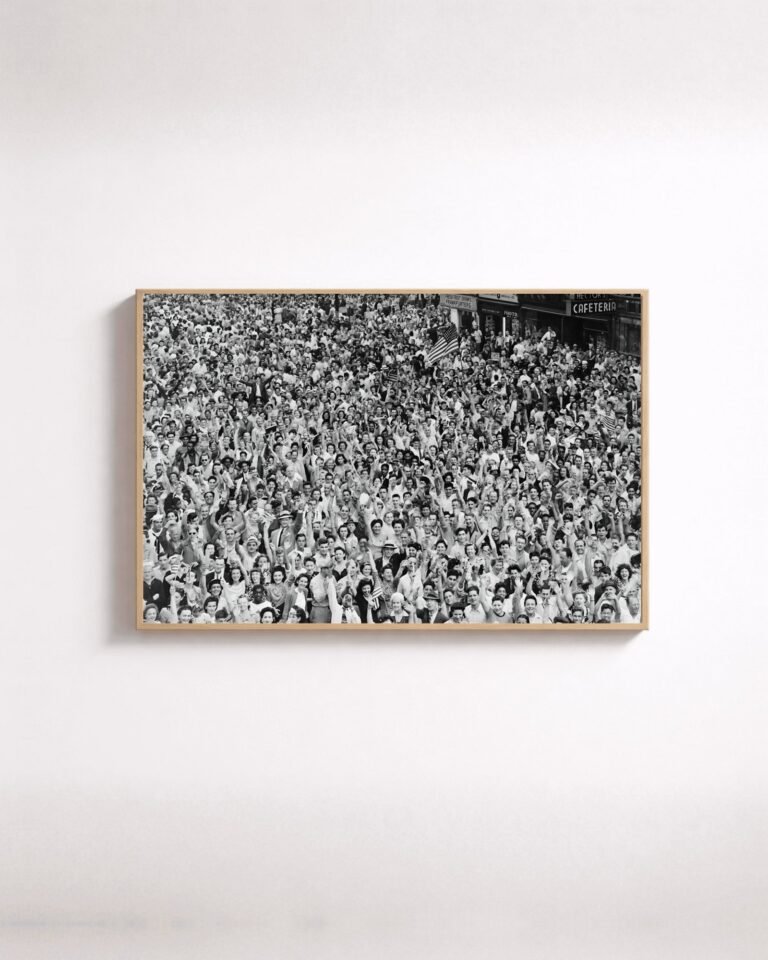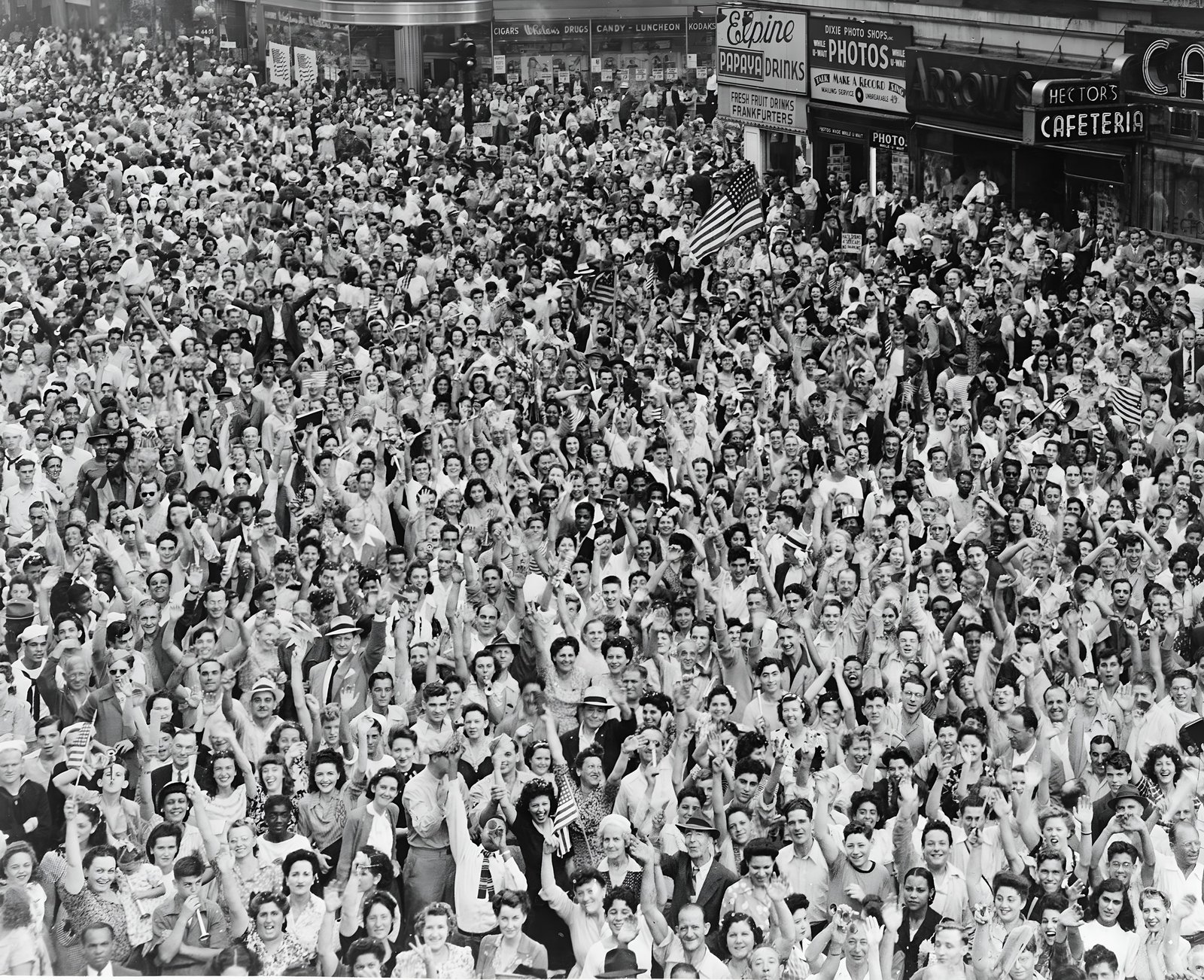
Every famous crowd photograph is really two pictures: the event, and the faces. Our print Times Square, V-J Day is the wide frame of the twentieth century’s happiest afternoon — Times Square in August 1945, photographed from above at the moment the war’s end was being celebrated, the square filled from edge to edge with people: thousands upon thousands of faces turned up toward the camera, arms raised, small flags in hand, beneath the cafeteria signs and photo-shop fronts of the old square. There is no single subject. There are ten thousand of them, and every one is having the best day of its life at the same time.
The photographer was a staff man for one of the city’s great picture newspapers, working the assignment every press photographer in New York was working that day: get above the crowd and get it all. From a high window or a marquee the whole square composed itself — a density of humanity so complete that the street disappears and the crowd becomes a texture, a field of faces interrupted only by flags and the raised arms of people waving, many of them directly at him. They knew what the photograph would be. They were posing for history, and enjoying it.
One frame of a city’s exhale
To understand the picture, remember what the crowd was exhaling. Behind those faces stood nearly four years of war: rationing, blackout curtains, casualty lists in the very newspapers that employed the photographer, sons and brothers scattered across two oceans. The surrender being celebrated that August afternoon ended all of it at a stroke, and the square — the city’s natural amphitheatre, built for crowds and announcements — filled in the way it was built to fill. Other cities celebrated; Times Square performed its celebration for the cameras, and the cameras, this one included, were ready.
The details repay a long look, which is the print’s real pleasure. A man in the foreground waves a flag the size of a handkerchief. A woman near the centre has both arms up and her mouth open mid-cheer. Sailors’ white caps punctuate the crowd like notes. The signs overhead — a cafeteria, a papaya-drink stand, a shop promising photographs while you wait — fix the square in its pre-war, pre-neon character: a working city’s crossroads, dressed in print and paint. Social historians mine frames like this for evidence; the rest of us can simply stand in front of one and feel the noise.
Hanging the crowd
This is a print to explore rather than glance at, and it deserves the widest wall available — a living room, a hall, a family kitchen, anywhere people gather and linger. It starts conversations the way a window starts them, and no two viewings find the same faces. The fine crowd detail is the argument for the larger sizes and for matte paper, which keeps the thousand small highlights from glaring; the poster sizes chart shows every size against a standard wall.
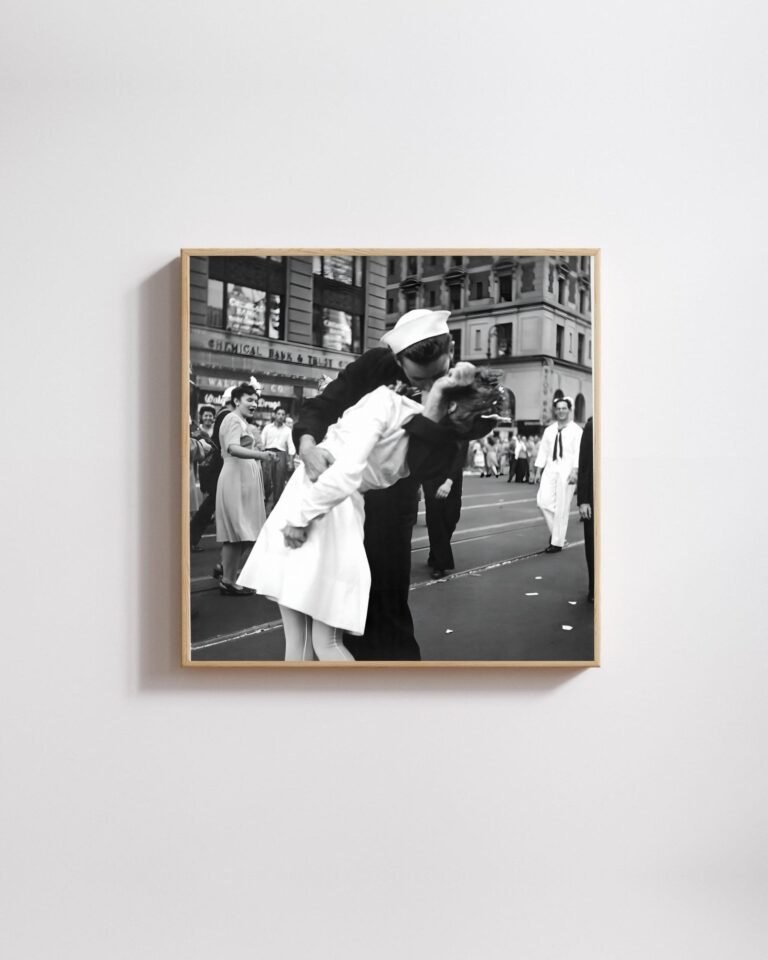
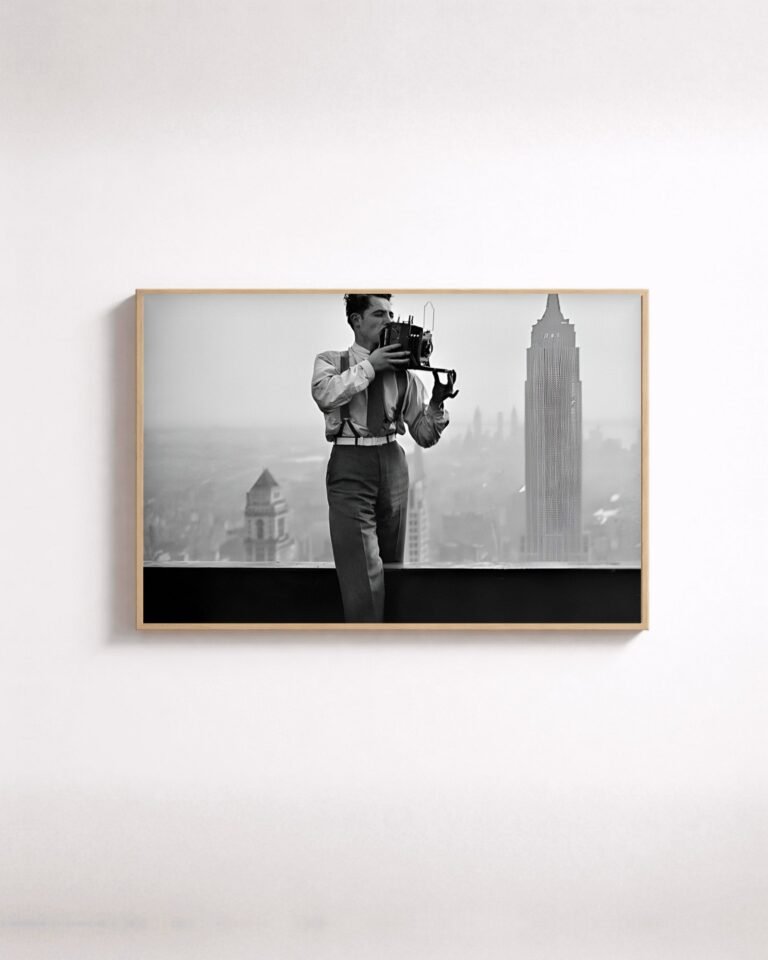
Its story completes itself at street level: Kissing the War Goodbye is the same afternoon in close-up — the sailor, the nurse, and the kiss that two photographers caught from opposite sides somewhere down inside this very crowd. And for the counterweight, The Pre-Race Ritual offers the solitary version of anticipation: one man, eyes closed, before his own form of noise begins. The crowd and the cockpit; the exhale and the held breath.
The frame survives today in the national library’s collection, preserved from the newspaper’s own archive — one of the great accidental museums of American life, assembled deadline by deadline by working photographers who rarely knew they were making history. They were. This square full of strangers, none of them named, all of them unforgettable in aggregate, is as complete a portrait of 1945 as any single face could give.
Photograph: Dick DeMarsico, NY World-Telegram / Library of Congress — Public domain. Source: the holding archive.
Common questions
What day is this?
The best day. The famous square in August 1945, on the announcement that the war in the Pacific was over — photographed from above and filled edge to edge with a waving, flag-waving crowd. Somewhere down in that crowd is the famous kiss; up at this height, the whole city is the subject, and the joy is statistical as well as visible.
Why print the crowd rather than the couple?
Because this is the kiss's context, and context at this scale becomes its own picture: ten thousand faces, one emotion. The panorama rewards the way a crowd photograph should — the longer you look, the more separate celebrations you find inside it.
What size does a panorama like this need?
Wall. The wide sizes — 70×100 cm and A0 — let the crowd spread as it should, and the detail holds because the print is made at 300 dpi from the master. Over a sofa or across a hall, it is the collection's definitive piece of history.
What are the print specifications?
Archival pigment giclée at 300 dpi on 200gsm FSC-certified matte paper, each size a true crop from the master. Made to order in about 72 hours; free tracked shipping worldwide; framing in four finishes on the middle and larger sizes.