The back seat of a car at night is the smallest theatre in the world. Two people, a few feet of leather, black glass on every side, and a city passing as light smears on the windows. Nothing needs to happen in it. The drama is entirely in the seating arrangement, the clothes, and who is looking at whom — which is why photographers keep returning to it long after the car itself has stopped mattering.
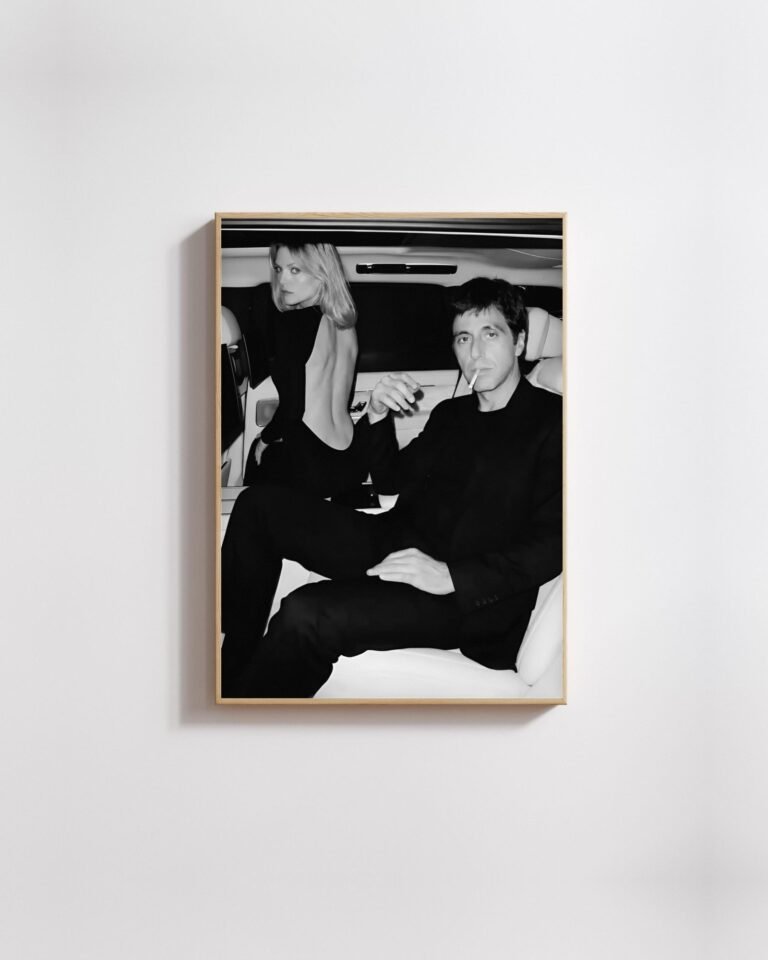
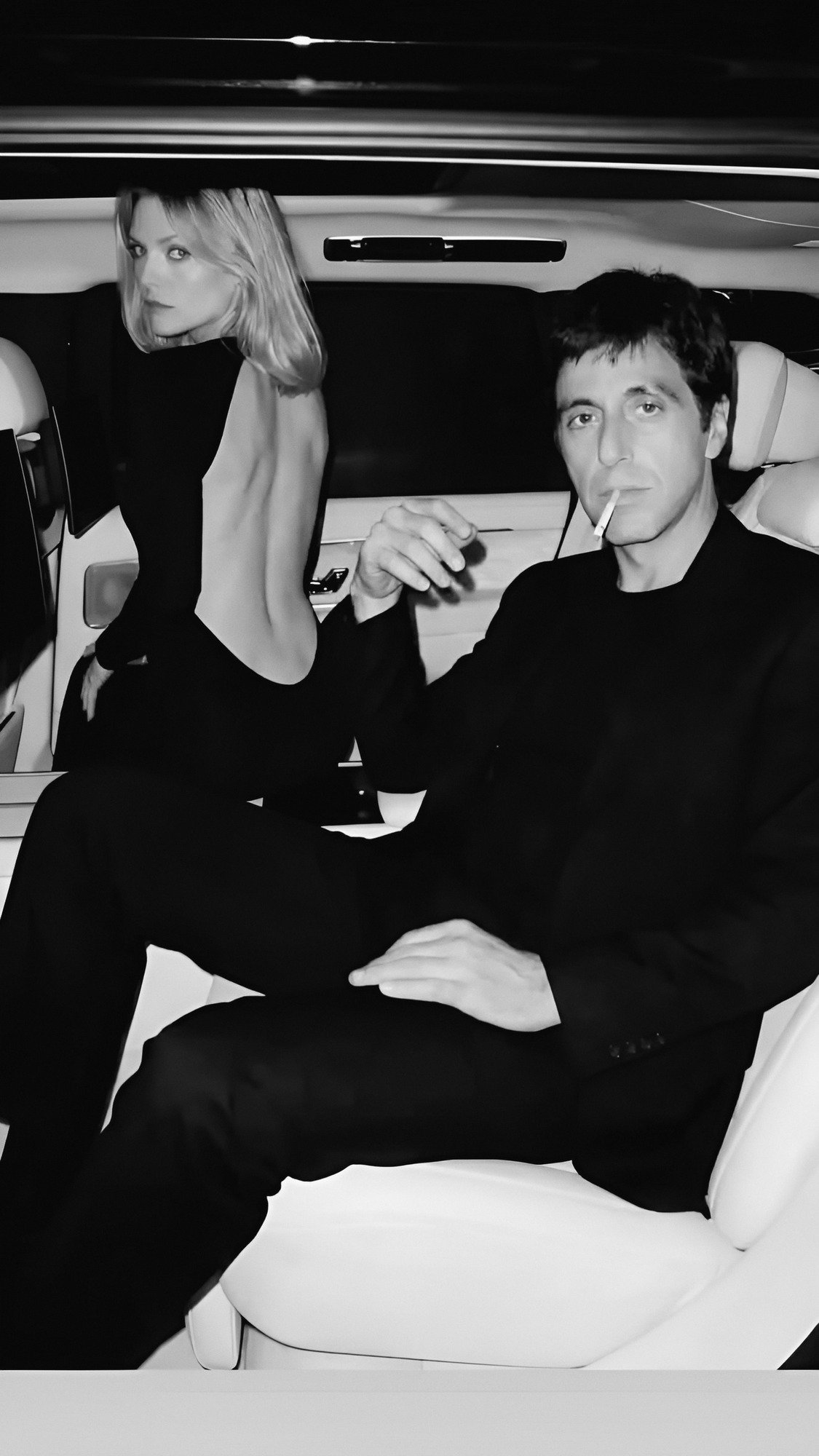
Our print The Back Seat at Night stages that theatre perfectly and then refuses to perform. In the foreground, a man in black sits deep in pale leather, legs crossed, a cigarette at his lips, looking directly into the camera with the calm of a man who has already decided everything. Behind him, a blonde woman in a black dress cut away to the back sits turned three-quarters away, glancing back over her shoulder — at him, at us, at something outside the frame entirely. The photograph does not say. The photograph will never say.
A story withheld is a story kept
Most images spend their meaning all at once: you read them, you smile, you move on, and a year later they have nothing left to tell you. The withholding images work the other way. This one gives you a setting, two characters in evening black, and one direct gaze that lands on whoever stands in front of the picture — and then it stops, permanently, the way a film stops when the projectionist walks out. Every viewer finishes it differently. That is not a flaw of narrative. It is the entire engine of its longevity on a wall.
The composition is doing quiet, deliberate work. He is large, frontal and lit like a confession. She is smaller, higher, turned away — yet it is her bare back and over-the-shoulder look that the eye keeps returning to, because the turned-away figure is always the one a picture is secretly about. Pale leather against black clothes gives the frame its chessboard: two people dressed for the same night and plainly headed for different parts of it.
Cinema without a camera crew
It is tempting to call the image cinematic, and it is — but it earns the word without borrowing a single scene. No plot is quoted. What it borrows from cinema is grammar: the two-shot, the eyeline that breaks the fourth wall, the sense that the previous scene ended badly and the next one has not been written. Hung on a wall, it behaves the way a paused film behaves in a room. People lower their voices slightly in front of it. People invent the dialogue. We have watched it happen.
The tall crop is essential to the effect. The figures stack rather than spread, her above and behind him, both cropped by the car’s roofline into a frame within the frame. The car interior becomes architecture — pale, padded, faintly glamorous architecture — and the black band of the window behind them is the night itself, kept outside where it belongs.
Where it hangs best
This is a print for rooms with a pulse after dark: a living room with low lamps, a home bar, the wall above a drinks cabinet or opposite the sofa where guests actually sit. It lights a conversation the way it lights a frame. Because the format is tall, it also rescues narrow walls — the strip beside a doorway or between windows that nothing else fits. Its ceiling in this wave is modest, and modest is right; the figures should stay near life size, close enough to meet the eye. Check your wall on the poster sizes chart before you choose.
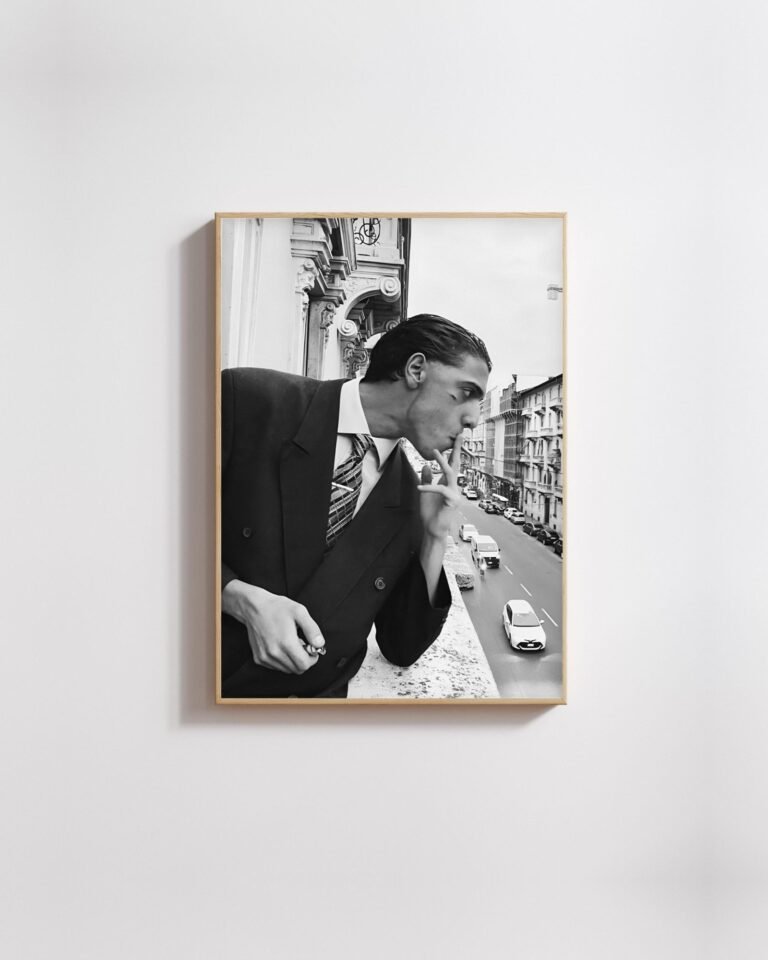
Its closest relative in this wave is Smoke on a Milan Balcony — the same unhurried, tailored darkness, a few hours earlier and one city over. From the earlier collection, Hypercar Beneath a Private Jet at Dusk supplies the machine and the silence without the people: the world these two are travelling through, emptied and waiting on the apron.
Common questions
What story is being withheld in this frame?
All of it. A man in black stares straight into the camera from a pale leather back seat at night; beside him, a woman in a backless dress looks anywhere else. Something has been decided between them, and the photograph refuses to say what. It is cinema without a camera rolling — a still that behaves like a scene.
Why does his stare carry the picture?
Because everyone else in the frame is looking away. Direct address is the oldest trick in portraiture and still the strongest: he is not posing for the photograph, he is accusing it. Hang the print and the room acquires a witness.
Where does it hang?
Living rooms and bars — rooms with evening in them. The pale leather against the dark clothes gives it unusual tonal range for a night shot, and it holds large sizes well, up to A0 if the wall can take the stare at that scale.
How is it made?
Archival pigment giclée at 300 dpi on 200gsm FSC-certified matte paper, made to order in about 72 hours and shipped free, tracked, worldwide. Framing in four finishes, with an optional white mat, on sizes from 27×35 to 70×100 cm.