Of all the parts of the body a painter can choose, the back is the one that never performs. A face arranges itself for whoever is looking. A back simply continues with its own business — breathing, standing, existing — and that indifference is exactly why artists have returned to it for centuries. It is the view we never have of ourselves, and the one everyone else has of us.
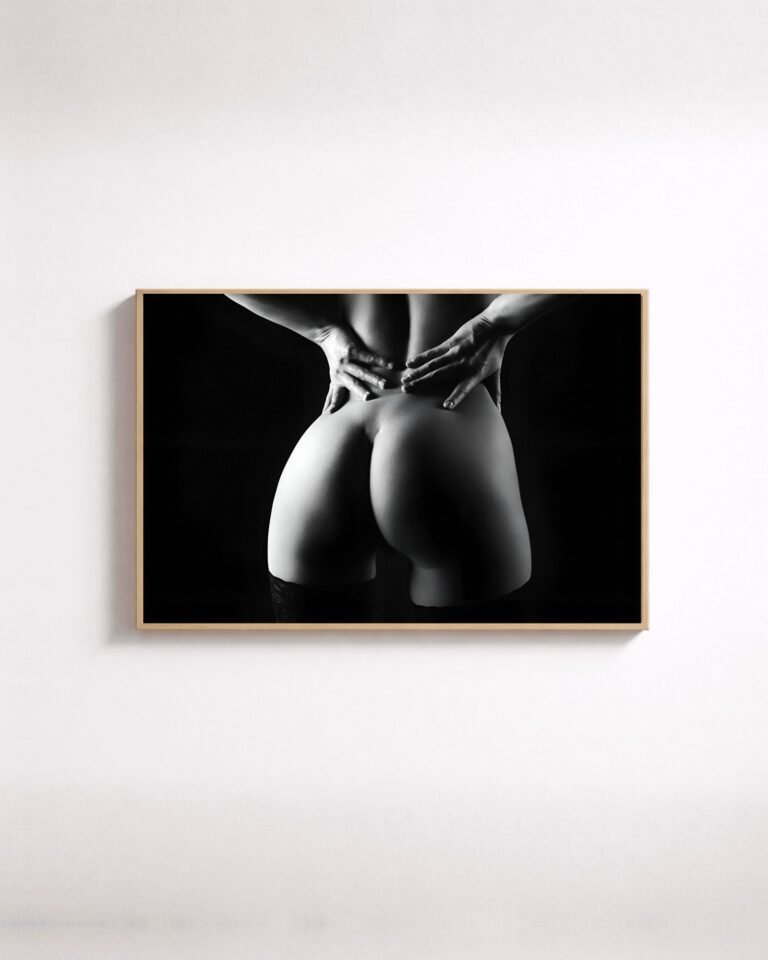
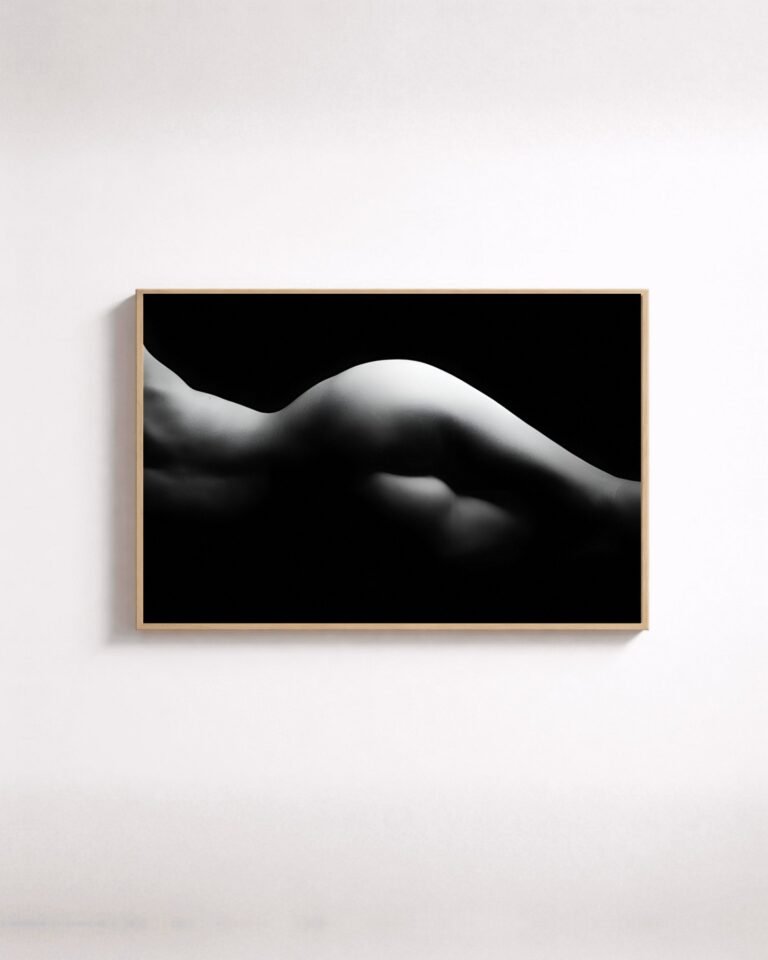
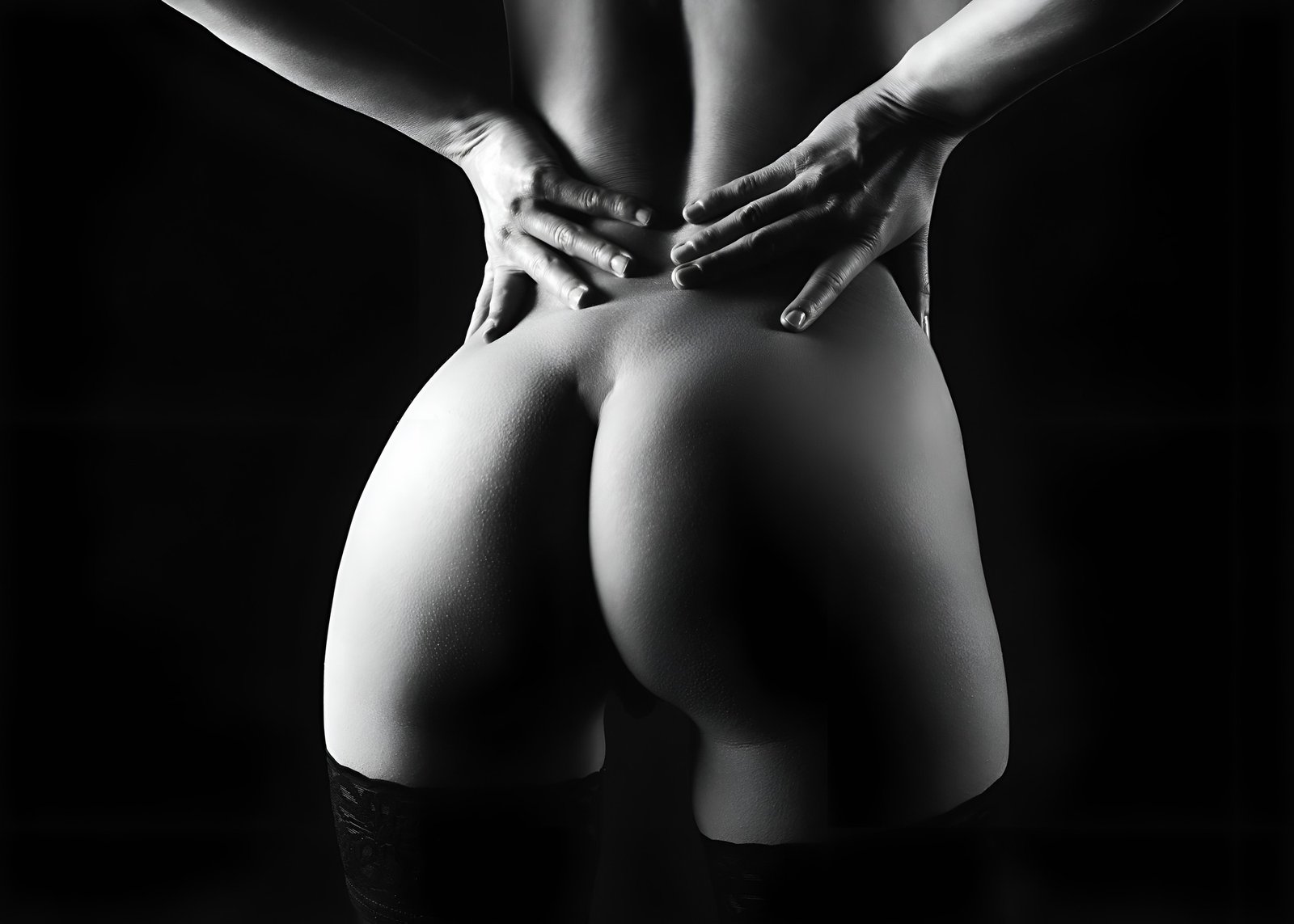
That is the whole of our print Bare Back in Soft Light: a woman photographed from behind against an unbroken black ground, both hands pressed flat at the small of her back, fingers spread, the light running down the centre of her spine and falling gently away at the shoulders. At the bottom edge, the tops of dark stockings close the composition like a signature. There is no face, no room, no furniture, no explanation. The photograph trusts the back to be enough, and it is.
Light kept in the middle tones
What makes the picture fine art rather than simply dark is where the light is allowed to live. The highlights never blow out and the blacks never quite crush the detail: the skin holds a long, luminous range of midtones, so the curve of the back reads as volume rather than silhouette. You can see the fine grain of the skin along the spine, the knuckles where the hands press, the slight tension where fingers meet flesh. It is a photograph about touch as much as sight — the hands are not decoration, they are the subject’s own hands, holding herself in the frame the way a dancer holds a pause.
The hands matter for another reason. Boudoir photography so often arranges a body for a viewer that the viewer forgets to be a person. Here the gesture is turned inward. She is not presenting herself; she is steadying herself. The difference is small on paper and enormous in a room, because it is the difference between a picture that asks to be looked at and a picture that allows it.
Why the back, and not the face
A portrait with a face in it belongs to someone. A back belongs to anyone who has ever stood in front of a mirror turned the wrong way, or caught their own shoulder blades in a shop window and been surprised by the stranger there. That anonymity is the print’s generosity. Hung in a bedroom, it does not introduce a third person into the room; it introduces a mood — quiet, held, unhurried — and lets the people who actually live there supply whatever story they need.
It also makes the photograph unusually easy to live with over years. Faces date a picture: hairstyles, glances, the fashion of an expression. A back in soft light could have been photographed in 1935 or last winter, and nothing in the frame will ever argue otherwise. The stockings hint at an era without insisting on one. The grain does the rest.
Living with a quiet print
Prints this dark and this still want calm walls and a little distance. A bedroom is the natural home — the wall opposite the bed, or the one you face first in the morning — with a dressing room a close second. Keep the frame simple and the mount pale; the contrast at the edge is what lifts the luminous back off the black ground after dark. If you are choosing a size, the poster sizes chart shows each option against a standard wall, and the smaller sizes suit this print well, because intimacy is its scale.
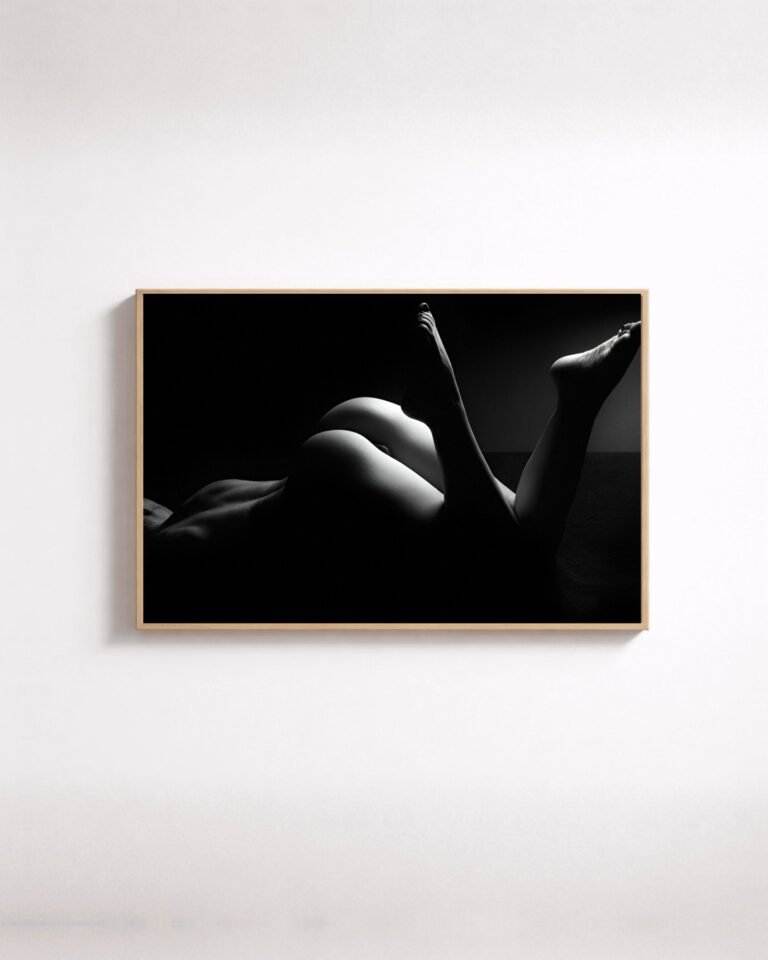
For company, hang it with its siblings from the same wave: Hips in Shadow, where the body becomes landscape, and Legs Against the Wall, the playful answer to this print’s stillness. Three studies of the same darkness — one held, one abstract, one smiling — and a wall that behaves like a small, private gallery.
Common questions
What is a figure study?
The oldest respectable subject in photography: the body treated as landscape and light rather than as a person. Here a bare back in soft light, hands pressed to the small of it, against deep black — no face, no narrative, just the long curve that painters spent centuries learning to draw.
Is it tasteful enough for a bedroom wall?
That is precisely where it belongs, and where most copies hang. The treatment is shadow and restraint — the figure emerges from darkness rather than being displayed by light. The collection's boudoir pieces sit behind the site's age gate for a reason, but their register is gallery, not pin-up.
How does the soft light print?
The matte stock earns its keep: 200gsm FSC-certified paper, archival pigment inks at 300 dpi, so the gradation from skin to black stays smooth with no banding and no glare. Soft photographs die on glossy paper; this one is specified against that.
What sizes suit a figure study?
Intimate ones, mostly — 30×40 and 40×50 cm at dressing-room distance — though the larger sizes turn the back into true landscape. Fifteen sizes run to A0; framing in four finishes, with an optional white mat, on the middle sizes and up.