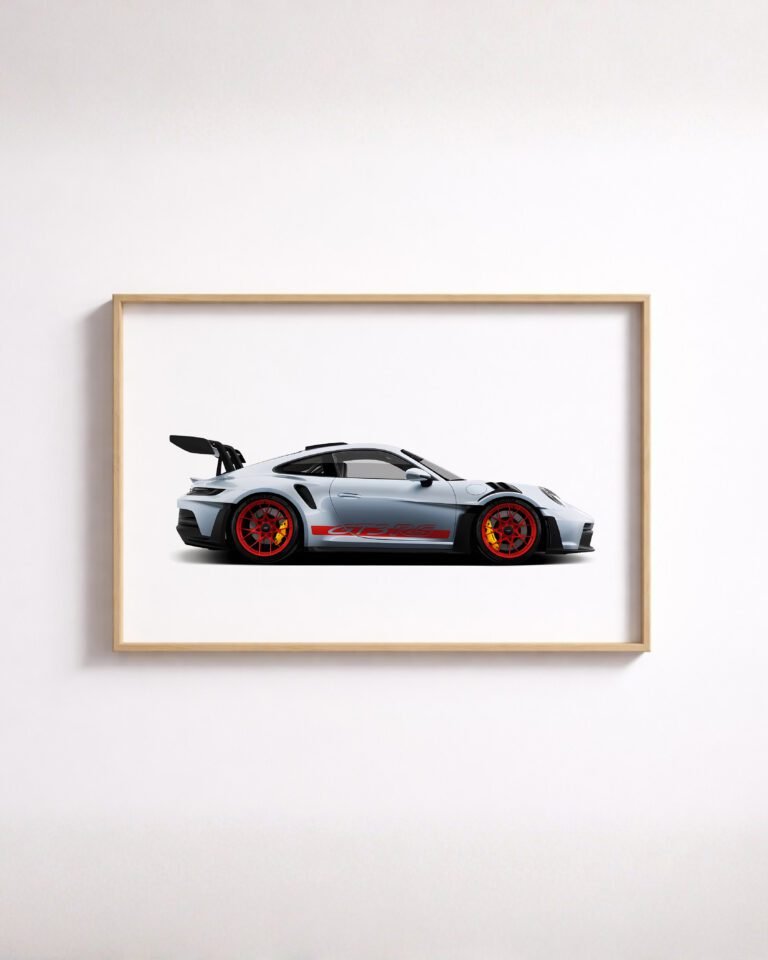
Searching for a Porsche 930 poster turns up a lot of the same car, because the 930 is mostly one shape and everybody photographs it from the same three-quarter angle. The two pieces in this catalogue deliberately do not do that. One is a drawing of the profile. The other is a photograph taken from directly above. Between them they cover the two things people actually want from this car, and neither of them is the angle you have already seen.
What the shape is for
The 930 is worth a moment of engineering before you choose a picture, because the parts that make it recognisable are all functional.
Porsche’s own account of the 911 Turbo generations puts the first car in 1974, with a 3.0-litre flat six, a single turbocharger and 191 kW — 260 PS. For the 1977 model year the engine went to 3.3 litres and a charge-air cooler was positioned below the rear spoiler, taking output to 221 kW, or 300 PS, at 5,500 rpm with 412 Nm, and a top speed of 260 km/h. The same year added a boost gauge, 16-inch wheels and power brakes.
That one sentence about the charge-air cooler is the reason the later wing is broad and flat rather than delicate. It is a cover over hardware. The lineage runs back further: Porsche describes the 911 Carrera RS 2.7 of 1972 as its first series production model with front and rear spoilers, so the tail on a 930 is the third or fourth iteration of an idea, not an ornament bolted on at the end.
The wide body is where the wheels went. The wing is where the cooler went. Almost nothing about this car’s silhouette is decoration.
The drawing
The illustrated 930 poster is a side profile: a black car, clean line work, plain ground, nothing else in the frame.
An illustration can do something a photograph cannot, which is remove every variable at once. No reflections, no background, no depth of field deciding which part of the car you look at. What is left is the outline — the arch line, the drop of the roof, the height and depth of the tail — stated flat. If the reason you want a 930 on the wall is the shape, this is the more honest picture of the two, and it is the one that will still read correctly from ten feet away.
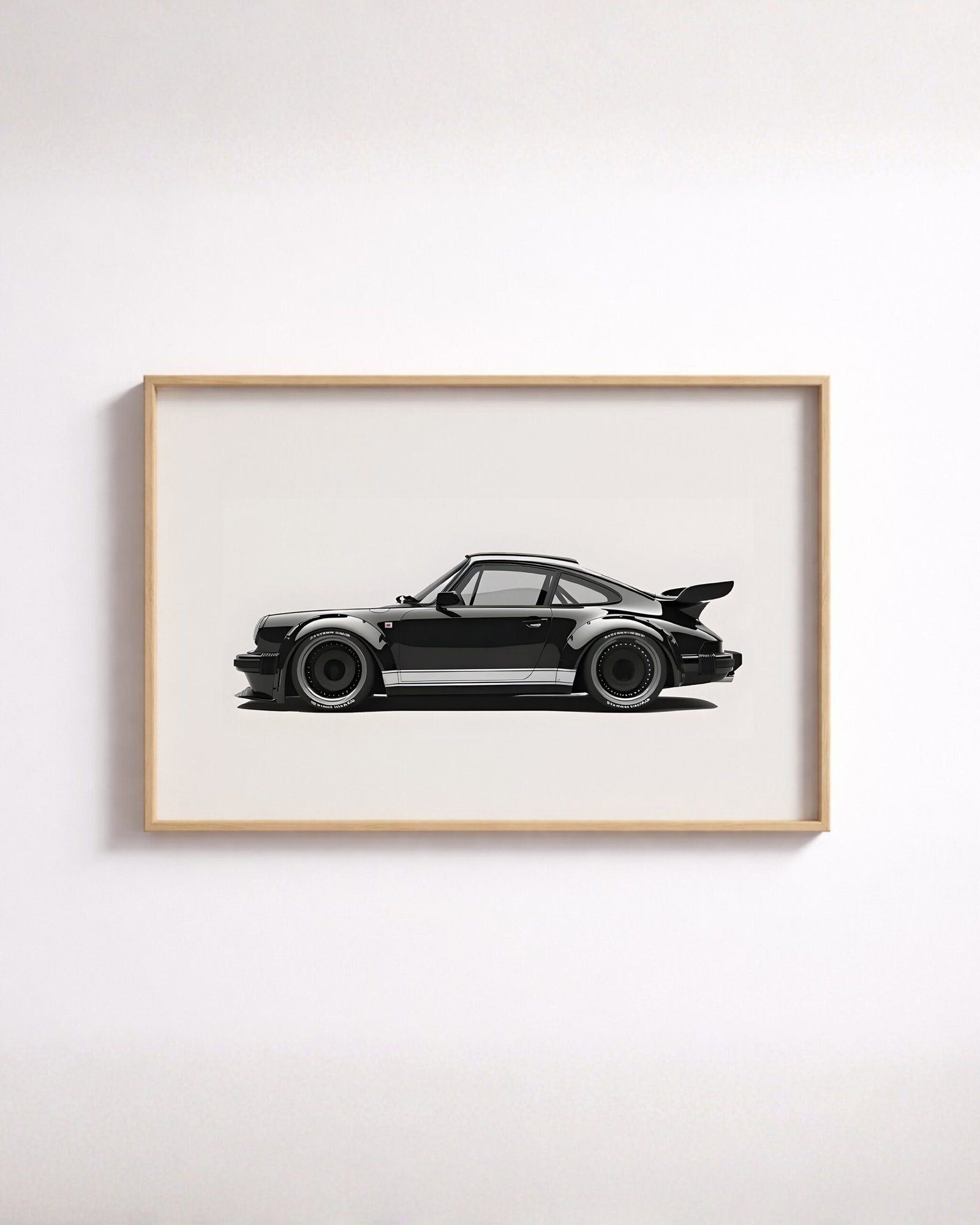
The photograph
The black and white Porsche 930 poster is shot from above in high contrast. That is an unusual angle for this car and it changes what you notice.
Seen from the side, a 930’s width reads as attitude. Seen from above, it reads as geometry: the arches are simply wider than the cabin, and the whole car is a plan view of where the wheels had to go. It is the more graphic of the two images and the more surprising one, and it suits a room where the picture is meant to be looked at rather than recognised.
Choosing a Porsche 930 poster: line or tone
The practical split:
- Line. The drawing. Flat, legible, reads from distance, holds up on a busy wall because it has no background to compete with anything.
- Tone. The photograph. Deep blacks, an unfamiliar viewpoint, more rewarding close up and more demanding of a clean wall around it.
Both are monochrome, and that is not an accident of the catalogue. Colour is the most variable thing about any surviving 930 — it depends entirely on which car was photographed. The outline does not.

Dating the car in the picture
If you want to know roughly which 930 you are looking at, read the tail. The first cars, from 1974, carry the narrower, more upturned wing. From the 1977 model year the engine went to 3.3 litres with a charge-air cooler sitting below the rear spoiler, and the wing had to grow broader and flatter to cover it. The same year brought 16-inch wheels, a boost gauge and power brakes. So a flat, wide tail is a later car, and the shape of it is the shape of a heat exchanger.
A note on the nickname
The 930 is widely called the widowmaker. That name is not Porsche’s and does not appear in the company’s own material about the car, and we treat it as folklore rather than specification. What is documented is a large step in boost from a single turbocharger and the rearward weight bias every 911 of that era carried. The mechanism is on record. The reputation is a story about the mechanism, and the two should not be quoted at the same volume.
Where each one hangs
Both pieces are landscape. That points them at a horizontal wall — over a desk, over a sofa, along a hallway — rather than a narrow vertical space, and it is worth measuring before choosing, because a landscape print squeezed onto a narrow wall looks like a mistake regardless of what is in it.
If you want the engineering behind the tail in full, we have written about what the whale tail was actually for. And for why every 911 since 1963 has been recognisably the same car, there is the piece on the silhouette that never changes.
Common questions
What does 930 actually refer to?
It is Porsche's internal type number for the turbocharged 911 of that generation. Buyers use it as a nickname; the factory used it as a code.
Drawing or photograph - which 930 poster is better?
They are answering different questions. The illustration is about the outline: wide body, whale tail, side profile, nothing else. The photograph is shot from above, so the width becomes a plan view rather than a stance. If you care about the shape, take the drawing. If you care about the object, take the photograph.
What is the spoiler on the back for?
More than it looks. Porsche's own record of the 911 Turbo generations notes that for the 1977 model year the engine went to 3.3 litres with a charge-air cooler positioned below the rear spoiler. From that point the shape of the wing is partly the shape of the hardware underneath it.
Is either poster in colour?
No. Both are monochrome - the illustration is a black car on a plain ground, and the photograph is high-contrast black and white. That is deliberate: the 930's identity is its outline, and colour is the part of it that varies most between cars.