Porsche 911 Turbo history starts with a badge that has been on the car for longer than most of the people buying one have been alive. It first appeared on a rear wing at the Frankfurt show in September 1973, and it is still there, on a car that now runs an electric turbocharger. Between those two points is a straightforward record of what Porsche actually changed, generation by generation, and it is more interesting than the marketing language usually lets on.
Porsche 911 Turbo history, generation by generation
The first generation, the 930, gets the full story — the wind-tunnel programme, the wing, the 1977 intercooler — in a separate piece, so this one stays with the headline facts and moves on to what came after it.
| Generation | Years | Power | What changed |
|---|---|---|---|
| 930 | 1974–1977 | 191 kW (260 PS) | The original; parts shared with the 917 and the Carrera RSR |
| 930 (3.3) | 1978–1989 | 221 kW (300 PS) | Charge-air cooler under the wing, “a world first in a production car” |
| 964 | 1989–1994 | 235–265 kW (320–360 PS) | Over 85% of components redesigned; catalytic converter added |
| 993 | 1995–1998 | 300 kW (408 PS) | Twin turbochargers; all-wheel drive standard for the first time |
| 996 | 1999–2005 | 309 kW (420 PS) | First water-cooled Turbo engine |
| 997 | 2006–2011 | 353–368 kW (480–500 PS) | Variable Turbine Geometry turbos, a world first for a petrol production car |
| 991 | 2013–2019 | 383 kW (520 PS) | Active rear-wheel steering |
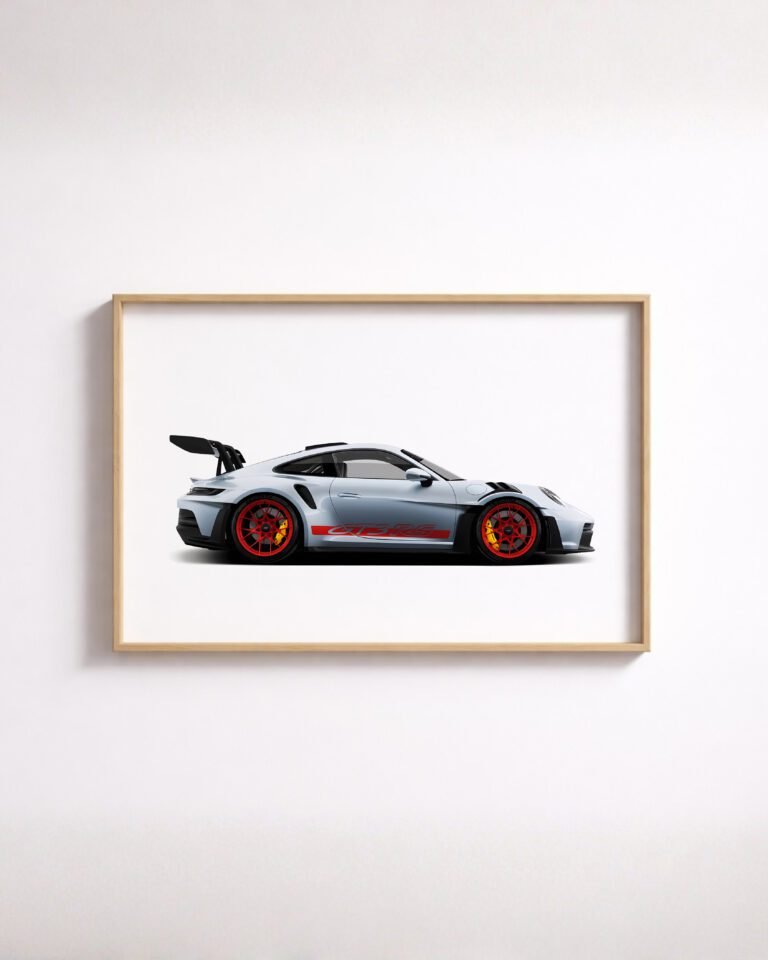
| 992 | 2020–present | 427–523 kW (580–711 PS) | Wider body; the 2026 Turbo S adds electric turbochargers |

What changed each time it mattered
Two decisions did more to define the car than any single horsepower figure. The first is all-wheel drive, which arrived with the 993 in 1995 and has stayed on every Turbo since — before that, from 1974 to 1994, the Turbo sent all its power through the rear wheels alone. The second is water cooling, which the 996 introduced in 1999 after twenty-five years of air-cooled Turbo engines, in the same generation that took the whole 911 line water-cooled.
The 997, in 2006, added a smaller technical change with a larger real-world effect: Variable Turbine Geometry turbochargers, which Porsche states plainly were “the first petrol-engine production car in the world” to use them. VTG lets the turbo behave like a smaller one at low revs and a larger one at high revs, which is most of the reason turbo lag stopped being something 911 Turbo owners had to plan around.
An electric turbocharger, for the first time
The newest chapter uses a technology none of the previous eight generations had. The current 911 Turbo S runs a T-Hybrid system with two electric exhaust-gas turbochargers — Porsche notes the related Carrera GTS uses one, the Turbo S uses two — for a combined 523 kW (711 PS) and 800 Nm of torque available from 2,300 to 6,000 rpm, with 0–100 km/h in 2.5 seconds. An electric turbo spins up on electrical power before exhaust gas is even flowing hard enough to drive it, which removes the one weakness a turbocharged engine has always had against a naturally aspirated one — a subject the piece on the 911’s shape touches from the other side, since the same rear-engine layout has shaped every one of these eight cars.

Which print
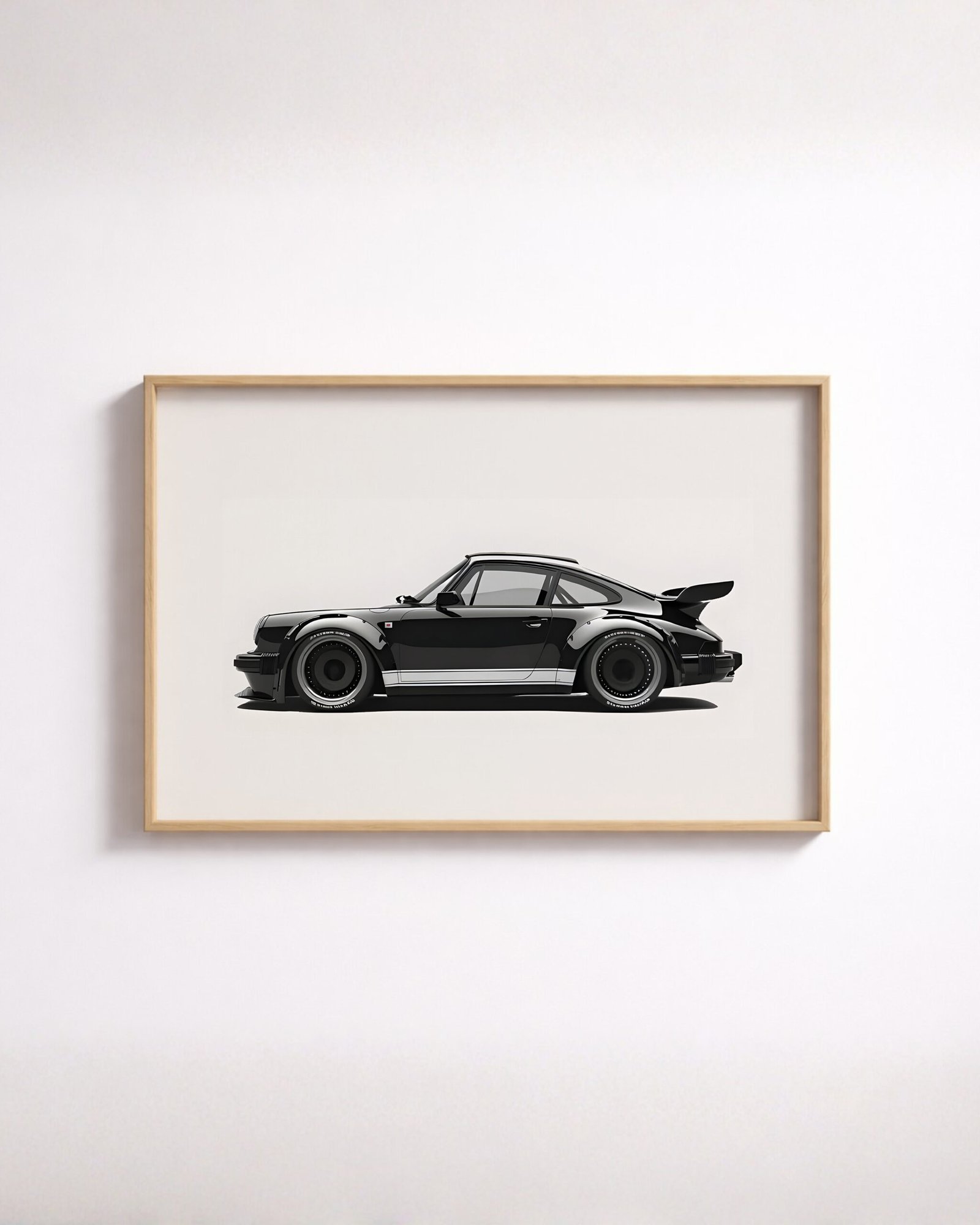
The store carries the first chapter of this history, the 930, and only the 930 — there is no print of a later Turbo generation to link to, so the rest of this article is context, not a catalogue. Between the two 930 listings, the black 911 Turbo (930) poster is an illustration, drawn in clean lines that state the shape plainly, while the black-and-white 911 (930) portrait is a photograph, better suited if you want the wide body and the wing read as objects rather than outline.
Both are made to order on 200gsm archival matte paper, pigment giclée at 300 dpi, with the full size ladder on each product page.
Related reading: the whale tail’s second job, as an intercooler cover, and sixty years of the same silhouette.
Common questions
How many generations of Porsche 911 Turbo are there?
Eight, by Porsche's own count: the 930 (1974, revised 1978), the 964 (1989), the 993 (1995), the 996 (1999), the 997 (2006), the 991 (2013) and the 992 (2020), which now includes a hybrid Turbo S with electric turbochargers on top of the naming already used for each.
What was the first Porsche 911 Turbo?
The 930, shown as a prototype at the 1973 Frankfurt show and put into production for 1974 with a 3.0-litre turbocharged flat six making 191 kW (260 PS). It is the only Turbo generation this store carries a print of, in two versions, an illustration and a photograph.
Is every Porsche 911 Turbo all-wheel drive?
No. The 930 and 964 generations were rear-wheel drive, sending all of their power through the back axle alone. All-wheel drive became standard on the 911 Turbo starting with the 993 generation in 1995, and every generation since has kept it.
What is the most powerful Porsche 911 Turbo ever built?
The current 992.2 911 Turbo S, which combines a twin-turbo engine with a T-Hybrid system using two electric turbochargers for a combined 523 kW (711 PS) and 800 Nm of torque, according to Porsche, with 0-100 km/h in 2.5 seconds.