The Formula 1 eras can usually be told apart from an outline alone, and almost never because a designer wanted a car to look that way. Where the engine sits, whether there are wings and how high they stand, how wide the track is, what is bolted over the driver’s head — each of those arrived as a regulation, on a known date, and most of them arrived because something had already gone wrong.
The silhouette is a document. This is how to read it.
1950 to 1960: the engine in front of the driver
The World Championship opened at Silverstone on 13 May 1950, and for its first decade the shape of a Grand Prix car followed from a single decision: the engine sat ahead of the cockpit. The driver therefore sat above the propshaft — high, upright, a long way back, behind a long bonnet and inside tyres that look almost bicycle-thin to a modern eye.
Stirling Moss ended that at the 1958 Argentine Grand Prix. Wikipedia’s history of the sport records it as the first World Championship victory for a car with the engine mounted behind the driver, and it was not a works car but a Cooper T43 entered privately by Rob Walker. Within three years the whole field had moved the engine.
The last front-engined car to win a World Championship race did so at Monza on 4 September 1960 — Phil Hill’s Ferrari 246 F1, at a Grand Prix the British teams boycotted. Lotus, BRM and Cooper stayed away over the danger of the banked circuit, and Ferrari’s one advantage that weekend was straight-line speed on an oval. Which is another way of saying the layout had already lost the argument everywhere else.
The tell
Long bonnet, driver sitting high and well back, narrow tyres, no wing anywhere on the car. That is pre-1961, and there is nothing else it can be.
1968 to 1969: wings, briefly on stilts
Aerodynamic downforce arrived at Monaco in 1968, when Colin Chapman fitted modest front wings and a spoiler to Graham Hill’s Lotus 49B. Full-width wings carried high above the car on slender struts followed within weeks. They worked because they loaded the suspension directly instead of going through the chassis — which is precisely what made them fragile.
After the failures at the 1969 Spanish Grand Prix the FIA restricted wings in size and height and required them to be mounted rigidly to the bodywork. So the tall strut-mounted wing has an unusually narrow date range: roughly twelve months. It is the single easiest thing in motorsport photography to place in time.

1977 to 1982: the ground-effect wedge
The Lotus 78 brought ground effect to Formula 1 in 1977, with wing-profiled sidepods sealed to the road by sliding skirts, and the Lotus 79 turned the idea into the dominant car of 1978. The downforce now came from underneath rather than from wings, which means the cars of this period do not look particularly aerodynamic. They look like doorstops with full-length sidepods running from the front wheels to the rear.
Cornering speeds rose faster than anyone could justify. Formula 1’s own account of the rule changes records that skirts were banned and a 6 cm ground clearance imposed for 1981 — teams engineered around both — and that for 1983 the rule was made blunt: flat bottoms between the tyres, no skirts, no argument. Cornering speeds dropped sharply and the sidepod got shorter.
1977 to 1988: turbocharging
Renault entered the RS01 at the 1977 British Grand Prix with a 1.5-litre turbocharged V6, the first turbo car in Formula 1 and unreliable enough that rival teams called it the yellow teapot, for the white smoke. The first Grand Prix win for a turbocharged engine came two years later at Dijon-Prenois, Jean-Pierre Jabouille in the Renault RS10.
By 1986 the regulations permitted only 1.5 litres with supercharging, and turbos were banned outright from 1989. The visual signature of the era is bulk: intercoolers and their ducting made the cars wider and squarer through the middle than anything on either side of the period. It is also the era in which almost every photograph people think of as classic Formula 1 was taken — including the wet Estoril afternoon that produced Ayrton Senna’s first Grand Prix win.
1989 to 2013: the naturally aspirated middle, and the narrow years
The formula went to 3.5 litres naturally aspirated for 1989, down to 3.0 litres for 1995, to a mandatory V10 configuration in 2000, and to a 2.4-litre V8 for 2006 which ran to the end of 2013.
None of that is visible in a photograph. The useful marker for this stretch is track width. For 1998 the maximum width was cut from two metres to 1.8, and grooved tyres were introduced — three grooves at the front, four at the rear. A car that looks tall and narrow for its length, with clean longitudinal lines cut into the tyres, belongs to that period and no other. It is the least loved silhouette in the sport’s history and the easiest to identify.

2014 onward: hybrid, halo, ground effect again
The 1.6-litre turbocharged V6 hybrid arrived in 2014. In 2017 the cars went back to two metres wide, on tyres roughly a quarter wider than before — rears from 325 mm to 405, fronts from 245 to 305 — which is why a 2017 car looks squat parked next to a 2016 one. The halo became mandatory in 2018. Ground effect returned in 2022.

The 2026 regulations keep the 1.6-litre turbocharged V6, drop the MGU-H, split the output roughly evenly between combustion and electrical power and run it on fully sustainable fuel. For the first time in half a century the defining change to the formula is chemical rather than aerodynamic, which may be why these cars are harder to date by eye than any generation since the 1990s.
The parts of a race that are not the car
Two things in a Formula 1 photograph date it as reliably as the bodywork, and neither is the machine.
The first is the pit lane. A crew in overalls and no helmets, hand-operated jacks, a car standing still for the better part of a minute — that is a different sport from a modern stop, and the difference was created by rule changes rather than by fitness. The history of the pit stop runs from a lost wheel nut at the Nürburgring in 1957 to a 1.80-second tyre change, and almost every step of it is a regulation.
The second is the circuit. Monaco has been on the calendar for the whole of that history at 3.337 km and 78 laps, and its geometry has barely moved, which is why it produces the most recognisable images in the sport and why one driver’s record there — Senna won it six times — is still the number everyone quotes.
Which of the Formula 1 eras to hang, and what we will not tell you
One thing has to be said plainly, because it decides how our own listings are written. We do not know where or when most of these photographs were taken, and we do not invent it. A listing here names a driver, a car or a race only when that is documented; where it is not, the listing says what it can see and stops.
So the practical way to choose is by subject, not by date.
- A specific race. The Senna Lotus 97T print is the only one in the collection tied to a named Grand Prix — car 12, the 1985 Portuguese Grand Prix — and the article above is about that afternoon.
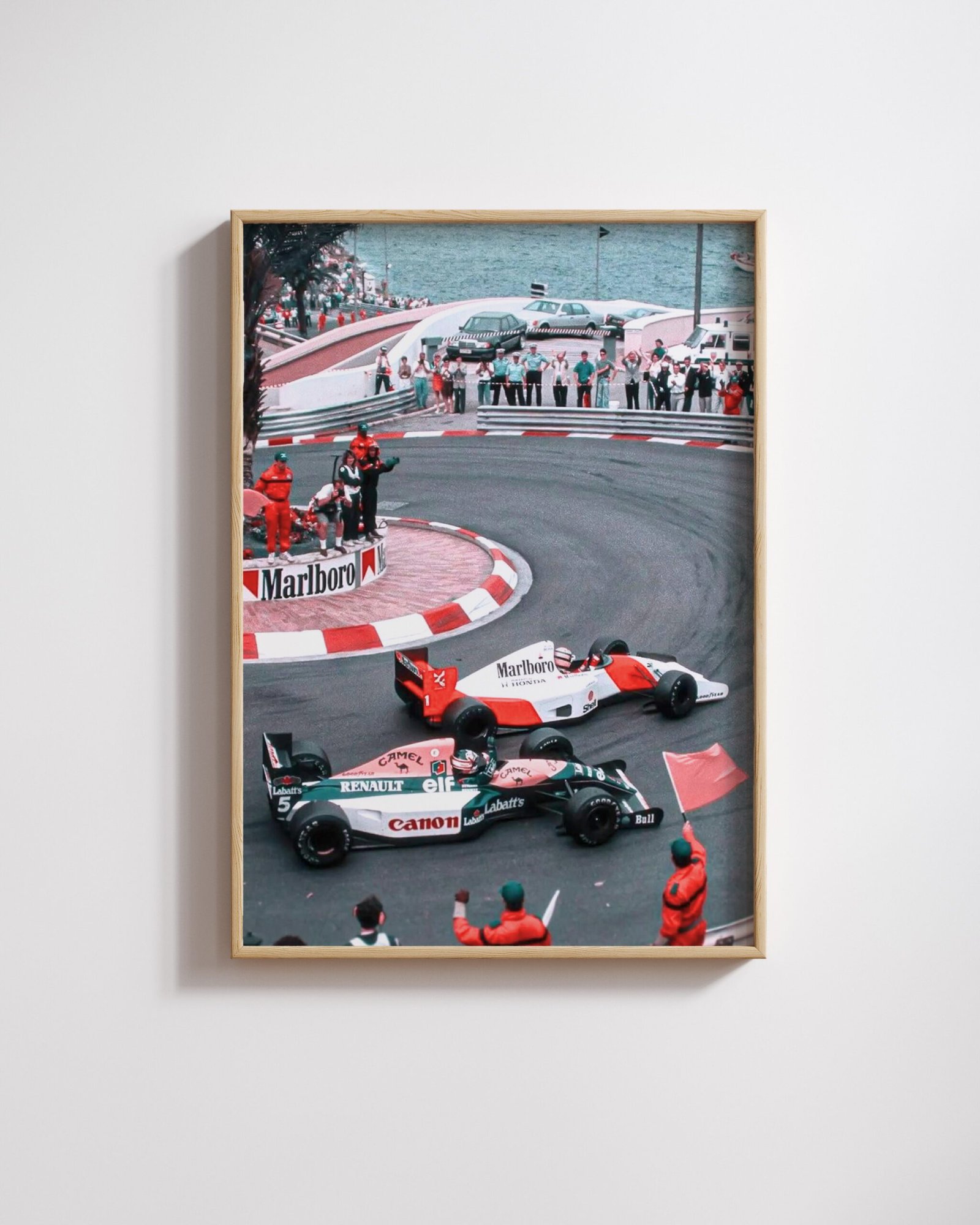
- A place. Senna at Monaco names the circuit and not a year, which is the honest position: there are six years it could defensibly be.
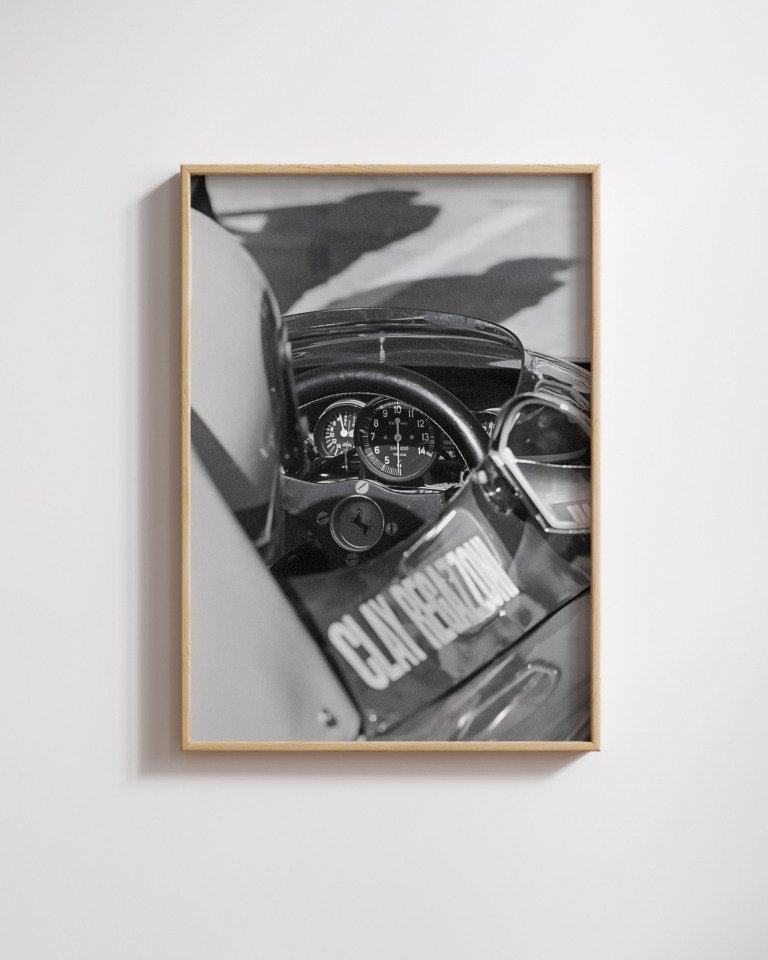
- A driver. Senna’s 1991 McLaren season, a Senna portrait in racing gear, a Michael Schumacher tribute, an overhead cockpit study, a Ferrari cockpit portrait and a George Russell poster each name a person and nothing more.
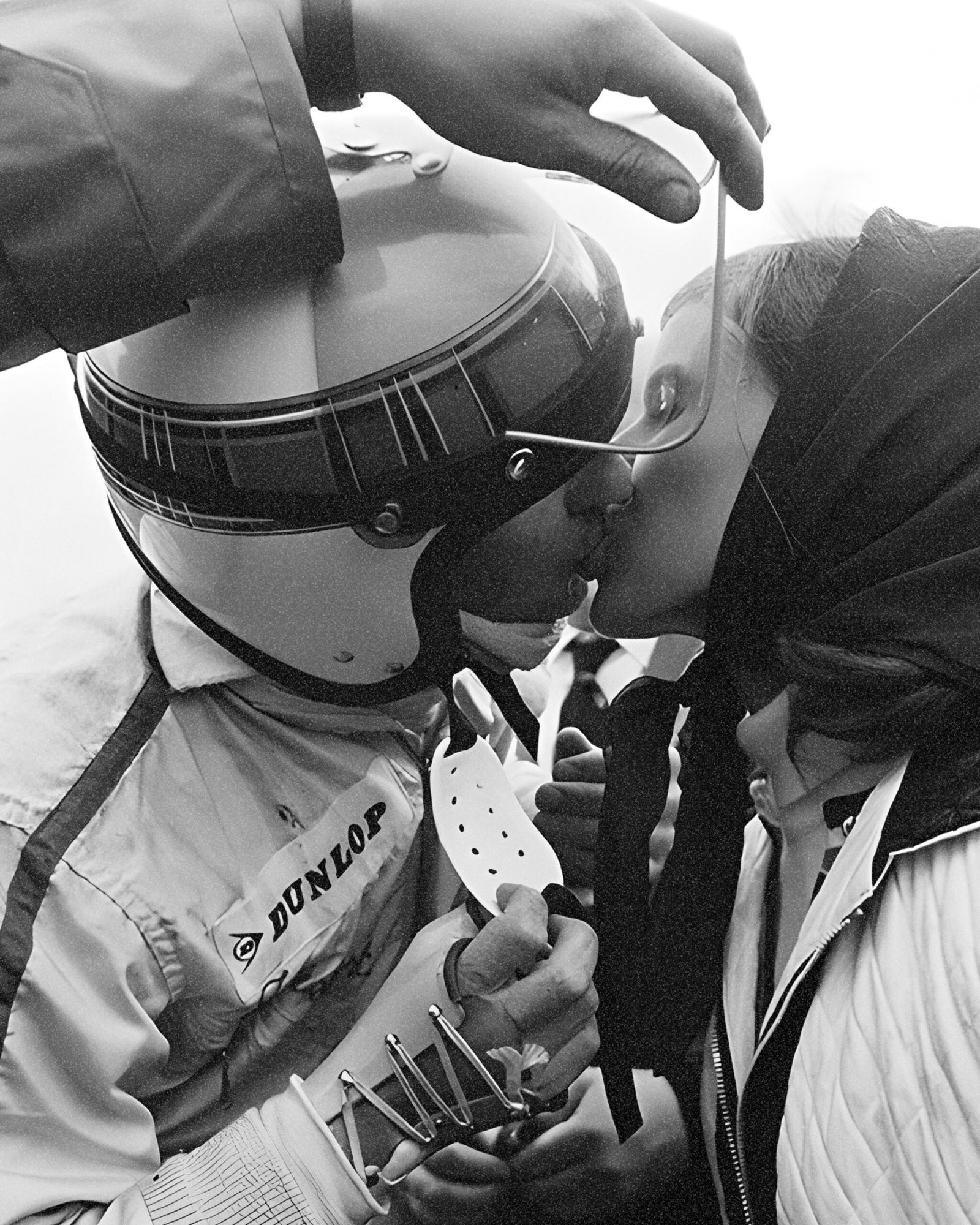
- The sport itself. the pit-lane print, a vintage pit crew, a pit stop shot in motion, a blurred single-seater, a modern Mercedes at speed and a classic open-wheel machine are pictures of Formula 1 as a thing that happens, with nobody named — which is the truthful description of every one of them.
Every print is made to order on 200 gsm archival matte paper, pigment giclée at 300 dpi, on the press within 72 hours and shipped tracked and free worldwide. Framing is available from 27×35 cm to 70×100 cm in solid wood, assembled by hand with the hanging hardware already fitted.
Common questions
How can you tell what era a Formula 1 car is from?
By four things, in this order: whether the engine sits ahead of the driver, which puts it before 1961; whether a wing is carried high on struts, which narrows it to about twelve months in 1968 and 1969; whether the sidepods run full length, for ground effect; and how wide the car is.
When did Formula 1 cars stop having the engine in front?
Stirling Moss won the 1958 Argentine Grand Prix in a privately entered Cooper T43 with the engine behind him — the first World Championship win for that layout. Within three years the whole field had followed. The last front-engined winner was Phil Hill's Ferrari 246 F1 at Monza on 4 September 1960.
Why do the cars from 1998 to 2008 look tall and narrow?
Because the maximum width was cut from two metres to 1.8 for 1998, and grooved tyres arrived at the same time — three grooves at the front, four at the rear. Cars went back to two metres in 2017, on rears that grew from 325 mm to 405, which is why a 2017 car looks squat beside a 2016 one.
What should I look for if I want a print from a particular era?
Start from the outline rather than a date. A long bonnet with the driver sitting high is pre-1961; a tall airbox and low bolted-on wings is the middle 1970s; a squared, bulky midsection is the turbo years. Our listings describe what is in the frame and do not say when or where a photograph was made.
What changes in Formula 1 for 2026?
The 1.6-litre turbocharged V6 stays, the MGU-H goes, output splits roughly evenly between combustion and electrical power, and the fuel becomes fully sustainable. For the first time in about fifty seasons the defining change is chemical rather than aerodynamic, which may be why these cars are harder to date by eye.