F1 pit stop history begins with a dropped wheel nut. Juan Manuel Fangio came into the pits at the Nürburgring on lap 13 of the 1957 German Grand Prix leading Mike Hawthorn and Peter Collins by 30 seconds. A mechanic dropped the rear-right wheel nut under the car and spent close to half a minute finding it. Fangio rejoined third, about 48 seconds behind Collins, with 10 laps left.
He then broke the lap record nine times, took 15.5 seconds out of Hawthorn on his first lap back and 8.5 more on the next, and won by roughly three seconds. It is one of the great drives, and it exists because a pit stop in 1957 was something that happened to you.
F1 pit stop history begins in 1957, as an accident
For the first three decades of the World Championship, stopping was a cost you tried to avoid entirely. Fuel went in from churns. Wheels came off with a hammer. Nobody had rehearsed it, because nobody planned to do it, and a team that stopped had usually already had its race go wrong.
That is why the arithmetic in the paragraph above works out the way it does. Fangio’s stop cost him a 30-second lead and put him 48 seconds behind: 78 seconds of track position surrendered in one pit box, on a 22.810 km lap of the Nürburgring where his own fastest time that day was 9:17.4. Nothing about a modern stop is remotely comparable — and the reason for that is not the crew.

1982: Gordon Murray turns it into a strategy
The change came from Brabham’s chief designer. Gordon Murray worked out that a car starting on half tanks and softer tyres, running higher turbo boost because it knew a top-up was coming, could gain more time on track than the stop would cost in the pit lane.
Brabham brought the equipment to the 1982 British Grand Prix and neither BT50 lasted long enough to use it. It finally happened at the Österreichring on 15 August 1982 — and here the sources genuinely disagree, so we will not pretend otherwise. Wikipedia’s report of the 1982 Austrian Grand Prix says Nelson Piquet made the first planned mid-race fuel and tyre stop in modern Formula 1 history, shortly before half distance. Wikipedia’s page on the Brabham BT50 credits Riccardo Patrese with the stop, held up only 15 seconds and rejoining still in the lead. Both agree it was a Brabham, that day, and that Gordon Murray thought of it.
Neither driver finished. Patrese’s engine failed three laps later, Piquet’s electrics gave out on lap 32, and Elio de Angelis won the race. The idea survived anyway, because everyone in the pit lane had watched it work.
1984: the rule takes the fuel away
Refuelling was permitted until 1983 and then banned. For the next ten seasons a stop meant tyres and nothing else, which is the point at which a pit stop stops being a refuelling operation with a tyre change attached and becomes a tyre change with a stopwatch on it. Everything that makes a modern stop look the way it does — the choreography, the rehearsal, the count of people — comes from that decade.

It is also the decade in which a stop first decided a famous race outright. The closest Monaco Grand Prix Senna ever won turned on Nigel Mansell coming in on lap 71 of 78 for a puncture that Goodyear afterwards denied had happened.
1994: it comes back, and Hockenheim
Refuelling returned for the 1994 season. On 31 July that year, at the Hockenheimring, Jos Verstappen’s Benetton stopped on lap 15 and fuel was sprayed onto hot bodywork. A few seconds later it ignited. Verstappen had his visor up and took burns around his eyes; no crew member was seriously hurt. Gerhard Berger won the race from pole, which is not what anyone remembers about it.
The images from that stop did more to shape how people think about the pit lane than any rule did. A pit lane is the only place in motorsport where twenty people stand within arm’s length of a car that has just come off a straight, and for sixteen seasons they did it beside an open fuel line.
2010: gone again, and the two-second stop
Refuelling was banned from 2010, on safety grounds and on cost — as Motorsport.com’s account of the decision records, the rigs had to be freighted to every race, and removing them removed that bill. Fuel tanks grew and the cars got longer to accommodate them.
What was left was pure tyre work, and it collapsed toward the physical limit almost immediately. A stop is now worked by up to twenty mechanics and takes around three seconds. The record is 1.80 seconds, set by McLaren on Lando Norris at the 2023 Qatar Grand Prix — 0.002 seconds inside the mark Red Bull had set at the 2019 Brazilian Grand Prix.

Two thousandths. That is the margin at the end of seventy years of trying, and it is worth stating plainly what actually moved the number over that period: not fitness, not equipment, but four rule changes about fuel.
What this does to a photograph of a pit lane
It makes one datable and the other not, which is more useful than it sounds.
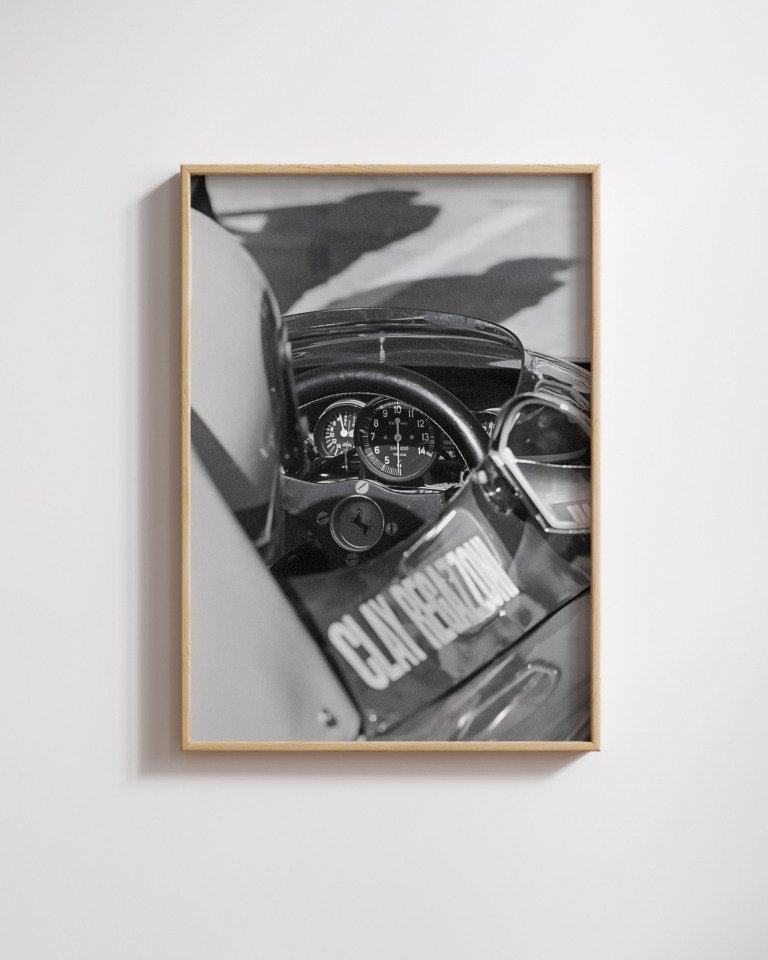
A crew in cloth overalls without helmets, working a car that is standing still long enough to be photographed sharply, is from the era when the stop was an event. The vintage pit crew poster is that picture. So, in a different register, is the pit-lane print — a moment in a pit lane rather than a race, and the best-selling image in this collection.
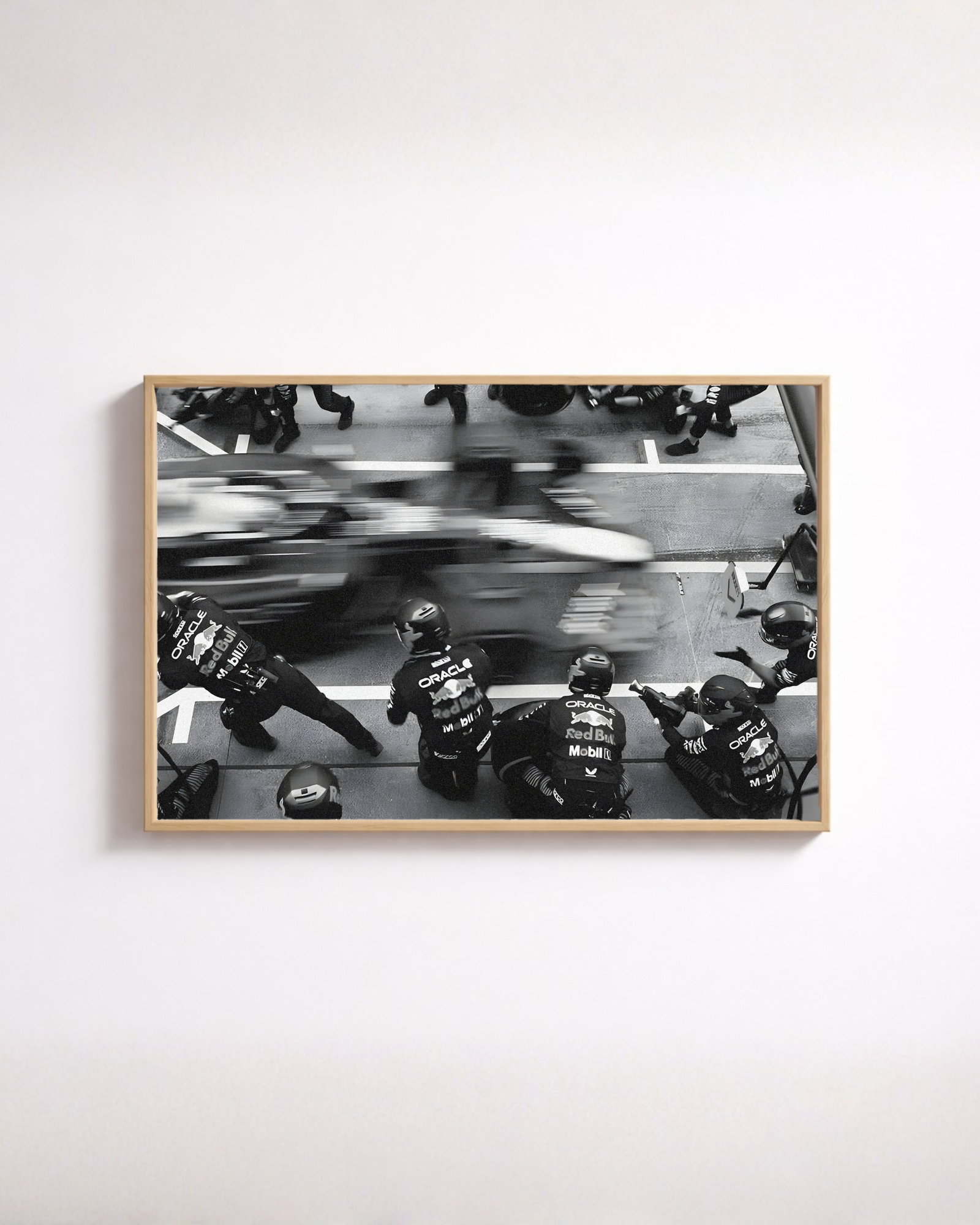
A modern stop cannot be photographed that way. Three seconds is not long enough for a composition, so the photographs that work are the ones that accept the blur and use it: a pit stop shot in motion, or a car reduced to a streak.
What none of these prints will tell you is which team, which year or which race, because we do not know and will not guess. The listings describe what is in the frame and stop there. If you want the version of that history you can date — where the cars themselves place a photograph in time — that is the shape of the car.
Every print is made to order on 200 gsm archival matte paper, pigment giclée at 300 dpi, on the press within 72 hours and shipped tracked and free worldwide.
Common questions
How fast is an F1 pit stop now?
Around three seconds, worked by up to twenty mechanics, and it is only tyres — refuelling has been banned since 2010. The record is 1.80 seconds, set by McLaren at the 2023 Qatar Grand Prix, two thousandths of a second inside the mark Red Bull had set at the 2019 Brazilian Grand Prix.
Why did pit stops used to take so long?
Because nobody planned them. For the first three decades of the World Championship a stop was something that had gone wrong: fuel came from churns, wheels came off with a hammer, and no crew had rehearsed the job. Fangio lost 78 seconds of track position in one box at the Nürburgring in 1957.
Who invented the planned pit stop?
Gordon Murray at Brabham, in 1982. He worked out that starting on half tanks and softer tyres, on higher boost, would gain more on track than the stop cost in the pit lane. It happened at the Österreichring on 15 August 1982; sources disagree on whether Piquet or Patrese made it.
When was refuelling allowed in Formula 1?
Until 1983, then banned; back for 1994, then banned again from 2010 on safety and cost grounds, since the rigs had to be freighted to every race. Four rule changes about fuel, and between them they explain almost the whole change in how long a stop takes.
Can a modern pit stop be photographed the way an old one was?
Not really. Three seconds is not long enough for a composition, so the pictures that work either accept the blur or use it. An older stop, with a crew in cloth overalls and a car standing still, holds still long enough to be photographed sharply — which is why those frames look like a different sport.