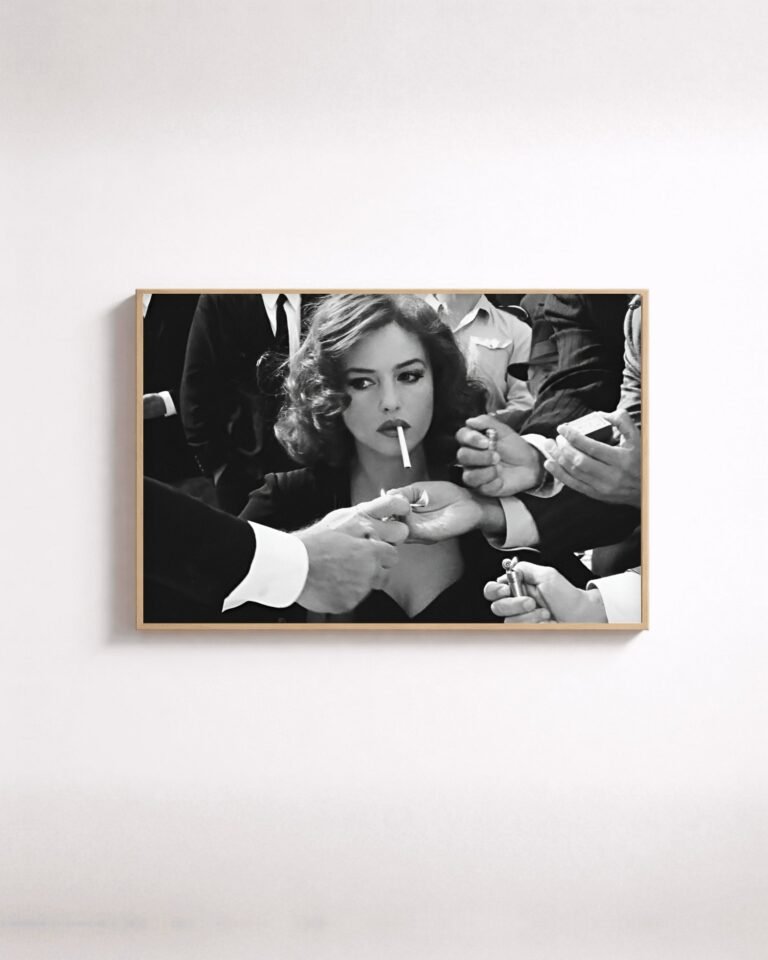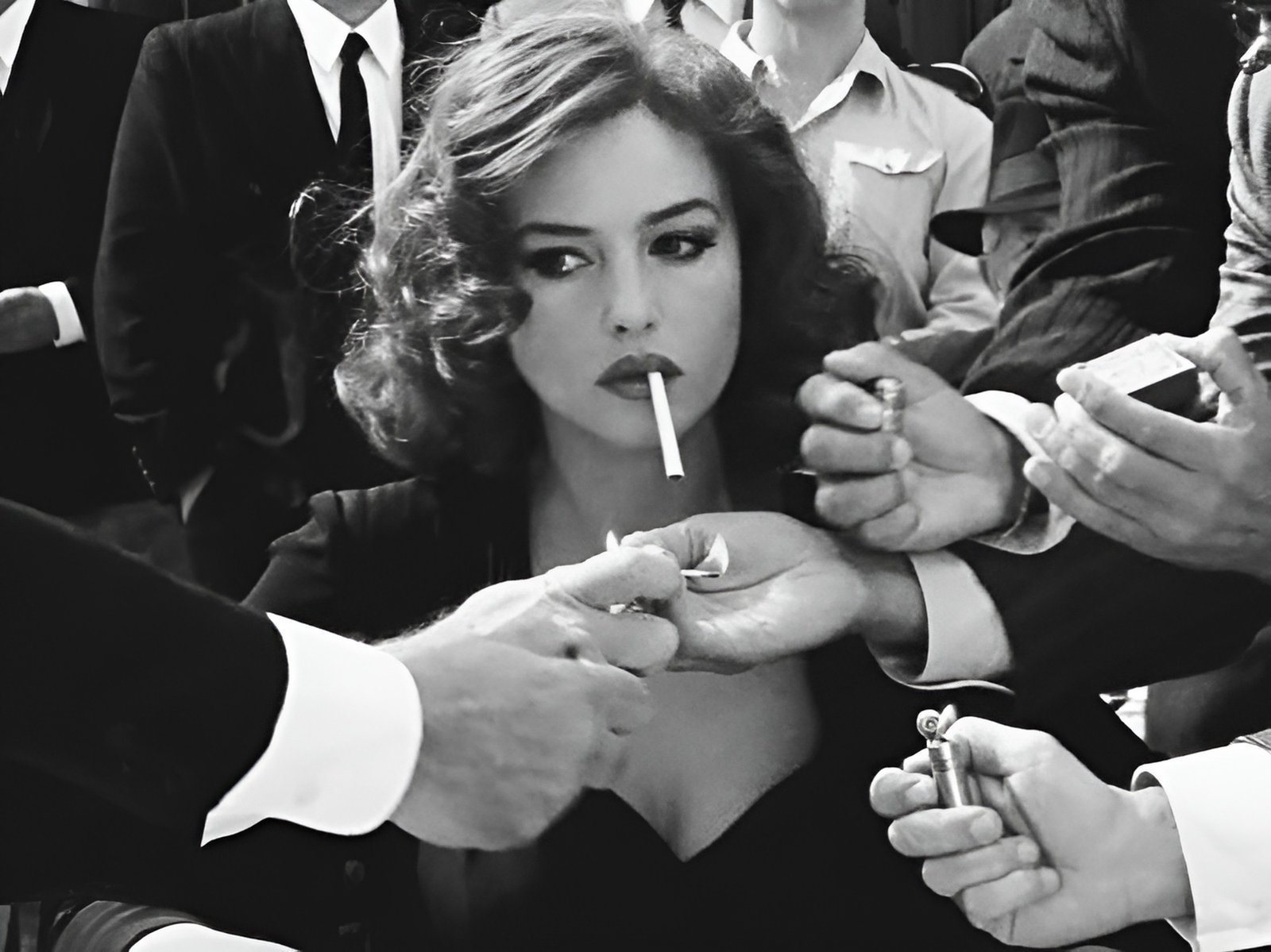
Count the hands. That is the first thing everyone does in front of this small, dense, unforgettable photograph: from the left, a hand cupping a lit match; from the right, a fist around a lighter, another pair of hands opening a packet, another lighter at the lower corner — a whole thicket of male hands rising around one woman’s face, every one of them holding out fire. And at the centre of the thicket, entirely calm, a cigarette still unlit between her lips, her gaze travelling past the flames to somewhere none of the hands can follow.
The print is Everyone Has a Lighter, and it is a miniature — a small print, by design, because its power is the power of a face at reading distance. A woman sits in a crowd of men in a sunlit southern piazza, dressed in black, hair waved, mouth set — and the whole social order of a town arranges itself around the simple fact that she has not yet accepted a light.
A whole society in one gesture
Great cinema occasionally produces a single gesture that contains its entire world, and this is one. The offered lighter, in that place and era, was never only about fire: it was the one approach a man could make in broad daylight, in front of everyone, with complete propriety — a proposal disguised as a courtesy. Multiply it by a crowd and you have a parliament of proposals, all pending. Her unlit cigarette is the longest held breath in photography.
And her expression is the reply to all of it. Not coy, not flattered, not even particularly pleased — level, self-possessed, faintly weary, the look of a woman who has been offered flames by experts and found the offering more interesting than the fire. The photograph is usually described as being about desire. Look longer and it is about something rarer on film: indifference, held with perfect posture, in public, at noon.
Why it is a small print
Some images expand; this one concentrates. The crop is already tight — face, cigarette, hands, flames — and its drama is forensic: the curl of a match flame, the grain of a knuckle, the exact set of a mouth. Enlarged to poster scale, those details would coarsen into noise. At miniature scale they stay sharp as evidence, and the viewer does what the crowd in the picture is doing: leans in. The small print makes you join the piazza. That is not a limitation of the format. It is the format finishing the photograph’s idea.
It also honours the image’s origin among the great small things of cinema — the frames people cut out of magazines and pinned up, the stills that travelled in wallets and lockets of the mind long before they were merchandise. A locket-scale print of a face like this is not a compromise. It is the historically correct size.
Look once more at the hands, because the picture is composed like a still life around them. No two are alike: one cups a match with the tenderness of a man sheltering a candle, one brandishes a steel lighter like a tool, one is already retreating with an opened packet, spent. Read left to right, they are a short story of hope, effort and withdrawal — and she has not moved a muscle for any of them. The flames are small. The refusal is enormous.
Living with it
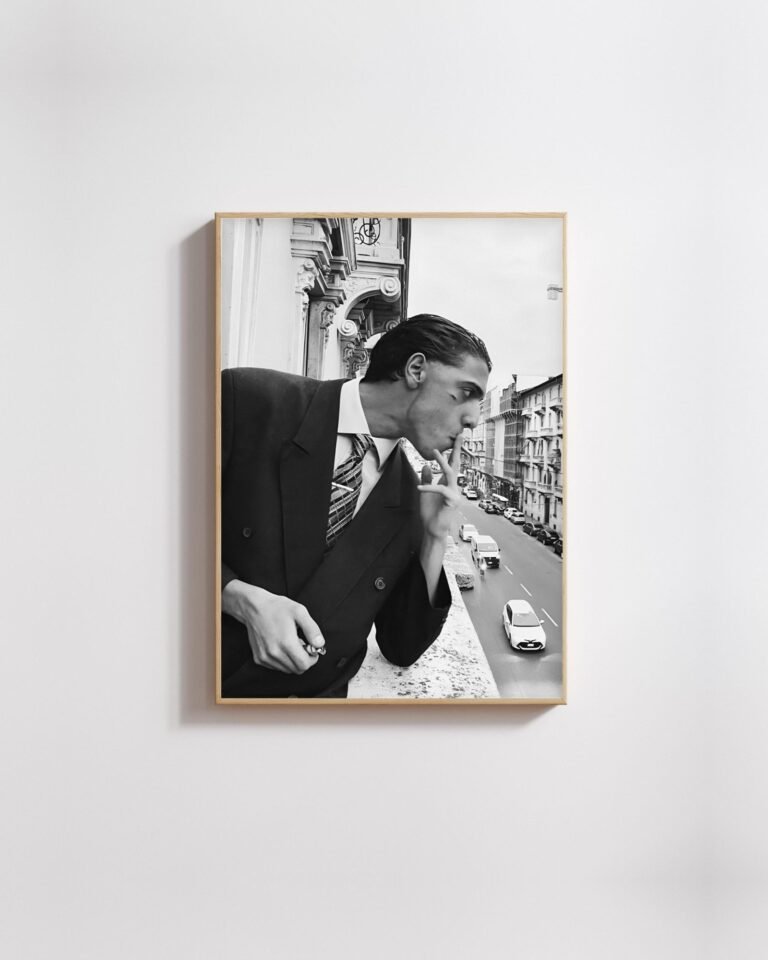
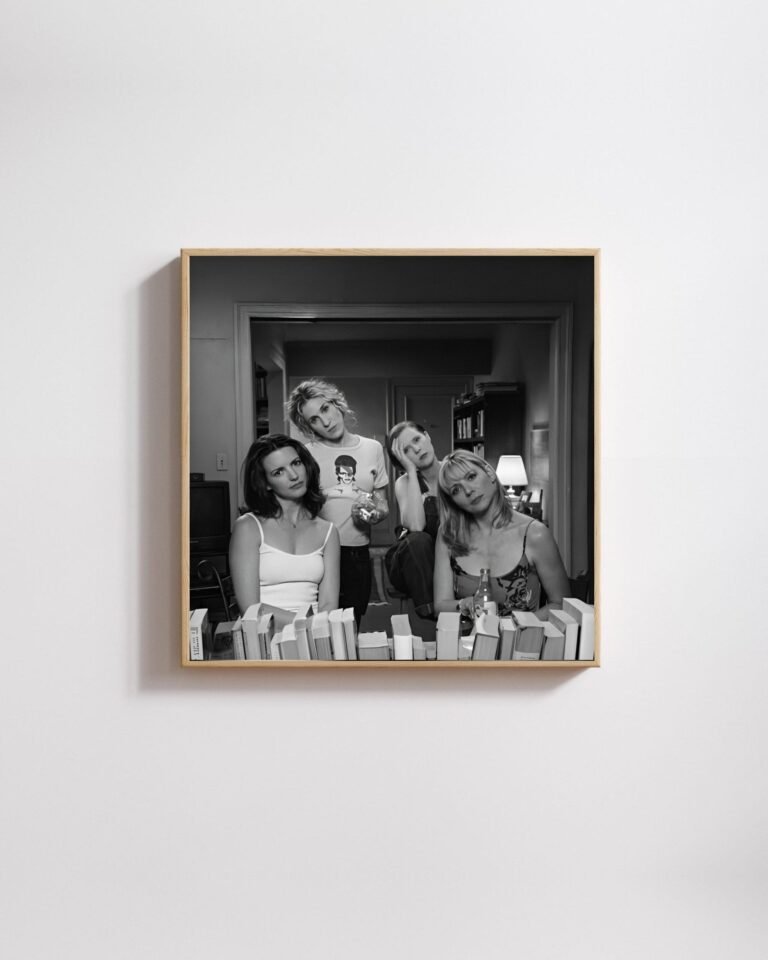
Hang it where people pass close and slowly: a desk wall, a bedside, a narrow hallway, the wall beside a reading chair — anywhere a face at reading distance can stop a person mid-step, the way she stopped a piazza. The poster sizes chart shows how the small formats sit. Its natural shelf-mates are the wave’s other miniatures with outsized presence: carried away, all tenderness at dawn, and the press photographer, whose level gaze across a city street answers this one’s across a crowd.
Common questions
What is she deciding in this photograph?
Nothing — that is the power of the frame. A woman with an unlit cigarette stands surrounded by men's hands, each offering a lighter or a match, and her gaze passes over all of them. A famous beat of Italian cinema: courtship reduced to a single held second, and the second belongs entirely to her.
Why is the print small in scale?
The frame is dense with hands and faces, and it rewards closeness. At desk, bedside or narrow-hallway size it reads like a secret; the detail — the flames, the expressions, the cigarette still unlit — is the picture. It is also one of the most gifted pieces in the collection.
Does it pair with other prints?
It belongs to the collection's Italian thread — the Milan balcony, the back seat at night — and matches their sizes exactly, so a pair or triptych hangs level. Same paper, same black-and-white treatment, same era of cinema in the air.
How is it made?
Archival pigment giclée at 300 dpi on 200gsm FSC-certified matte paper. Made to order within about 72 hours and shipped free with tracking, worldwide, in a protective tube or ready-framed.