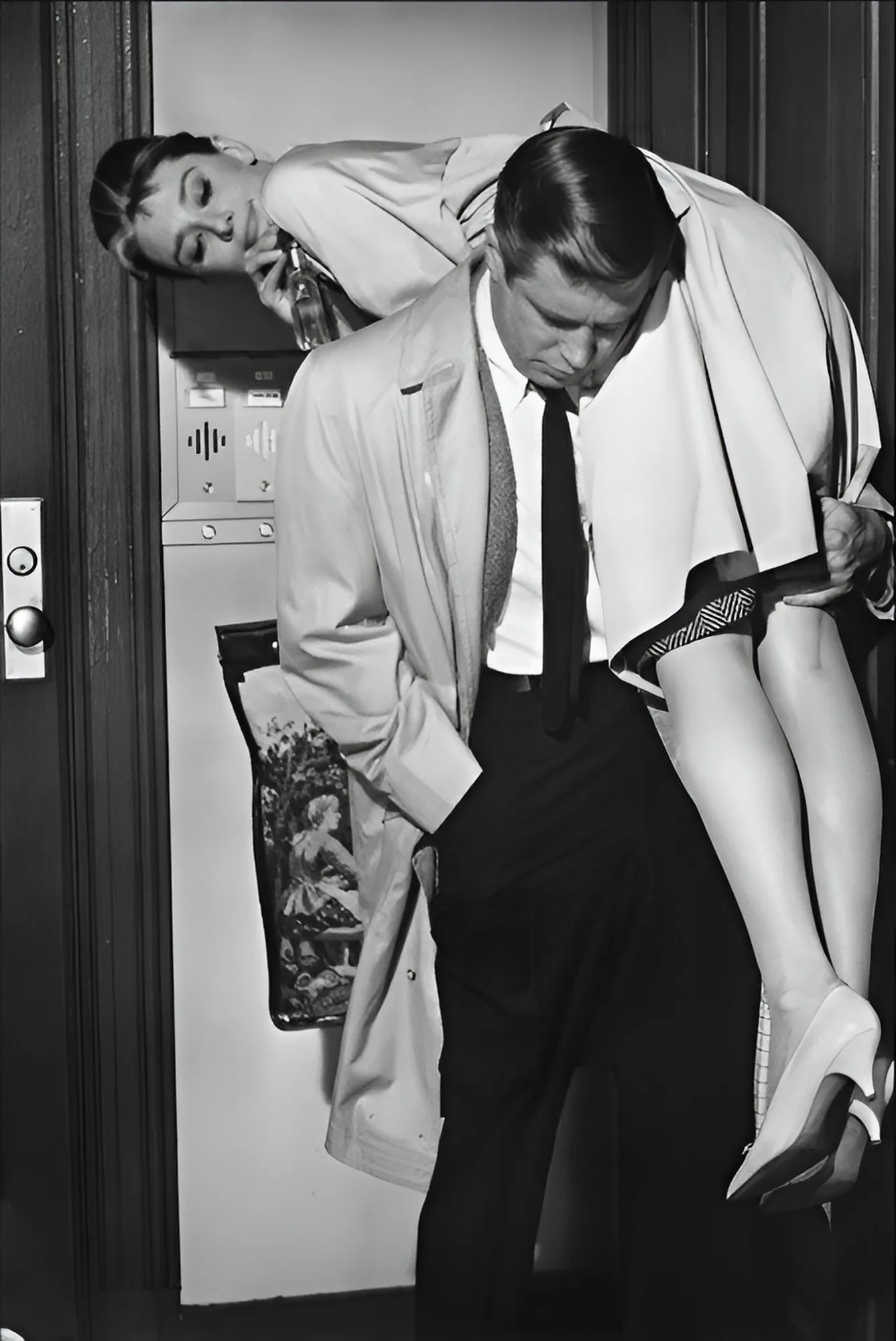
Some photographs need a wall to themselves. This one needs a bedside. It is the smallest print in this wave — deliberately, defiantly small — and everything about it is scaled like jewellery: a doorway, a key, a pair of white heels, and a man doing the oldest gallant thing in the world at the least gallant hour of the day.
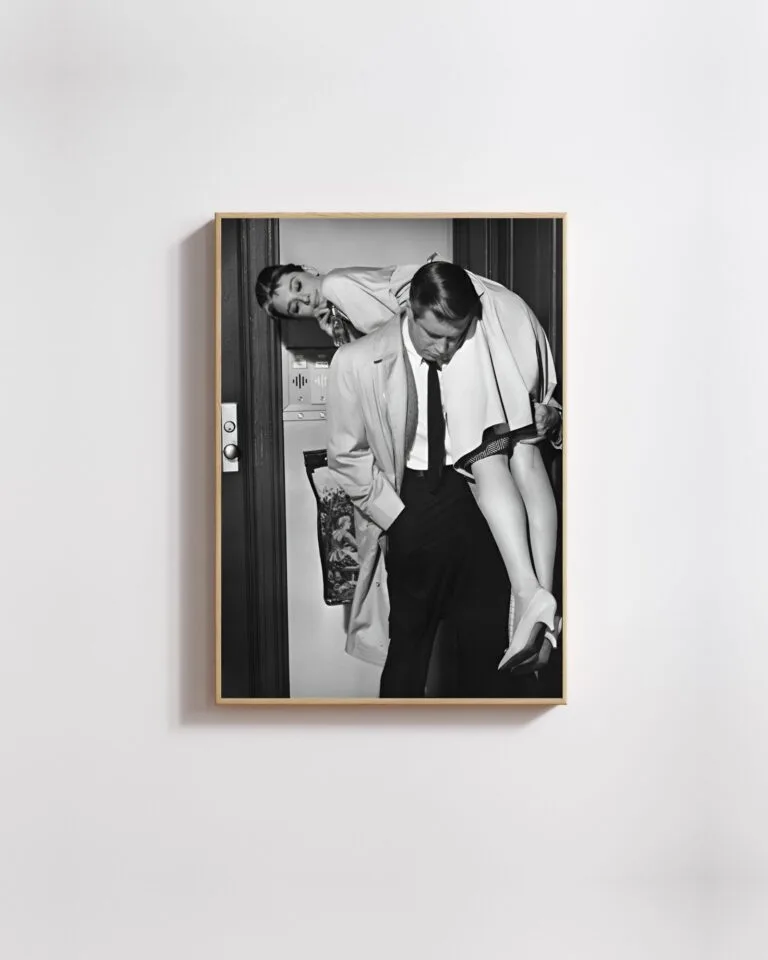
The print is Carried Away: dawn after a party, a man in a raincoat carrying a woman over his shoulder through the doorway of an apartment. She is draped like a coat over his shoulder, eyes closed, one hand still curled around what looks like her key. Her white heels dangle at his waist. He is looking down, hunting for the lock, wearing the expression of a man completing a logistical operation that romance assigned him at about four in the morning.
The hour nobody photographs
Cinema has always loved the party and the morning after, but it usually cuts between them. What it rarely keeps is the hinge — the actual arrival home, the fumbled door, the carried weight. That hinge is this photograph’s whole subject, and it is why the image feels less like a film still and more like a memory somebody happened to develop. Anyone who has ever been either person in this doorway owns a version of it.
The details do the period work without a word of caption. The raincoat worn like armour over evening clothes. The narrow tie. The little tapestry bag hanging by the door. The heels — white, high, entirely unrepentant — still on her feet, because taking them off was a problem for a later hour. Early-sixties elegance is usually photographed upright and smiling. Here it is horizontal and asleep, and it has never looked more elegant.
In praise of the small print
There is a snobbery of scale in wall art, as if a photograph’s seriousness rose with its width. The history of photography disagrees: some of the most treasured images ever made were contact prints and cabinet cards, things you held. A small print changes the contract between picture and viewer. It does not address the room. It addresses one person, at reading distance, who has chosen to step close — and stepping close is itself a kind of intimacy the big statement piece can never offer.
That is why this frame is offered as a miniature and nothing larger. Enlarged, the joke would coarsen and the tenderness would thin out. At jewel size, it keeps both. It is a locket of a photograph, and it is meant to be hung like one: somewhere private, somewhere near, somewhere its person passes at the beginning and end of the day.
The composition deserves a word, because it is doing quiet comic work. She is horizontal, he is vertical; she is light — pale coat, pale legs, white shoes — and he is the dark column underneath, in black trousers and a narrow tie, holding the whole arrangement up. The doorway frames them like a proscenium, and the little intercom panel on the wall watches like a critic. It is slapstick built like a classical doorway scene, which is exactly the kind of joke that survives at locket size.
Living with it
Think of the places a locket-print belongs: a dressing-table wall, the narrow strip beside a bathroom mirror, a bedside, the inside face of a wardrobe door, a powder room that deserves one good secret. The poster sizes chart shows how the small formats sit against a wall. It keeps affectionate company with everyone has a lighter, the wave’s other miniature with an outsized stare, and with the press photographer, its small, steady-eyed neighbour from the same shelf of little prints with long lives.
Common questions
What is the scene in this frame?
Dawn after the party: a man in a raincoat carrying a woman over his shoulder through an apartment doorway, her white heels dangling behind him. It is a still from the great age of screen romance — a whole night, and the decision to end it this way, compressed into one doorway.
Why is the print deliberately small in feel?
Some frames are murals and some are jewellery. This one is a jewel: an intimate, funny, tender moment that works at bedside and dressing-table scale, where you come across it at close range rather than taking it in from across a room.
Can I hang it in a pair?
It pairs naturally with the other cinema frames in the collection — the arrival, the red carpet, the bubble bath — same era of glamour, same black-and-white treatment. The sizes are shared across the range, so a matched pair or a row of three is easy to build.
What does 'made to order' mean for timing?
Your print does not exist until you order it. It is printed as an archival giclée on 200gsm matte, checked, and packed within about 72 hours, then sent with free tracked shipping, worldwide.