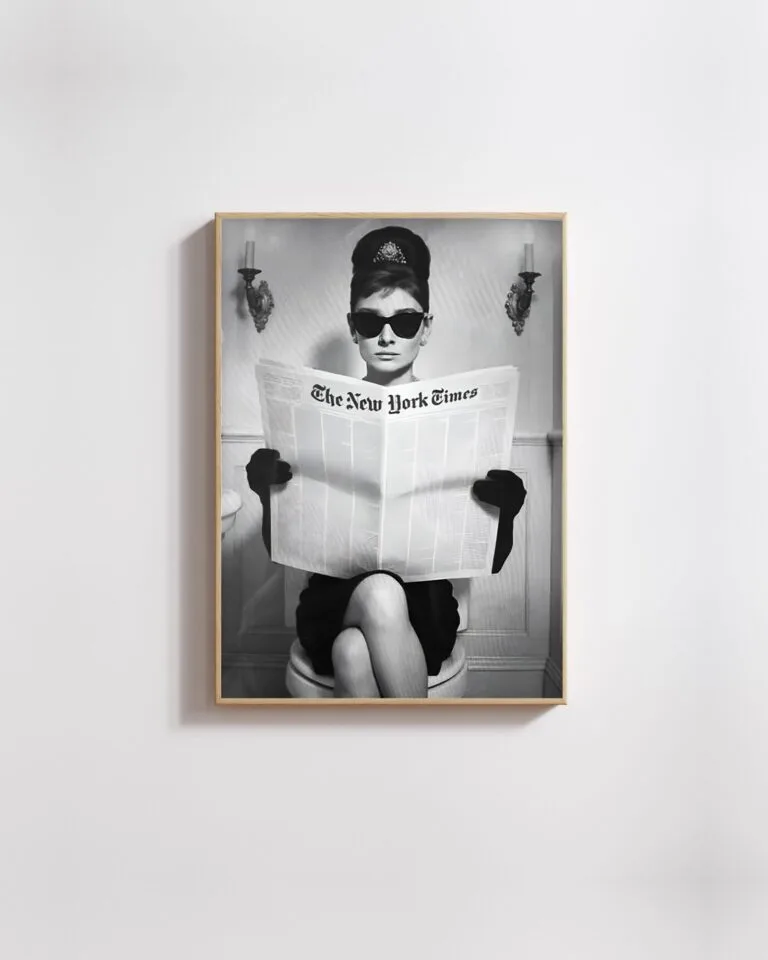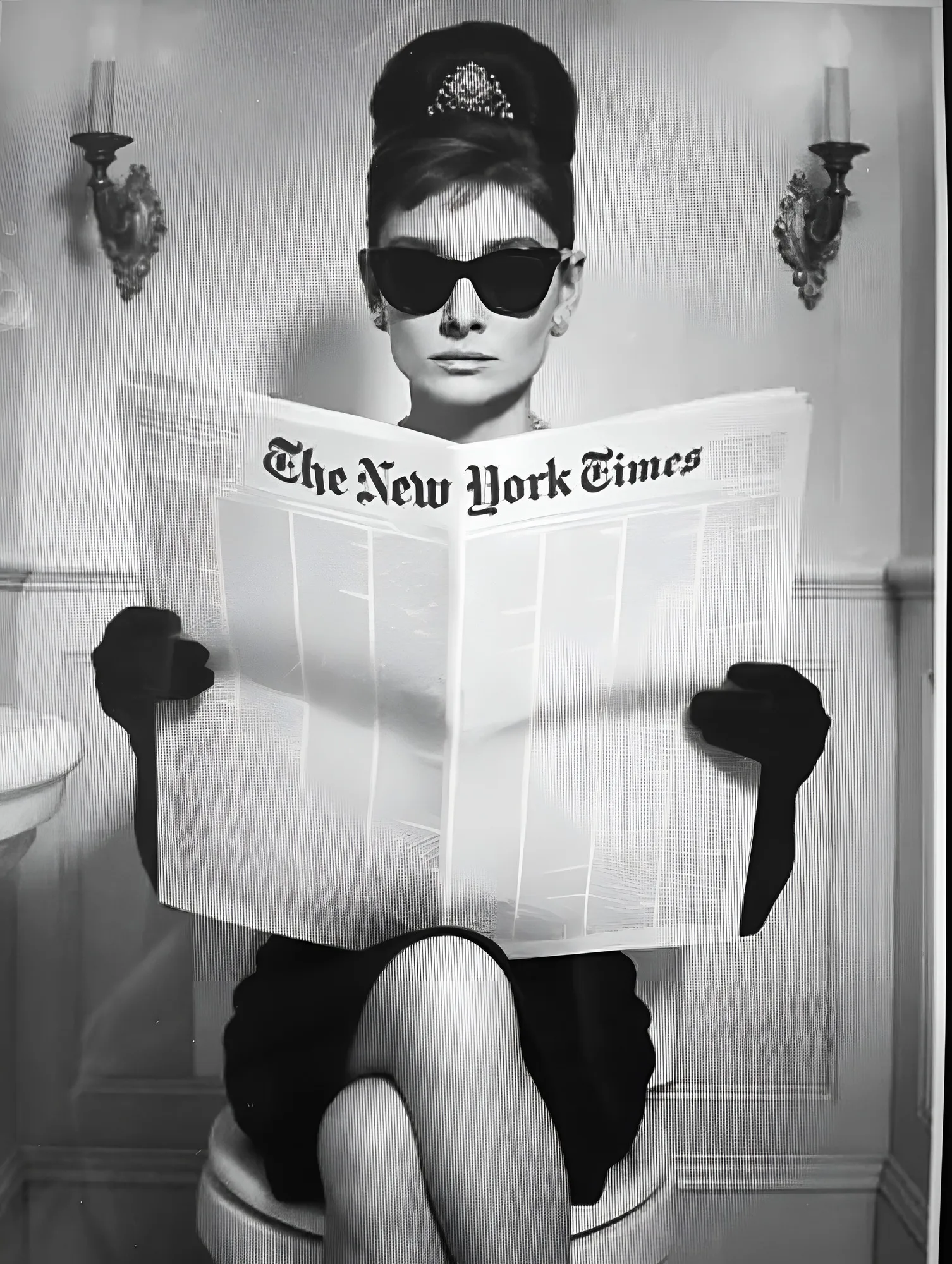
Breakfast is the most diplomatic meal of the day, and this woman has declared independence from it. She is seated, dressed, gloved, crowned with a small tiara in a pile of hair — and entirely unavailable, behind the two oldest screens in the world: a pair of dark sunglasses and a broadsheet newspaper held open like a castle gate.
The print is The Sunglasses Editorial: a woman holding a broadsheet wide in black-gloved hands, her face half-hidden behind oversized dark glasses, hair swept up high with a jewelled tiara catching the light above it. Her knees are crossed beneath the paper. Her expression, what little of it escapes the sunglasses, is perfectly calm. She is not reading the news. She is using it.
The art of being unavailable
Every era photographs its own version of this woman, because every era needs her. The sunglasses indoors, the newspaper as furniture, the dressing for an audience she then declines to address — it is a small theatre of withholding, and the camera is cast as the petitioner, kept politely on the other side of the page. Editorial photographers of the sixties understood that refusal photographs better than welcome. Welcome ends the picture. Refusal starts it.
Look at how the image is built. The newspaper is the largest, palest shape in the frame — a bright wall with a masthead for a cornice — and she rises from behind it like a headland from a white sea: the piled hair, the tiara, the dark lenses. Gloves down both sides like black punctuation. It is less a portrait than a fortification with a face, and the composition has the nerve to leave the best part — her eyes — entirely to your imagination.
Tiara at breakfast
The tiara is the detail that turns a good photograph into a great one. Evening jewellery at a morning table is a deliberate wrongness, a leftover from the night before worn into the day as a statement of policy: the party was hers, the morning is also hers, and the dress code for both is whatever she is already wearing. Fashion editorial has borrowed this trick ever since — one element overdressed, everything else composed — because it tells a whole biography in a single glint.
That is also why the image has outlived the sitting it came from. It is not really about a person; it is about a posture that never dates. Composure as armour. Print as a shield. The calm of someone who has decided that the world’s first demand of the day — attention — will be met on her schedule, not its.
The sunglasses deserve their own history. Oversized dark glasses became the editorial uniform of a particular kind of woman at a particular moment — worn indoors, worn at breakfast, worn precisely where they were not needed against the sun. Their function was never optical. They were a drawn curtain with a face behind it, and every photographer of the era knew that a subject who withholds her eyes gives the viewer work to do. Work, in a photograph, is another word for staying power.
Living with it
This print belongs where the day’s own ceremonies happen: a dressing room, a bathroom wall with ambitions, a boutique corner, a hallway where people check themselves before leaving. It is a bright picture — that big pale field of newsprint sees to that — so it holds its own on coloured walls and next to stronger, darker neighbours. The poster sizes chart shows the sizes against a standard wall. It keeps natural company with the bubble bath, its unguarded opposite from the same morning-after world, and with the party trick, the evening before this breakfast, caught mid-sip. Read in sequence, the three of them tell you everything about a weekend.
Common questions
What is she doing behind the newspaper?
Declining to be read. A woman in oversized dark sunglasses holds an open broadsheet in black-gloved hands, hair piled high with a small tiara — the full armour of a certain kind of celebrity morning. The paper is a prop; the sunglasses are the statement. It is an editorial photograph about privacy performed in public.
Why does this frame feel so modern?
Because the gesture never dated. The broadsheet, the dark glasses, the refusal to engage — it could run in a fashion magazine this season. Black and white strips away the period detail and leaves the attitude, which is why the print sits comfortably in contemporary rooms.
Where does it hang best?
Dressing rooms, boutique walls, a landing that needs one confident piece. The composition is a tight portrait crop, so it takes the smaller and middle sizes particularly well — 30×40 and 40×50 cm are the natural choices.
Is it available framed?
Yes: unframed, or in black, white, natural or dark wood, with an optional white mat, on sizes from 27×35 to 70×100 cm. Black on black is the editorial choice; the white mat is the gallery choice.