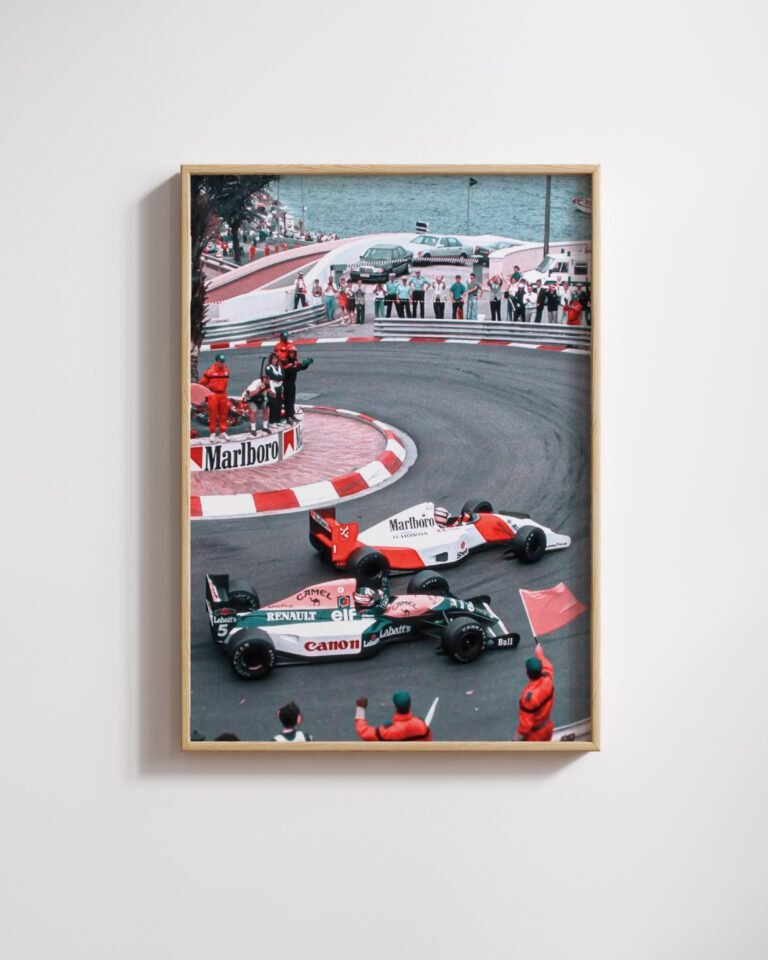
What is a giclee print? Start with the awkward part: “giclée” is not a specification.
Merriam-Webster defines it as “a process by which high-quality prints are produced using an ink-jet printer”. That is the whole definition. No body certifies it, no test qualifies for it, and nothing stops anyone printing on newsprint with office ink and calling the result a giclée. The word entered English in the 1990s — the Oxford English Dictionary’s earliest evidence is from 1993 — borrowed from the French gicler, to spurt or squirt, after the way the ink arrives at the paper.
So the word tells you the print came out of an inkjet. It does not tell you which ink, which paper, or at what resolution. Those three are the entire difference between a print that holds and one that does not, and they are what to ask about instead.

1. Pigment or dye
This is the one that matters most, and it is a question about chemistry rather than marketing.
Dye inks are colourants dissolved in liquid; the colour soaks into the sheet. Pigment inks are solid particles suspended in liquid — closer, as Epson’s print-permanence white paper puts it, to the colorants used in automotive paint — and they sit in and on the coating rather than dissolving into it.
The consequence, in the same paper: “When compared under equivalent test conditions, inkjet prints made with pigment-based inks and printed on papers designed to react favorably with them yield significantly better lightfastness than do most dye-based inkjet prints.” Pigment is also less vulnerable to ozone in ordinary rooms, and relatively water resistant where dye on the wrong paper is not.
Our prints are pigment giclée at 300 dpi. Archival, not dye. If you are comparing prints anywhere — here or elsewhere — that is the line worth finding on the page, and its absence is informative.
2. The paper: what 200gsm means
Grammage is mass per unit area, expressed in grams per square metre; ISO 536 is the standard that defines how it is measured. A sheet one metre square that weighs 200 grams is 200 gsm. That is all the number says — it is a measure of weight, not of quality, and a heavy sheet of bad paper is still bad paper.
What it is useful for is calibration against paper you have handled. Office copier paper is typically 80 gsm. At 200 gsm a sheet has enough body to stand up from a table edge on its own, which is the difference between something that reads as a print and something that reads as a poster.
The paper is FSC-certified. The Forest Stewardship Council label is a chain-of-custody claim: it means the fibre is traced back to forests managed to the FSC’s standards, or to recycled or controlled sources, rather than simply asserted to be sustainable by the company selling it.
3. Matte, and what it is for
A gloss surface reflects light the way a mirror does — angle in, angle out. Which is fine until the wall opposite has a window in it, at which point the window is what you see and the photograph is what you have to find behind it.
A matte surface scatters incoming light in every direction instead. There is no bright spot to move around, so the image reads the same from anywhere in the room and at any time of day. On black-and-white work, where the entire subject is tonal separation, that is not a preference. It is the difference between seeing the picture and seeing the lamp. What that does to a monochrome image specifically is worked through in black-and-white prints on matte paper.

It is worth choosing your wall with the same logic. The size guide deals with where a print goes; the short version is that matte solves reflection and nothing solves direct sun.
4. 300 dpi, in dots
Dots per inch is a density, so it only means something once you attach it to a size. At 300 dpi:
- A 20×25 cm sheet is 2,362 × 2,953 dots.
- A 70×100 cm sheet is 8,268 × 11,811 dots — a shade under a hundred million of them.
300 dpi is a specification set for a sheet held at reading distance. At three paces across a room it is well past what the eye is asking for, which is the point: the resolution is chosen so that the print is never the limiting factor.
How long does it last? The honest answer.
Every permanence figure you have ever read is a figure about a test, and the test conditions are the important half of it.
Epson’s white paper sets out the accepted industry practice: glass-filtered cool-white fluorescent light, ten to twelve hours a day, at 450 lux or more. Ratings are quoted using “a glass filter (approximately 30% UV filtration) to simulate framing prints under glass”. The independent laboratory most often cited, Wilhelm Imaging Research, publishes on that basis — its table in that paper is headed “Years of Display Based on 450 lux/12hrs/day, Prints Framed Under Glass”, and under those conditions a pigment inkjet print is rated at 104 years while a dye-sublimation print in the same table runs to four.
Those numbers belong to specific printers, inks and papers, each tested individually. They are not a figure for anything on this site, and we do not publish one, because we have not run the test and the honest version of that number would arrive with four conditions attached. ISO 18937 is the current standard method if you want to read what the test involves.
What is worth acting on is the light, which is the variable you control. The Conservation Center for Art & Historic Artifacts recommends a maximum of 50 lux for works of art on paper and photographs, with ultraviolet ideally between 0 and 10 microwatts per lumen and never above 75, and states that damage from light exposure “is both cumulative and irreversible”. Nothing undoes it afterwards. A wall that catches direct sun for an hour a day will do more to a print than any decision you make at checkout — including whether to buy it framed or rolled.

What is a giclee print, then, in one sentence
An inkjet print, made with pigment rather than dye ink, on a heavy matte paper, at a resolution fine enough that the dots stop being visible. Every part of that is checkable on a spec sheet. None of it is carried by the word giclée itself.
What we do not claim
No edition numbers. No plate numbers. No certificates. Everything is made to order, so nothing is stocked and nothing is ever the last one left — an edition number on a print that does not exist until you ask for it would be a decoration rather than a fact.
The specification is short on purpose: 200gsm archival matte paper, FSC-certified, pigment giclée at 300 dpi, on the press within 72 hours, delivered free and tracked worldwide. Everything on that list can be checked. Nothing has been added to it to match somebody else’s page.
You can see what it comes out like on the Porsche 911 Turbo (930) poster, the Mercedes 300 SL Gullwing poster and the Senna Lotus 97T print. If you are buying for someone else, buying an art print as a gift covers the parts that get harder when the wall is not yours.
Common questions
What is a giclee print, exactly?
It means the print came out of an inkjet printer. Merriam-Webster defines it as a process producing high-quality prints on an ink-jet printer, and that is the whole definition: no body certifies the word and no test qualifies for it. Ask which ink, which paper and what resolution instead.
Is pigment ink better than dye ink?
For lightfastness, yes. Epson's print-permanence paper reports that under equivalent test conditions, pigment inkjet prints on papers designed for them hold up significantly better than most dye-based prints, and cope better with ozone and water. Our prints are pigment, and that is the line worth finding on any product page.
Is 200gsm good for a poster?
Grammage is mass per unit area, measured the way ISO 536 sets out, and nothing else. At 200gsm a sheet weighs about two and a half times office copier paper, so it has enough body to stand out from a table edge instead of flopping over. That is what separates a print from a poster in the hand.
How long will the print last?
We do not publish a figure, because we have not run the test. Published permanence numbers describe laboratory conditions — filtered fluorescent light, ten to twelve hours a day, at 450 lux or more — not your hallway. Light is what decides it, and conservation guidance recommends a maximum of 50 lux.
Why matte paper rather than gloss?
A gloss surface reflects light the way a mirror does, so a window across the room lands on the picture and you have to look past it to find the image. Matte scatters that light instead, so the picture reads the same from anywhere in the room and at any hour of the day.