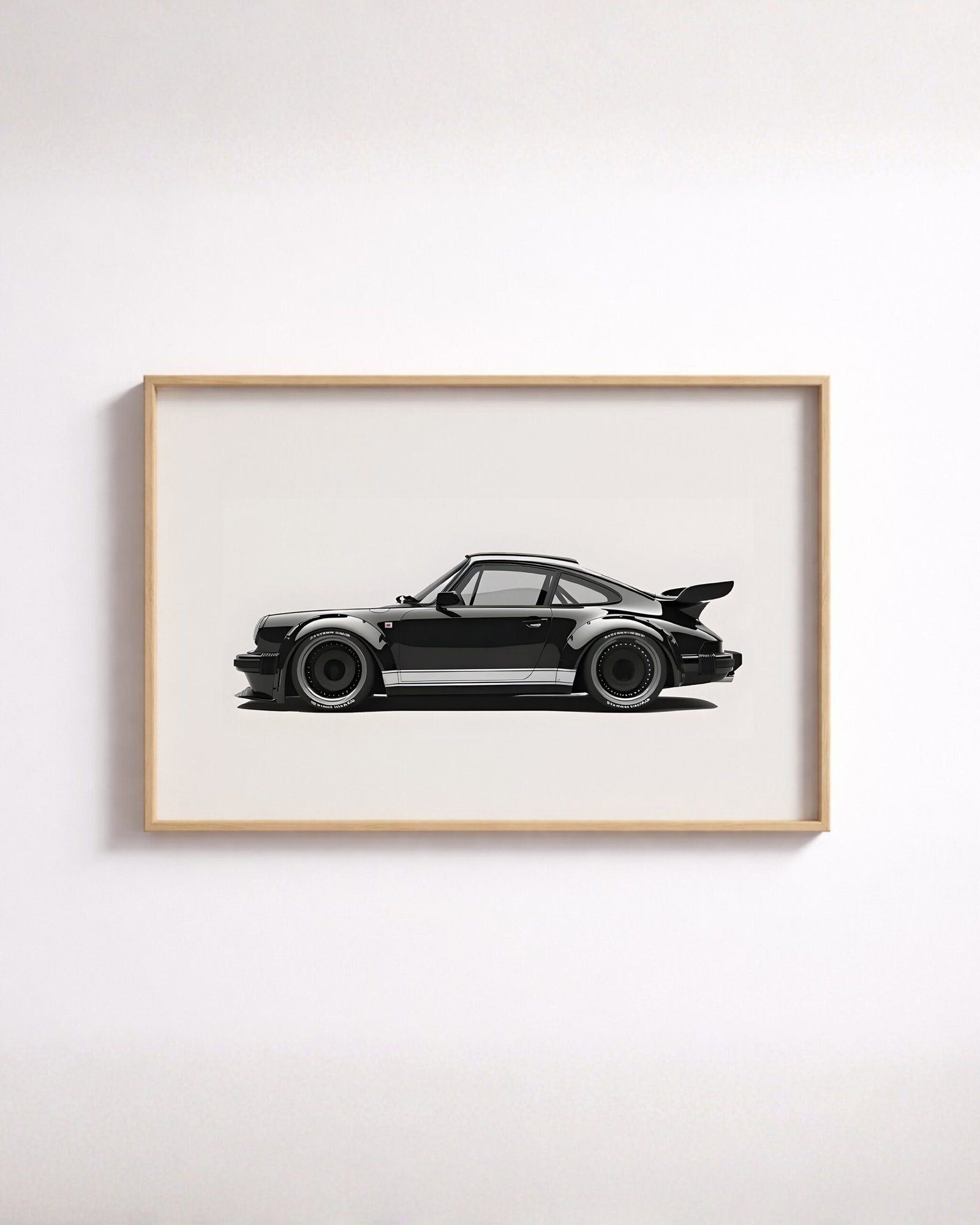
E30 M3 homologation is the reason the boot lid of an E30 M3 sits about 40 mm higher than the boot lid of an ordinary E30, and is made of glass-reinforced plastic rather than steel. Nobody at BMW raised it because it looked better raised. It went up because air leaving the roof needed somewhere useful to go, and the rulebook said that whatever the race car did, five thousand road cars had to do first.
That sentence is the whole car. Almost every visible difference between an M3 and a 320i is a racing part that a regulation forced BMW to sell to the public.
E30 M3 homologation: the rule
Group A replaced Group 2 as the FIA’s production-based touring-car formula from 1982, and it is the formula the Deutsche Tourenwagen Meisterschaft ran to from 1984 to 1992 and the European Touring Car Championship from 1982 to 1988. Before 1993 it required 5,000 identical cars built in twelve consecutive months before a model could be homologated at all.
There was a second clause, and it matters as much as the first. A manufacturer could homologate an evolution of an already-approved car — an ET extension, in the regulation’s language — on a run of 500 units.
Those two numbers, 5,000 and 500, wrote the specification of every E30 M3 that exists.
Three panels
BMW showed a prototype at the Frankfurt IAA in September 1985 and started production in March 1986, running to June 1991. What it built was not a trim level.
According to the record of the car’s specification, the only exterior body panels shared between the regular 3 Series and the M3 were the bonnet, the roof panel and the sunroof. Everything else — front and rear valances, wings, sills, C-pillars, boot lid, rear screen — was specific to the M3.

A manufacturer does not re-tool a bodyshell to sell 5,000 saloons. It re-tools a bodyshell because the shape has to be legal on a circuit, and the 5,000 are the price of entry.
What each change was for
The modifications run to a front splitter, a rear apron, sill panels, and reworking of the body around the rear window and C-pillars as well as the boot lid. Read as styling, that list is arbitrary. Read as aerodynamics, it is a single coherent argument about the back of the car.
The standard E30’s rear screen sits at a relatively upright angle and its boot lid is low. Air separates off the roof, misses the boot, and leaves a large low-pressure area behind a light rear end. On a road car at legal speeds this is a non-issue. On a circuit it is rear-axle lift.
So the rear screen was flattened and bonded in, the C-pillars filled to carry the air further back, and the boot lid raised roughly 40 mm in glass-reinforced plastic so that the airflow had a surface to press on. The flared arches follow the same logic from the other direction — they exist to cover racing track widths and tyre sections that a standard arch could not.

The engine got the same treatment. The S14 is a 2,302 cc four, producing 147 kW (200 PS) in European specification without a catalytic converter, and 143 kW (195 PS) with one. A four-cylinder in a range full of BMW’s own straight-sixes is not a cost decision. It is a decision about mass over the front axle and about revving.
1987: what the rule bought
The first World Touring Car Championship was run in 1987, and Roberto Ravaglia took the drivers’ title in a BMW M3 run by Schnitzer Motorsport. It was the only WTCC season of its era; the championship did not return until 2005.
The M3 also took the European Touring Car Championship and the DTM in the same year, along with several national titles. Accounts differ on exactly which national championships belong on that list, so we will not print one — the three above are the ones a race record settles.
Whatever the precise count, the point stands: a car that existed because of a production quota won on its first attempt at almost everything it entered.

The evolutions were also a rule
The 500-unit evolution clause is why the interesting M3s exist at all.
The Evolution II raised output to 162 kW (220 PS) at 6,750 rpm. The Sport Evolution of 1990 took the S14 out to 2,467 cc and 175 kW (238 PS) at 7,000 rpm, with adjustable front and rear aerodynamics, and was built in a run of 600.
None of those cars was built because customers asked for them. Each is a homologation batch: a set of parts the race team wanted, produced in the minimum quantity that made those parts legal, and then sold.
A note on production numbers
Totals for E30 M3 production vary between sources, depending on whether convertibles and the evolution models are counted in. The figure most often given is 17,970. We are quoting it as the figure most often given rather than as a settled one, because it is not settled.
What is not in dispute is the shape of the thing: BMW needed 5,000 and sold several times that, which is the unusual part. Most homologation specials are a chore the manufacturer endures. This one turned into a business.
The print
Our BMW E30 M3 black-and-white portrait is the print this article is written around, and monochrome suits the car for a specific reason. Strip the colour and what is left is the outline: the flare of the arches against the flat sides, the depth of the boot lid, the fill of the C-pillar. Those are the homologated parts. A black-and-white photograph of an E30 M3 is, whether or not it intends to be, a photograph of a rulebook.
Made to order on 200 gsm archival matte paper, pigment giclee at 300 dpi, with the full size ladder on the product page.
If the idea of a shape decided by what has to fit underneath it is the interesting part, two more pieces follow it: the Porsche 930’s rear wing, which ended up as an intercooler cover, and sixty years of Porsche changing everything except the outline. If you are hanging the two eras together, the black 911 Turbo (930) poster is the one that carries the wing.
Common questions
What is homologation, and why did it shape the E30 M3?
Homologation is the process of getting a model approved to race. Group A, before 1993, required 5,000 identical cars built in twelve consecutive months before a manufacturer could enter one. Whatever the race car needed had to exist on those road cars first, so the rulebook wrote the specification of every E30 M3 sold.
Which panels does the E30 M3 share with a normal 3 Series?
Three: the bonnet, the roof panel and the sunroof. Everything else on the outside is specific to the M3, including the front and rear valances, the wings, the sills, the C-pillars, the boot lid and the rear screen. A manufacturer does not re-tool a bodyshell to sell 5,000 saloons.
Why is the boot lid so high?
Aerodynamics, not styling. A standard E30's rear screen is fairly upright and its boot lid is low, so air separates off the roof and leaves a low-pressure area behind a light rear end. On a circuit that becomes rear-axle lift. Raising the lid about 40 mm gives the airflow a surface to press on.
How many E30 M3s were built?
The figure most often given is 17,970, and we quote it as that rather than as a settled number. Totals vary between sources depending on whether convertibles and the evolution models are counted in. What is not in dispute is that BMW needed 5,000 to homologate the car and sold several times that.
Why does black and white suit this car?
Because the homologated parts are shapes rather than colours. Take the colour out of an E30 M3 portrait and what survives is the flare of the arches against flat sides, the depth of the boot lid and the fill of the C-pillar, which is to say a photograph of a rulebook.