You can pick a Spitfire out of a sky from a long way off, and it is not the nose or the canopy that does it. It is the Spitfire elliptical wing. That shape was settled in a drawing office in Southampton in the mid-1930s, and it was not settled on looks.
Two requirements pulling in opposite directions
R. J. Mitchell had been chief designer and engineer at Supermarine since the age of 24. His reputation came from racing seaplanes: the Spitfire Society records the S.5 taking first and second place in the 1927 Schneider Trophy at 281 mph, the S.6 winning in 1929 at 328 mph, and an S.6B winning the trophy outright for Britain in 1931 at 340 mph. His first attempt at a fighter, the Type 224, was rejected. The reworked Type 300 became the Spitfire.
Its wing had to do two incompatible things at once. It had to be thin, because thickness is drag and the entire case for the aeroplane was speed. It also had to be deep enough to swallow eight machine guns, their ammunition and an undercarriage that folded into it.

Why the Spitfire elliptical wing answers both
The theoretical half is not in dispute. Lifting-line theory shows that the lowest induced drag occurs when lift is distributed elliptically from wingtip to wingtip, and NASA’s own teaching material names the aeroplane while saying so:
The outstanding aerodynamic performance of the British Spitfire of World War II is partially attributable to its elliptic shaped wing which gave the aircraft a very low amount of induced drag.
The practical half came from the man who drew it. Beverley Shenstone, the Canadian aerodynamicist on Mitchell’s team, described the choice with no reference to elegance at all:
The ellipse was simply the shape that allowed us the thinnest possible wing with room inside to carry the necessary structure and the things we wanted to cram in.
That is a packaging statement, and it is the more useful of the two. An elliptical planform keeps chord — and therefore absolute depth — where the spar, the gun bays and the wheel wells need it, while the section itself stays proportionally thin. The Spitfire used a NACA 2200-series section of about 13 per cent thickness-to-chord at the root, thinning outboard to roughly 9.4 per cent. Published figures differ a little between sources; the argument they describe does not.
Where the planform came from is a separate question, and a live one. The Royal Aeronautical Society’s Journal of Aeronautical History carries J. A. D. Ackroyd’s paper “The Spitfire Wing Planform: A Suggestion”, which argues that the double ellipse may trace back to Prandtl’s finite-wing work at Göttingen rather than to any single moment of inspiration at Supermarine.
What the shape cost
A great deal, and it came close to costing the aeroplane the war it is remembered for. The precision demanded by the spar and the leading-edge structure caused severe production delays, and those delays got worse when the work was subcontracted to firms with no experience of metal-structured, high-speed aircraft. Most of the trouble was cleared by June 1939 — about fourteen months before it mattered most.

The prototype, K5054, first flew from Eastleigh on 5 March 1936 with Vickers’ chief test pilot “Mutt” Summers at the controls. Even that date is not perfectly settled: the RAF Battle of Britain Memorial Flight notes that Jeffrey Quill, who flew the aircraft shortly afterwards, put the first flight on 6 March.
Deliveries were slow to begin with. 1,566 Spitfire Is were built. No. 19 Squadron took the first of them in August 1938, nine squadrons were equipped by the outbreak of war, and by July 1940 there were nineteen.
The shape outlasted the argument
Mitchell died on 11 June 1937, at 42. He never saw a Spitfire squadron. The work carried on without him through 24 marks and 20,351 aircraft, and the Spitfire became the only British fighter in continuous production before, during and after the Second World War.
Engines changed, armament changed, and the planform stayed legible through all of it. That is the unusual part. Most fighters of the period are recognised by a nose or a tail. This one is recognised by a decision about induced drag and where to put the guns.
The print, and what we do not say about it
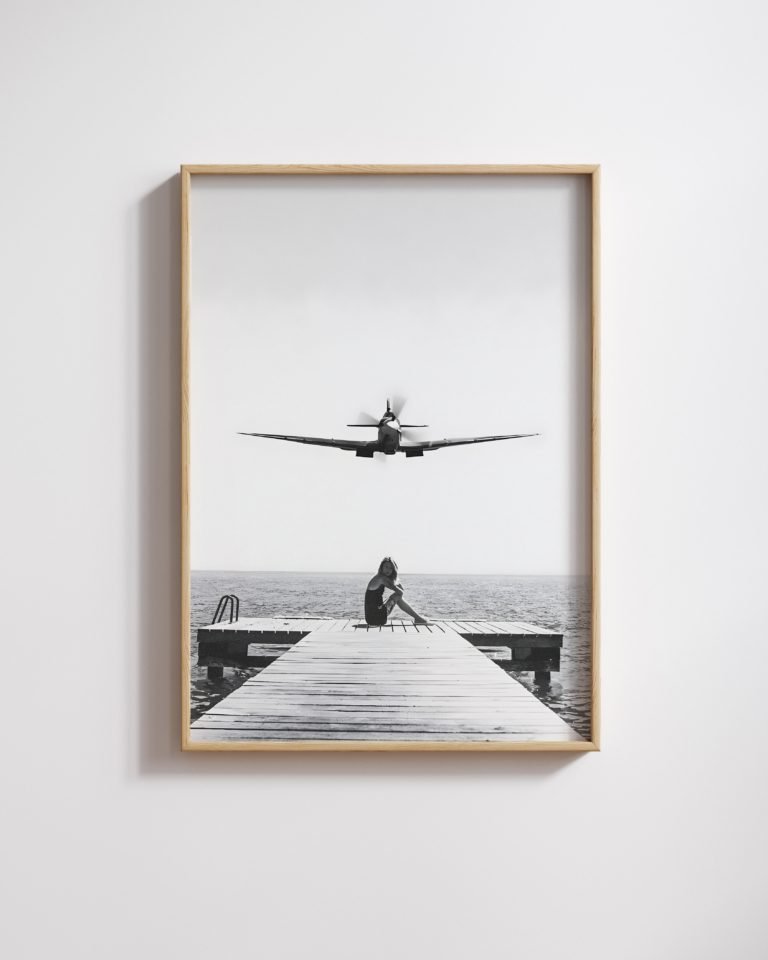
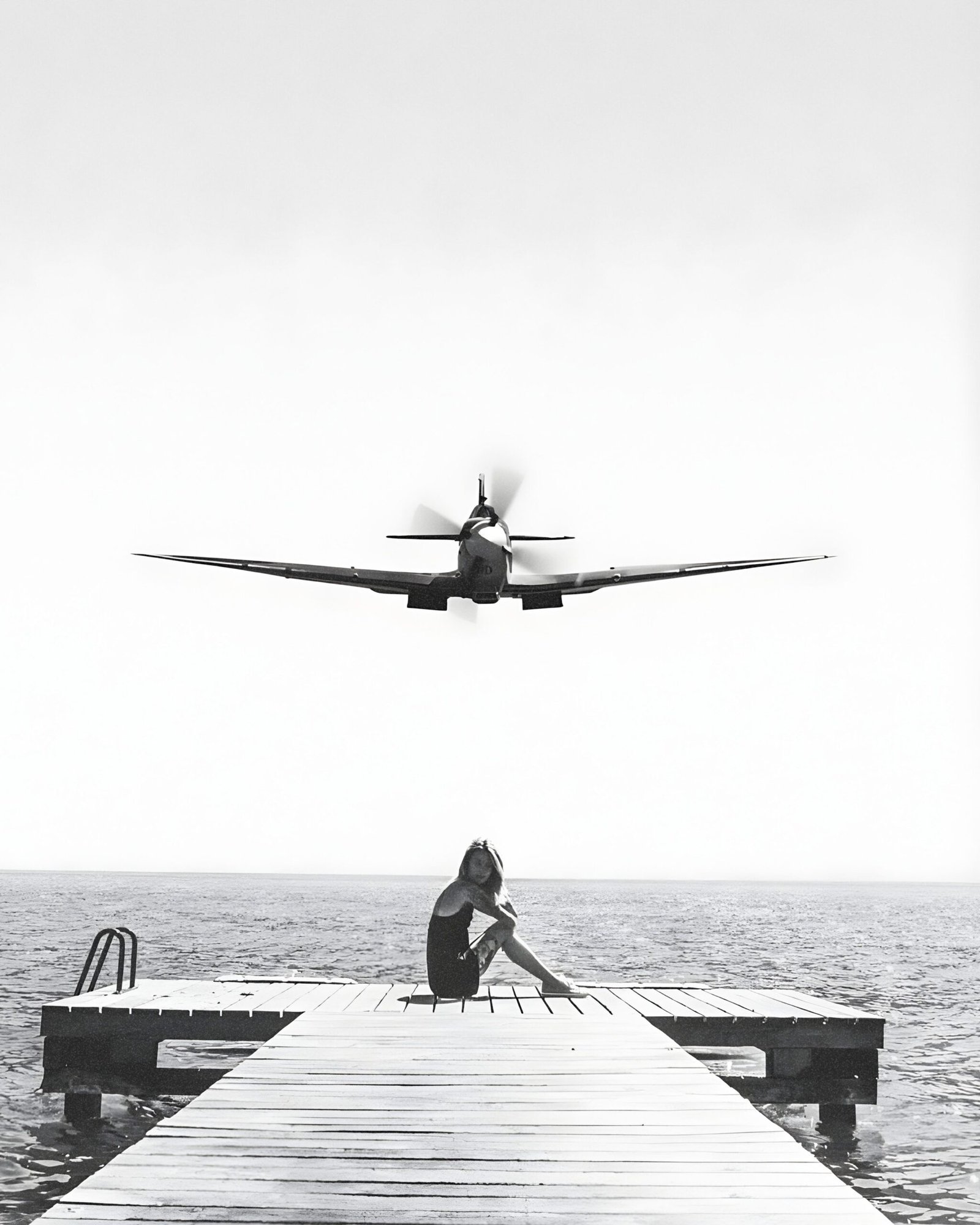
Dockside Daydream puts a Spitfire where you would normally see one — small, high, and going somewhere else — above a figure sitting on a dock. The aeroplane is the weather in that photograph rather than its subject, which is why it hangs in a room that is not a museum.
What we will not tell you is which mark it is, when it was taken, or what it is flying over. None of that is recorded in anything we hold, and a caption invented to sound authoritative is worse than no caption at all. The aircraft is documented to the last rivet. This photograph of one is not, and we would rather say so than guess.
It is printed on 200 gsm FSC-certified archival matte paper, pigment giclée at 300 dpi, made to order and on the press within 72 hours. Framing runs from 27 × 35 cm to 70 × 100 cm in solid wood, assembled by hand with the hanging hardware fitted.
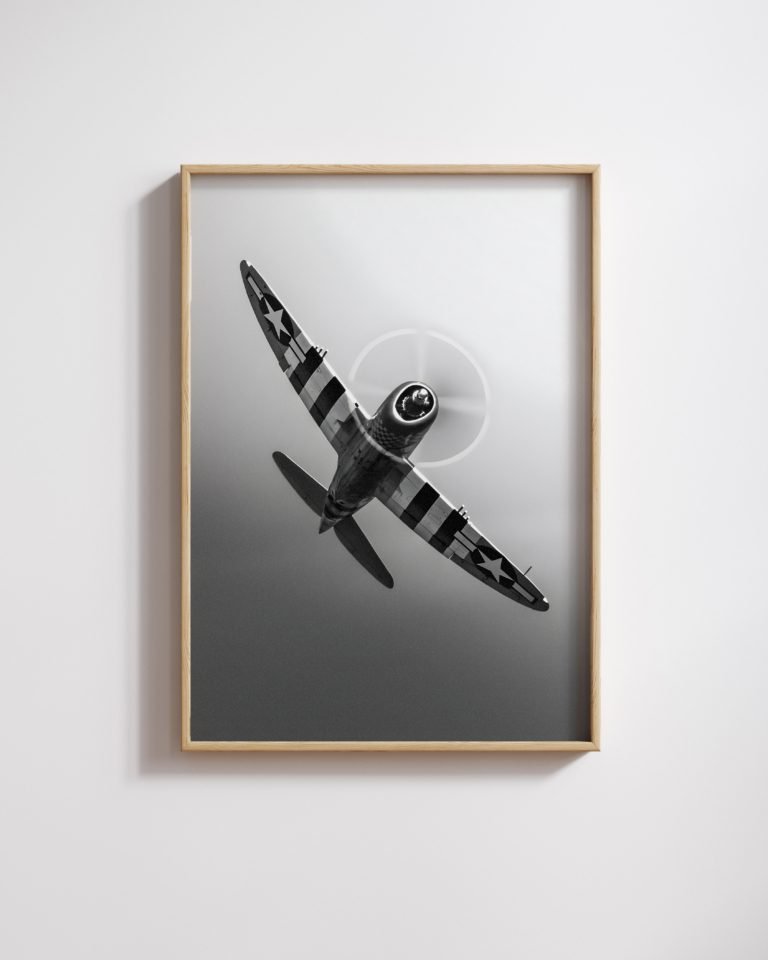
The other aeroplane in the collection answered the same design questions in almost the opposite way — that is why the P-47 Thunderbolt was so heavy. And if what draws you is a machine caught in the middle of a manoeuvre, the arithmetic of a turn is the same at ground level: how a racing motorcycle turns.
Common questions
Why was the Spitfire's wing elliptical?
Two arguments landed on the same answer. Lifting-line theory says an elliptical lift distribution gives the lowest induced drag, so the shape was fast. It was also an answer to a packaging problem: Beverley Shenstone called the ellipse simply the shape that allowed the thinnest possible wing with room inside for the structure, the guns and the undercarriage.
Did the elliptical wing really make the Spitfire faster?
The aerodynamic half of the case is not in dispute — NASA's teaching material credits the wing with giving the aircraft a very low amount of induced drag. But the shape was never only about drag. The section still had to be thin, roughly thirteen per cent thickness at the root and about nine at the tip.
Did the wing shape delay Spitfire production?
Badly. The precision the spar and the leading-edge structure demanded caused severe delays, and they got worse once the work was subcontracted to firms with no experience of metal-structured, high-speed aircraft. Most of it was cleared by June 1939, about fourteen months before the Spitfire was needed most.
Which mark of Spitfire is in the Dockside Daydream print?
We do not know, and we are not going to guess. Nothing we hold records the mark, the date or where the photograph was taken, and an invented caption would be worse than none. What the Dockside Daydream frame shows is a Spitfire small and high above a figure sitting on a dock.