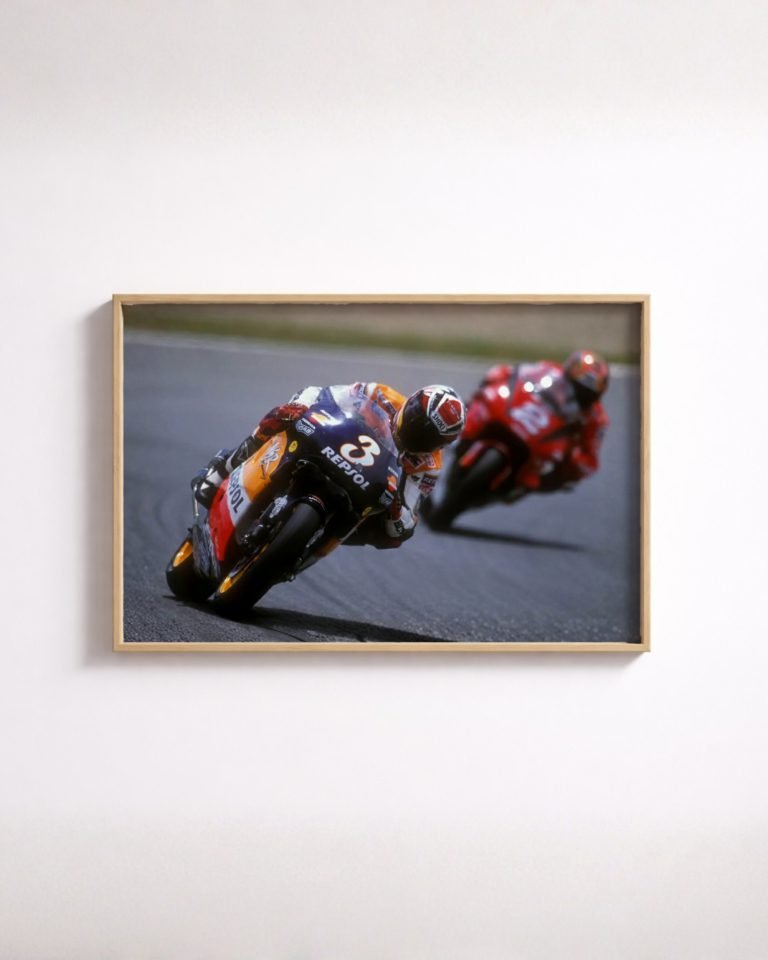
How a racing motorcycle turns looks, at full lean, like something held there by nerve. It is held there by arithmetic, and most of that arithmetic was settled before the corner began.
How a racing motorcycle turns: to go right, steer left
The single input that starts a corner is the one that looks wrong. To turn right, a rider must first steer left — briefly, and often by less than the eye can see. Joseph Fajans set this out in the American Journal of Physics in July 2000: steering a motorcycle is counterintuitive, and the turn is initiated by a counter-directed steering input.
The mechanism is not mysterious once you look at where the tyres are. A momentary steer away from the corner moves the front contact patch out from under the machine’s centre of mass. The bike then falls inward, and it keeps falling until the lean angle matches what the corner demands. The same paper is worth quoting for what it rules out: contrary to common belief, gyroscopic forces play only a limited role in balancing and steering. The spinning-wheel explanation everybody repeats is mostly wrong.
This matters for looking at photographs. By the time a bike is at full lean, the decisive input has already happened. Mid-corner is not the moment of decision. It is the readout of one.
The lean angle is not a choice
For an ideal banked turn, the angle is set by speed and radius alone: the banking angle equals the arctangent of v² / rg. That is standard physics — OpenStax’s University Physics gives it in the section on centripetal force, along with the detail that matters most here: the angle does not depend on mass. Aeroplanes make turns by banking for the same reason.
A leaning motorcycle is solving that equation with its own body rather than with the surface of the road. Which produces a conclusion most people find counterintuitive: two riders at the same speed on the same radius are at the same lean angle. Lean is not a measure of courage. It is a readout of speed and radius, and nothing else.

What separates riders, then, is not how far over they get. It is which radius they chose, when they chose it, and how long they are willing to stay there. (The equation above assumes a knife-thin contact point; a real tyre has width, so the true geometry is slightly more involved. The direction of the answer does not change.)
Why a later apex can be quicker
Read the same equation backwards and the racing line falls out of it. Turn in early and you describe a wide, even radius: less lean, more speed through the middle — and an exit that points off the edge of the track, so you are still turning at the moment you want to be accelerating.
Turn in later and the first half of the corner is tighter: more lean, less speed, and it feels slower because it is slower. But the exit radius opens up, the bike can be stood upright earlier, and power goes down sooner onto a straight that is longer than the corner ever was.
So the apex is a decision about where to spend radius, not a place on the tarmac. That is exactly why the mid-corner frame is the one worth photographing: the attitude of the machine at that instant tells you which decision was taken.

Hanging off, and what the knee is for
Moving the rider’s body to the inside shifts the combined centre of mass of bike and rider inwards, so the same corner at the same speed needs less lean from the motorcycle itself. Less lean means more of the tyre’s tread still under the machine, and more grip held in reserve. The posture is not theatre; it is a way of buying margin.
Where it came from is less settled than it is usually told. Motorcyclist records that the Finnish rider Jarno Saarinen introduced the knee-out style and that Kenny Roberts Sr popularised it — and RevZilla’s Common Tread has run a piece under the headline “Knee down — who was the first?”, which tells you the credit is contested rather than fixed. Treat it as a style that emerged in the early 1970s and became universal, and leave the first name to the people still arguing about it.
The knee itself is a depth gauge: it tells the rider how much lean is left. Protection was improvised long before it was manufactured — duct tape and cut-up plastic milk cartons — and dedicated sliders mounted to the suit with Velcro did not arrive until the 1980s. By the 1990s the slider was standard equipment rather than a bodge, which is one reason road-race photographs from that decade read as entirely modern in body position.
The print, and what we do not say about it
Apex Reverie is a road-race motorcycle mid-corner, and the listing records one thing about the era: the 1990s. It does not record the rider, the machine, the series or the circuit, and we are not going to name a championship on the strength of a paint scheme.
What the picture does record is a position — and it is the most informative position in the sport. Everything the rider decided is already visible in it, and nothing after it has happened yet.
It is printed on 200 gsm FSC-certified archival matte paper, pigment giclée at 300 dpi, made to order and on the press within 72 hours. Framing runs from 27 × 35 cm to 70 × 100 cm in solid wood, assembled by hand with the hanging hardware fitted. If you want the same physics with the traction taken away, the dune jump print is the other end of the same argument.
Two more places the same reasoning turns up: desert racing, where the corner stops being the point, and the Spitfire’s elliptical wing — an aeroplane in a turn is banking against exactly the same equation.
Common questions
Do you really steer left to go right on a motorcycle?
Yes, and it is the input that starts every corner. Joseph Fajans set it out in the American Journal of Physics in 2000: steering is counterintuitive, and a brief steer away from the corner moves the front contact patch out from under the centre of mass, so the machine falls inward. Often it is too small to see.
Does lean angle show how brave a rider is?
No. For an ideal banked turn the angle is the arctangent of v² divided by rg — speed and radius, and nothing else. It does not depend on mass either. Two riders at the same speed on the same radius are at the same lean angle; what separates them is which radius they chose.
Why do racers hang off the bike and put a knee down?
Moving the body inside shifts the combined centre of mass, so the same corner at the same speed needs less lean from the motorcycle itself — which leaves more tread under the machine and more grip in reserve. The knee works as a depth gauge, telling the rider how much lean is left.
What does the Apex Reverie print actually show?
A road-race motorcycle mid-corner, and the listing records only the era: the 1990s. It does not name the rider, the machine, the series or the circuit, and neither will we. What Apex Reverie holds is the most informative moment in the sport — every decision already taken, nothing after it yet.