Buying an art print as a gift puts you in an awkward position. The person buying a car or motorsport print is usually not the person who knows about cars. They know the recipient loves this stuff, and that is the whole brief. Everything below is written for that position, because it is a harder one than it looks and almost nothing online is written for it.
Three decisions, in the order that matters: size, framed or not, and subject. Size first, because it is the only one you cannot fix afterwards.
An art print as a gift: the size problem is the whole problem
You are choosing for a wall you have not measured, in a room you may not have stood in. There is no clever way round that, but there is a safe middle.
40×50 cm (15.7 × 19.7 in) and 45×60 cm (17.7 × 23.6 in) are the two sizes to default to. Both are large enough to be the thing on the wall rather than an ornament near it, and small enough to fit an alcove, a study, a hallway or the space above a desk without anyone having to rearrange the room. Both appear on every print in the catalogue, and both can be framed.

What to avoid unless you have actually seen the wall:
- A0 (84.1 x 118.9 cm — 33.1 × 46.8 in). Nearly a metre and a fifth tall. Magnificent in the right room and unusable in most, and the recipient cannot make it smaller.
- 13×18 and 20×25 cm. Handsome sheets, but at gift scale they read as a card rather than a picture, and neither can be framed.
If you genuinely do know the wall, the size guide has all seventeen sizes in centimetres and inches with the arithmetic for hanging above furniture.
Framed or rolled
A rolled print is a sheet in a tube. Somebody has to measure it, buy a frame, and fit it. That is a fine thing to give a person who enjoys doing it and an imposition on everyone else — a gift that arrives as a task is a gift that stays in the tube.
For most gifts, framed is the right answer: solid wood, assembled by hand, hanging hardware already fitted to the back, in Black, White, Wood or Dark wood. It comes out of the box and onto the wall the same evening, which is when you want to see the reaction.
Buy rolled when you know they frame things themselves, when they have a framer they use, or when the room has a scheme you would be guessing at. Note that framing runs from 27×35 cm to 70×100 cm, so five sizes have no frame option at all. Framed or rolled: which print to order sets out both sides.
Choosing the subject when they know more than you do
This is where a gift is won or quietly lost, and there are three rules that hold up.
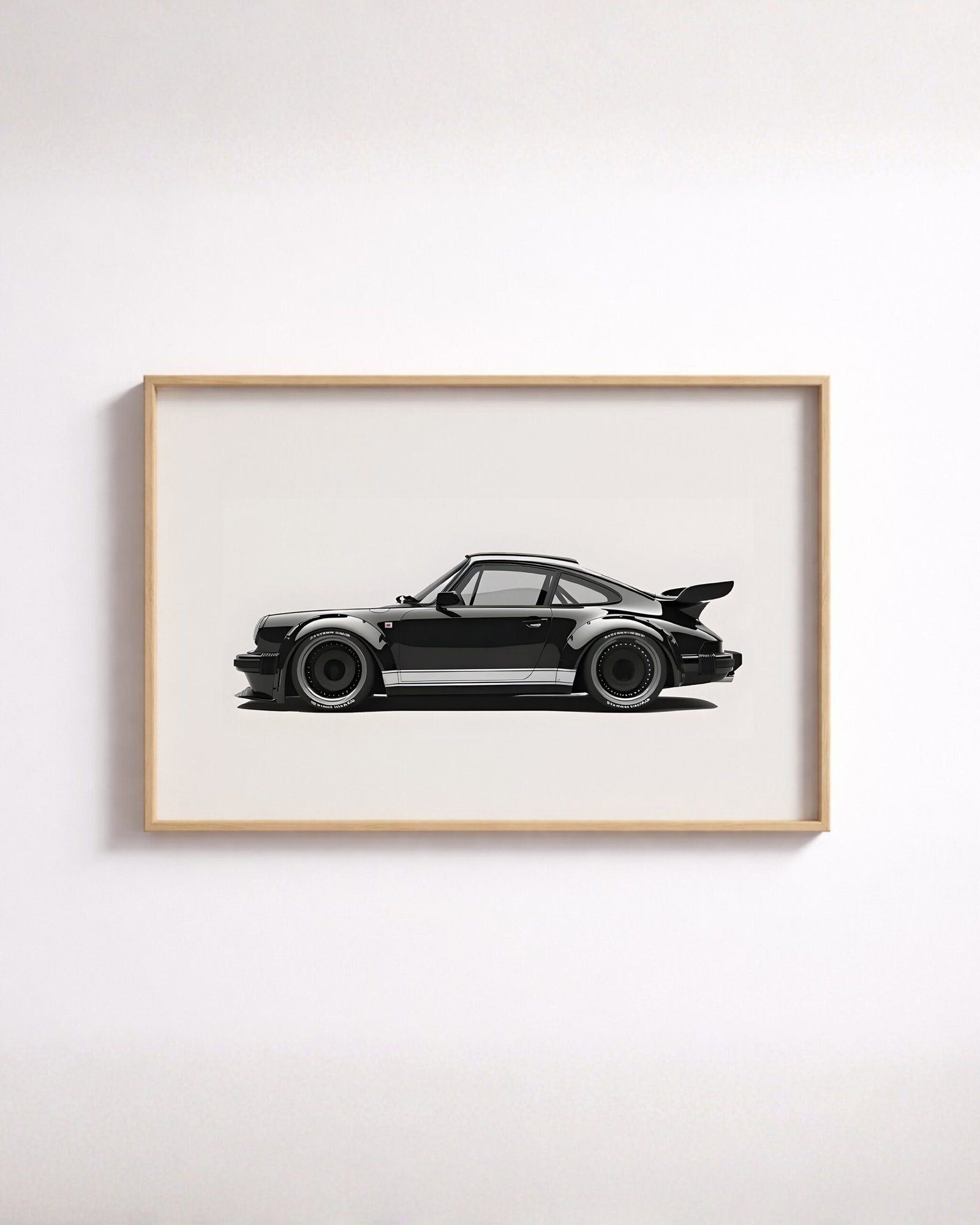
Buy the machine, not the badge. Somebody who owns an E30 wants an E30, not a BMW. Somebody who spent two years rebuilding a 930 wants the whale tail and the wide arches, not a generic silhouette. If you know what is in their garage, or what was, that is the answer and you can stop reading. The BMW E30 M3 print and the Porsche 911 Turbo (930) poster exist for exactly that person.

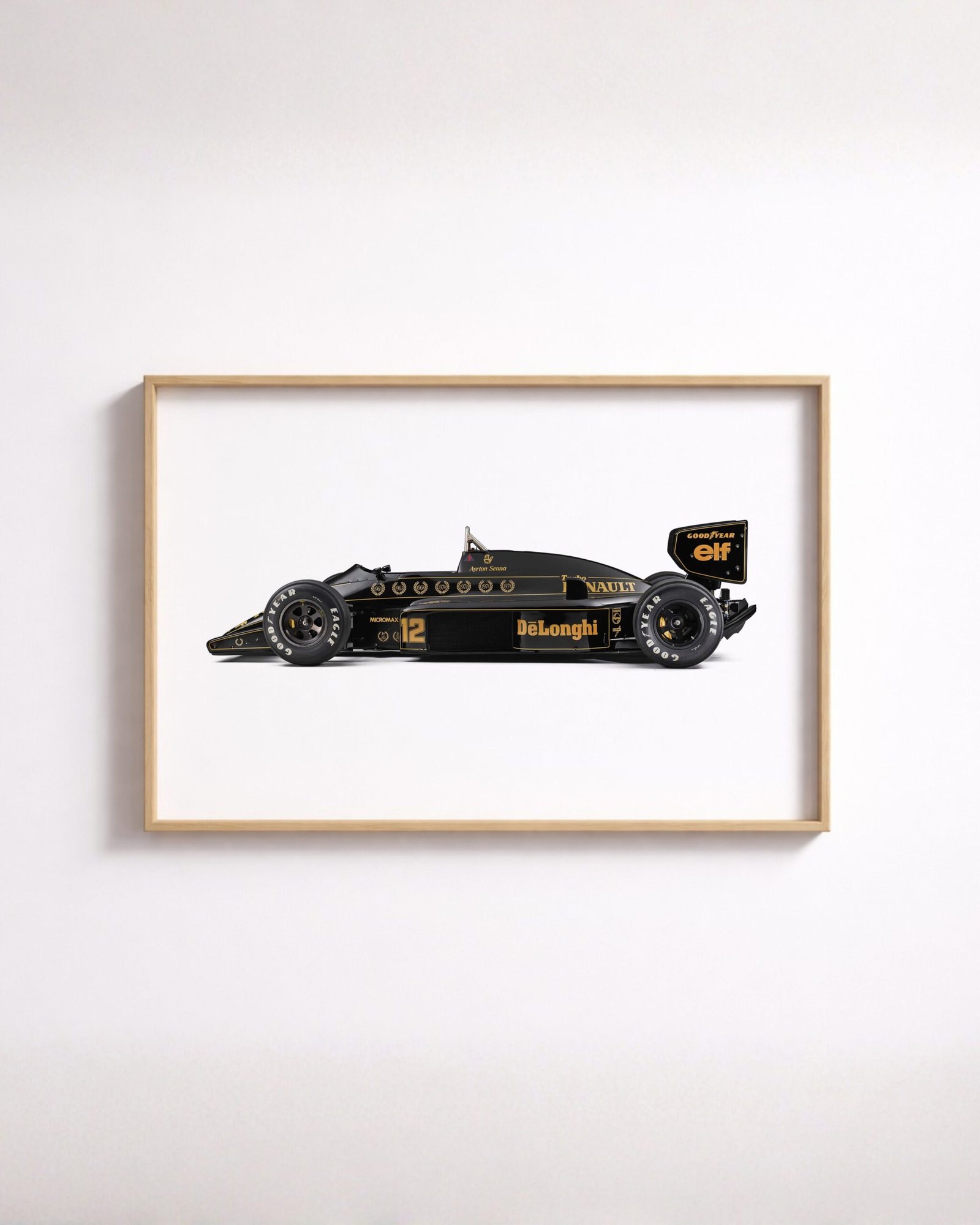
A specific moment beats a famous face. A driver portrait is a picture of someone they already know about. A named race is something they can tell you about, which is a different and better gift. Our Senna Lotus 97T print is the 1985 Portuguese Grand Prix — Estoril, 21 April, Senna’s first win in Formula 1, taken in torrential rain by 62.978 seconds over Michele Alboreto’s Ferrari, according to the sport’s own race results. That is a print with a conversation attached to it.

When you are not sure of the allegiance, buy the object. Driver and team prints require you to have guessed right, and getting it wrong is worse than being unadventurous. A machine does not carry that risk. The Mercedes 300 SL Gullwing poster, the 1967 Mustang print and the vintage Spitfire print are all safe with someone whose particular loyalties you do not know.
One more, practical rather than emotional: black and white sits in more rooms without an argument. Colour has to agree with the walls, the sofa and whatever else is hanging. Monochrome mostly does not.
Timing: work backwards, not forwards
Nothing here is stocked, because nothing is printed until it is ordered. Their copy does not exist until you ask for it. That is a good property for a gift and a bad one for leaving it late.
The sequence is: on the press within 72 hours, then 8 to 13 days tracked, shipping free and already in the price. Add those up and the realistic window is about two weeks from click to doorstep.
So order three weeks out and you have margin. Two weeks is tight. One week is a gamble, and there is no express option to buy your way out of it — free worldwide tracked shipping is what there is.
The one thing you cannot undo
You can change or cancel for 12 hours after ordering. A damaged, defective or incorrect print is replaced free: seven days to tell us, one photograph, nothing to post back.
A size chosen wrong is not covered, because the sheet was made for that order and cannot go back on a shelf there isn’t. This is the reason the size section is at the top of this page rather than the bottom.
If it helps to know what you are actually handing over: pigment giclée and 200gsm matte, explained covers what the paper and the ink are, and what nobody can honestly promise you about how long a print lasts.
Common questions
What size is safest when I have not seen the wall?
40x50 cm and 45x60 cm are the two to default to. Both are large enough to be the thing on the wall rather than an ornament near it, and small enough for an alcove, a study, a hallway or the space above a desk. Both appear on every print here, and both can be framed.
Will there be a price or an invoice in the box?
No. Orders ship with no invoice and no price slip inside, so nothing in the package tells the recipient what it cost. That also means it can go straight to their address without giving the game away, which is usually the part that worries somebody buying a present.
Can I add a gift message?
Not at checkout. A gift message has to be requested by email before you order, because it is added by hand rather than picked from a form on the site. Orders do arrive with no invoice or price slip inside, so a plain package is what turns up either way.
How far ahead should I order?
Work backwards. Nothing is stocked, so their copy is printed once you order: on the press within seventy-two hours, then eight to thirteen days tracked. That is roughly two weeks from click to doorstep. Order three weeks out for margin, because there is no express option to buy your way out.
How do I pick a subject for someone who knows more than I do?
Buy the machine rather than the badge, because somebody who owns an E30 wants an E30. A named race beats a driver portrait, since it is something they can tell you about. And where you are unsure of their loyalties, buy the object rather than the team and the risk disappears.