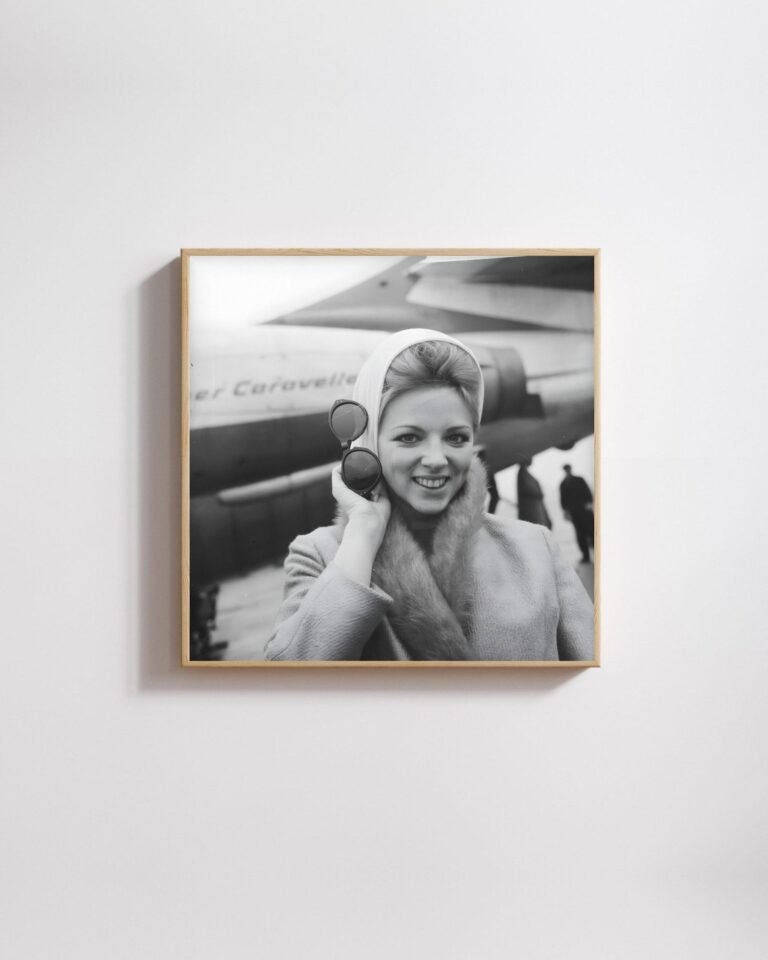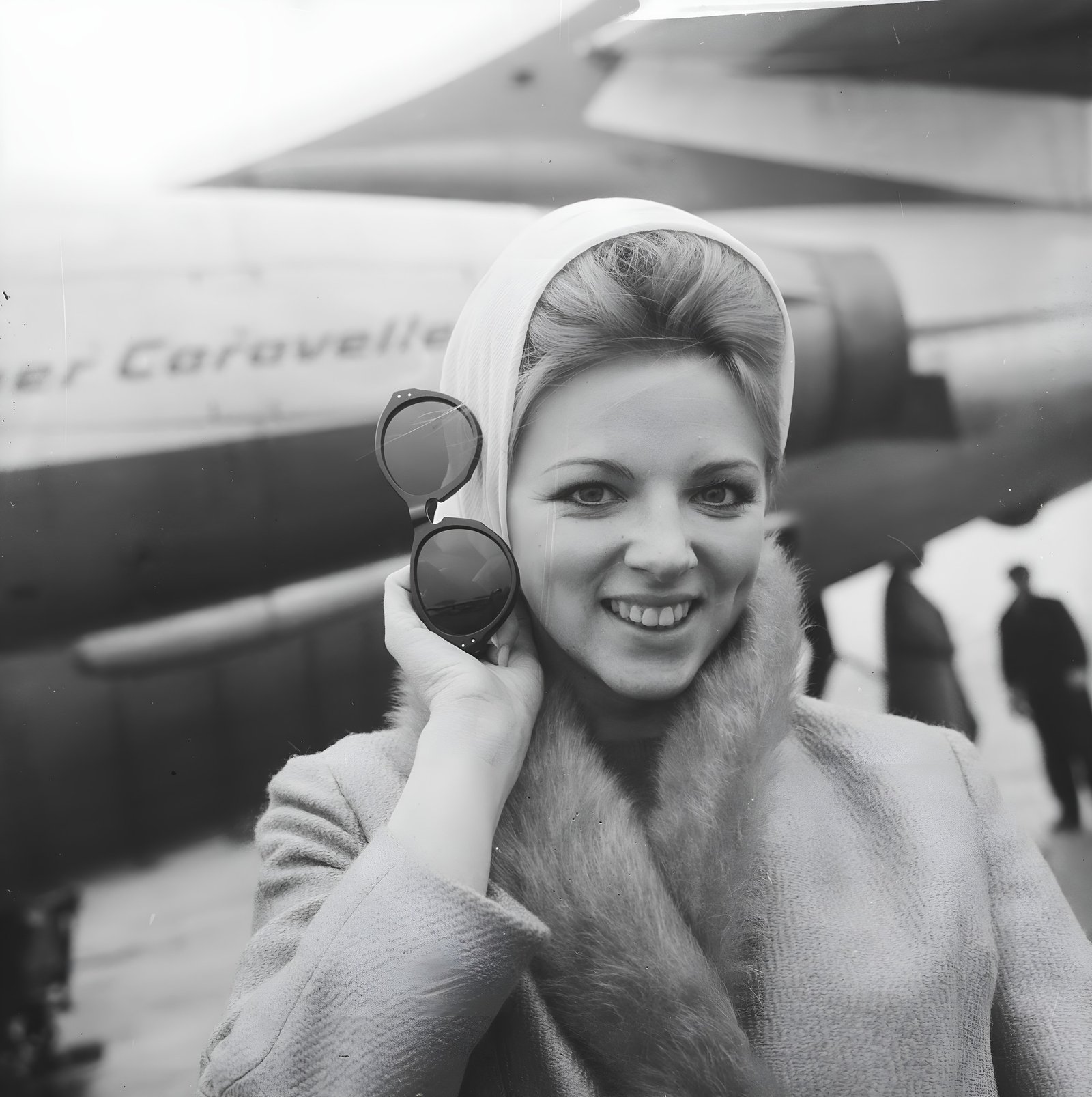
In 1965, the most reliable fashion show in the world had no runway, no tickets and a running time of about ninety seconds: it was the airport arrival. A star came down the aircraft steps, the press pack raised its cameras, and for the length of a walk across the tarmac, an outfit was judged by flashbulb. Our print Arrival in Fur, 1965 is the ritual caught at its brightest — a film star fresh off an airliner, wrapped in a fur-collared coat, a pale headscarf over her swept-up hair, holding her oversized round sunglasses up to one ear as she smiles straight into the lenses, the tail of the jet she arrived on filling the sky behind her.
Everything in the frame is the decade in miniature. The beehive under the scarf, the winged eyeliner, the big round sunglasses — round the size of saucers — the fur worn not for warmth but for punctuation. And behind it all, deliberately in frame, the aeroplane: the new jets had made arrival itself a glamorous act, and the stars of the sixties understood that the photograph began at the aircraft door. Dressing for a flight, in 1965, meant dressing for the cameras waiting at the bottom of the steps.
The agency photographers
The frame comes to us by a route worth telling. It was made by a photographer working for a national press agency — the Dutch agency whose staff covered everything from royal visits to football — and filed in the agency’s archive, where it slept for half a century. In the digital era the national archive that inherited those files made a decision of real consequence for photographs like this one: it released vast numbers of them under an open licence, free for anyone to print, publish and sell. A working press negative, shot on assignment and forgotten, became a piece of the common visual inheritance — which is how a ninety-second walk across a tarmac in 1965 can hang, legitimately and beautifully, on a wall today.
Agency photography has a particular honesty. Nobody art-directed this frame; the photographer had one chance, at the bottom of the steps, in flat northern light, and the charm of the picture is that its subject met him more than halfway. The sunglasses held to the ear — part wave, part prop, part shield against the bulbs — is the gesture of a professional who knew exactly what a press pack needed and enjoyed giving it. The smile is not for a film. It is for the ritual itself.
On the wall
Square, smiling and high-key, the print is a change of weather among the store’s darker frames — a bright picture for a dressing room, a bathroom or a sunlit hallway, anywhere a wall could use the sixties at their most cheerful. Its soft focus background of fuselage and tail gives it depth without clutter, and the fur’s texture is a small pleasure of the matte print at close range. The poster sizes chart shows the sizes against a standard wall.
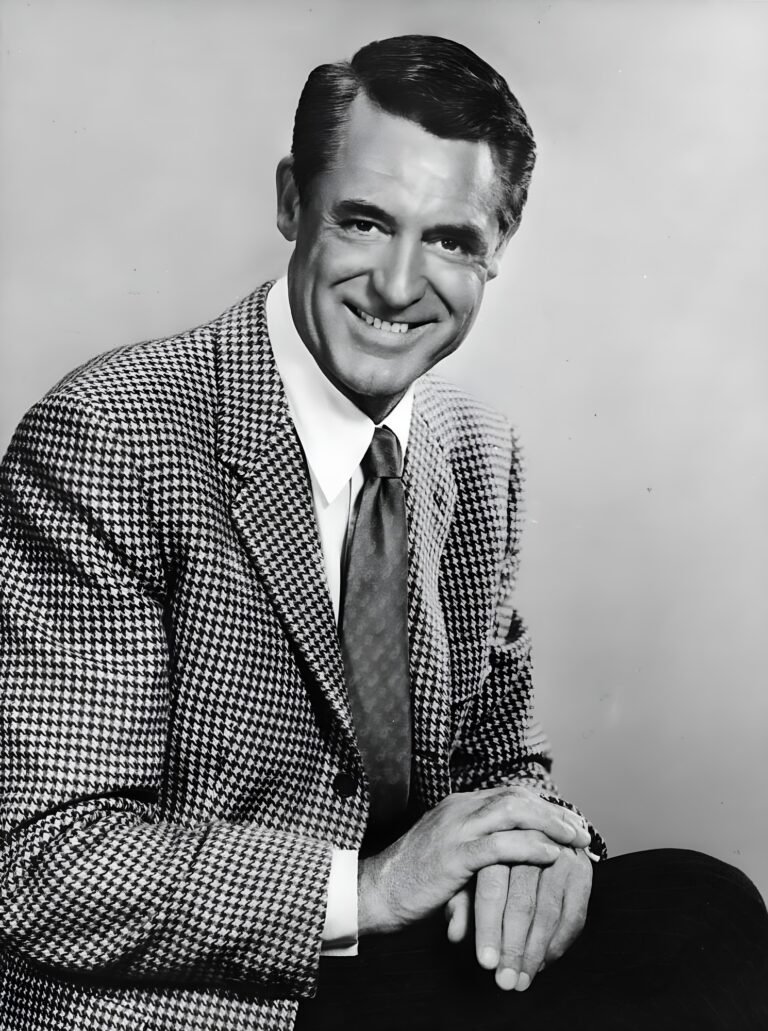
Its companions write the era’s other chapters: Studio Portrait in Evening Dress, 1958 is the same fame photographed formally seven years earlier, seated and tailored; and the hypercar beneath a private jet at dusk brings the aeroplane back into frame as pure machine. Between them — the arrival, the portrait, the jet — hangs a small history of how the twentieth century learned to travel beautifully.
The archive release deserves a final word, because it changed what a photograph like this can be. For decades the frame existed to be looked up, not looked at — filed, catalogued, effectively invisible. Open licensing returned it to circulation as a picture rather than a record, and pictures, unlike records, get to be loved. On a wall, in a frame, it resumes the work it was always best at: making an arrival feel like an occasion.
Photograph: Jack de Nijs / Anefo, Nationaal Archief — CC0. Source: the holding archive.
Common questions
What is she arriving from?
An airliner, in 1965 — the jet age's most glamorous ritual. A film star comes down the steps in a fur-collared coat and headscarf, sunglasses in hand, smiling for the waiting press. Airports then were theatres and arrivals were performances; this frame catches the performance at its most practiced and most pleased with itself.
Why does the photograph feel so bright?
Because it is a flash of daylight in a collection with a lot of beautiful darkness — tarmac light, a white aircraft behind her, a smile doing the rest. Hung among the moodier pieces it behaves like a window; hung alone it is pure mid-century optimism.
Where does it hang?
Dressing rooms and hallways — anywhere a bright, fashionable piece is wanted. It is also a natural gift for anyone whose style references stop, correctly, somewhere around 1965.
How is it made?
Archival pigment giclée at 300 dpi on 200gsm FSC-certified matte paper, made to order in about 72 hours and shipped free, tracked, worldwide. Framing in four finishes, with an optional white mat, on the middle and larger sizes.