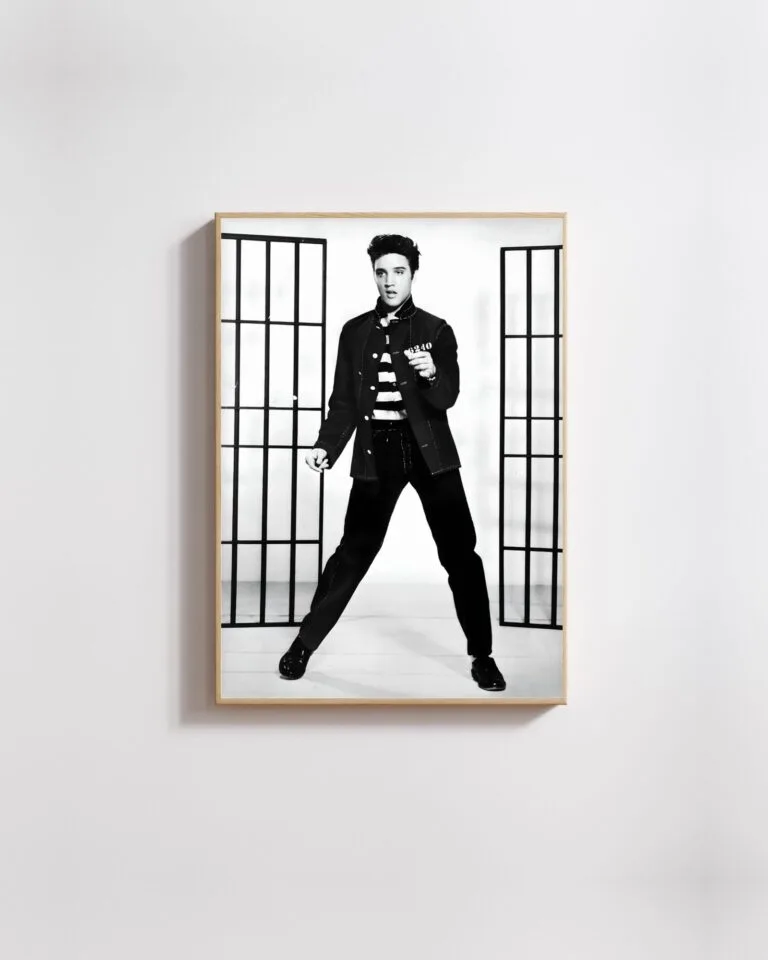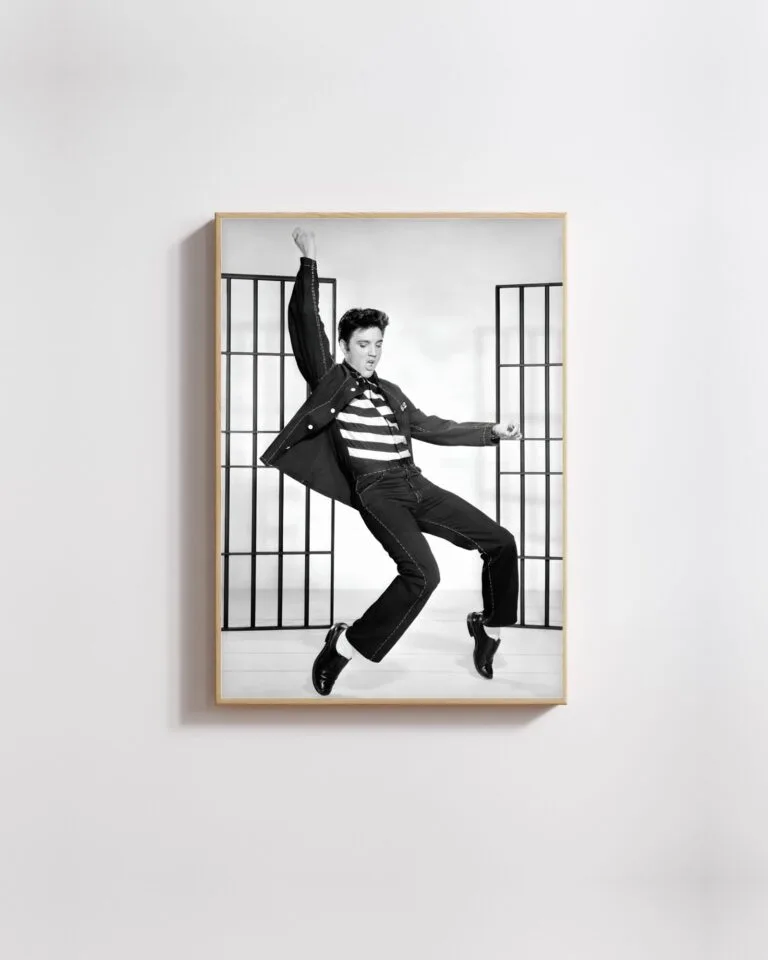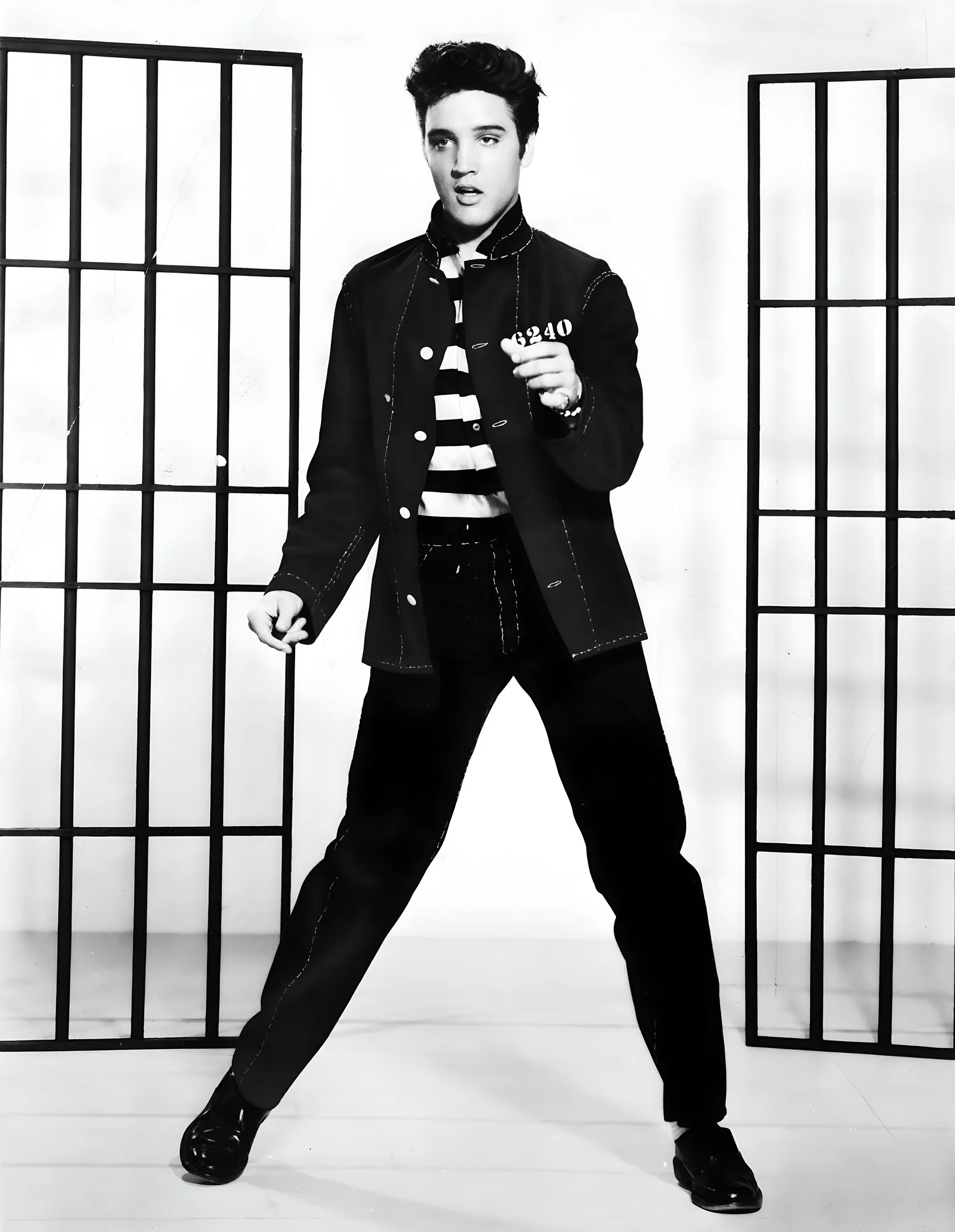
Every famous action photograph casts a shadow still — the frame the studio knew would work in a newspaper column, at lobby-card size, in a fan magazine at arm’s length. Our print The Jailhouse Portrait, 1957 is that frame: the young singer from the era’s defining dance production standing between the cell bars in his striped shirt and numbered jacket, feet planted wide, shoulders square, one hand extended toward the camera and pointing straight down the lens. No leap, no motion blur, no chorus. Just the stare the decade would remember.
A pointed finger is the oldest device in portraiture’s rhetoric — it breaks the picture plane and addresses the viewer personally: you. In 1957, aimed at the teenage audience the studios were only beginning to understand, it landed exactly as intended. The portrait says the quiet part of the production’s whole appeal: this is not your parents’ musical, and the young man in the striped shirt is not asking permission. Publicity departments printed the frame by the thousand, and it did its work in shop windows and magazine pages across two continents.
Two frames, one production
The portrait was made on the same set, in the same costume and almost certainly in the same session as the production’s famous dance stills — and the pairing is instructive, because it shows the studio system’s publicity machine thinking in complete sentences. The dance frame supplies the verb: the leap, the rhythm, the spectacle. The portrait supplies the subject: the face that a fan could pin up and know. Newspapers took the portrait; the culture, in the long run, kept both — and they remain the twin documents of how a single film performance was converted, by photography, into a permanent piece of iconography.
Notice, too, the craft of the lighting. Unit stills were made fast, between takes, with the production’s own lamps — yet this frame is lit like a considered portrait: the face modelled, the dark jacket held just off the white ground, the bars kept perfectly graphic. The singer’s expression does the rest, caught between invitation and challenge, which is precisely the register the whole production was pitched in. It is a performance of attitude so complete that the still threatens to out-act the film.
Hanging the stare
As wall art, the portrait is pure graphic force — black denim, white ground, the ruled lines of the bars — and it behaves like a poster in the best sense: it reads from across a room and rewards you at reading distance with the expression. It suits a study, a music room or a collector’s wall of cinema frames, anywhere directness is welcome. The poster sizes chart shows the sizes against a standard wall.
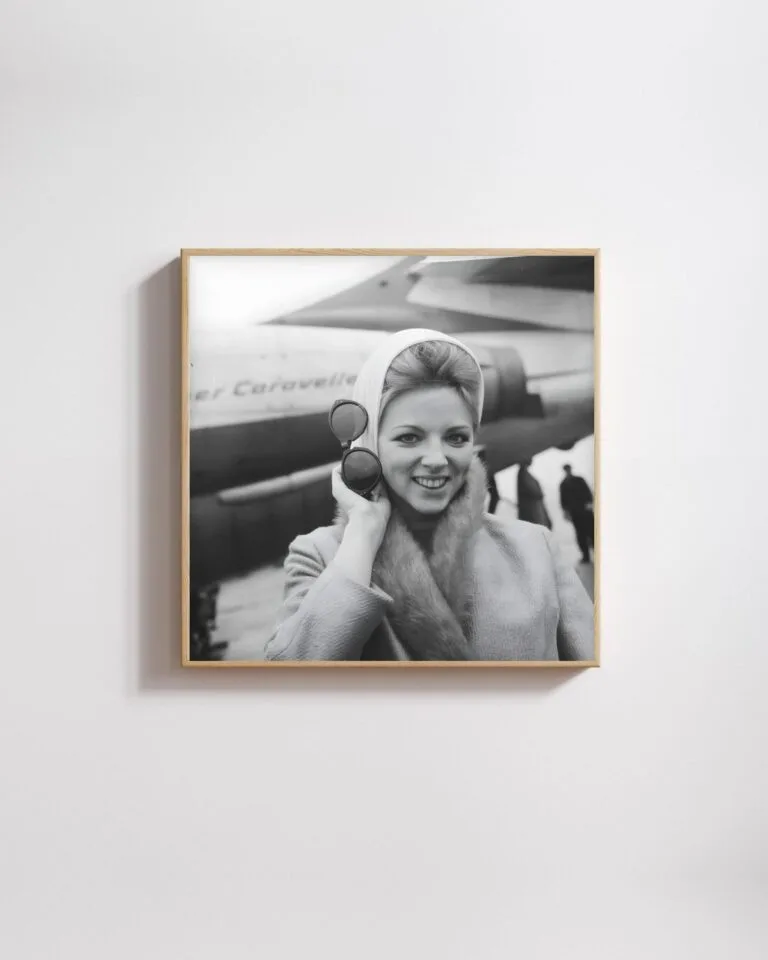
Hang it with its twin and the story completes itself: The Jailhouse Dance, 1957 supplies the motion this frame withholds. For a third voice from the same store’s era of composed portraits, The Muse and the Roadster brings the female counterpart — another sitter who understood that the camera is not observed, but addressed.
The portrait’s survival is owed to an archive rather than a fan. The negative passed into the national library’s collection, catalogued and preserved among the permanent records of American popular culture — an unlikely honour for a lobby still, and a just one. Publicity photographs were the folk art of the studio system, made fast, printed cheap and thrown away by the ton; that this one was kept, in a form that still prints with such snap a lifetime later, is the archive’s judgement on the frame, and it is hard to argue with. The stare outlasted the system that commissioned it.
Photograph: MGM / Library of Congress (LC-USZ6-2067) — Public domain (photograph). Source: the holding archive.
Common questions
How does this portrait relate to the dance frame?
They are twins from the same 1957 production. The dance frame is the leap; this is the stare — the young singer standing between the stylised cell bars, pointing straight at the camera. One is the performance everyone remembers; the other is the attitude that made the performance dangerous.
Why does the pointing gesture work so well as a print?
Direct address again — the oldest trick in portraiture. He is not performing for an audience in the scene; he is picking you out of it. At wall scale the point lands at conversational distance, and the portrait behaves less like a photograph of someone and more like an introduction.
Which size suits it?
It is a portrait and wants portrait treatment: 30×40 or 40×50 cm puts the stare at life-ish scale. Hung beside the dance frame at the same size, the pair reads as one work in two panels.
How is it printed?
Archival pigment giclée at 300 dpi on 200gsm FSC-certified matte paper, made to order in about 72 hours and shipped free, tracked, worldwide. Framing in black, white, natural or dark wood on the middle and larger sizes.