A Mercedes 300 SL poster is, in this catalogue, a choice between two photographs of the same car in the same colour scheme — and the pictures could hardly be less alike. One has a single door raised and reads as a study of an object. The other has both doors up in open country and reads as a landscape that happens to contain a car. Knowing why the doors are the deciding feature makes the choice quicker.
The doors are structural, not styling
This is the part that reframes both pictures. Wikipedia’s entry on the Mercedes-Benz 300 SL records the car under chassis code W 198, built as a gullwing coupe from 1954 to 1957 and as a roadster from 1957 to 1963, and traces it back to the 1952 W194 racing car.
The important sentence is about the frame. The tubular structure produced an unusually high and wide door threshold, and an upward-opening door was the only option that would let anyone climb over it. The most photographed feature of one of the most photographed cars ever built is a workaround.
Two further details from the same record are worth carrying into the picture. The coupe’s side windows are fixed — they do not roll down. And the car was introduced at the February 1954 New York International Auto Show rather than at Frankfurt or Geneva, where the company normally launched, with production starting at Sindelfingen that August. Bosch, separately, documents its own part in bringing gasoline injection to production cars, which is the other half of why this car mattered mechanically rather than visually.
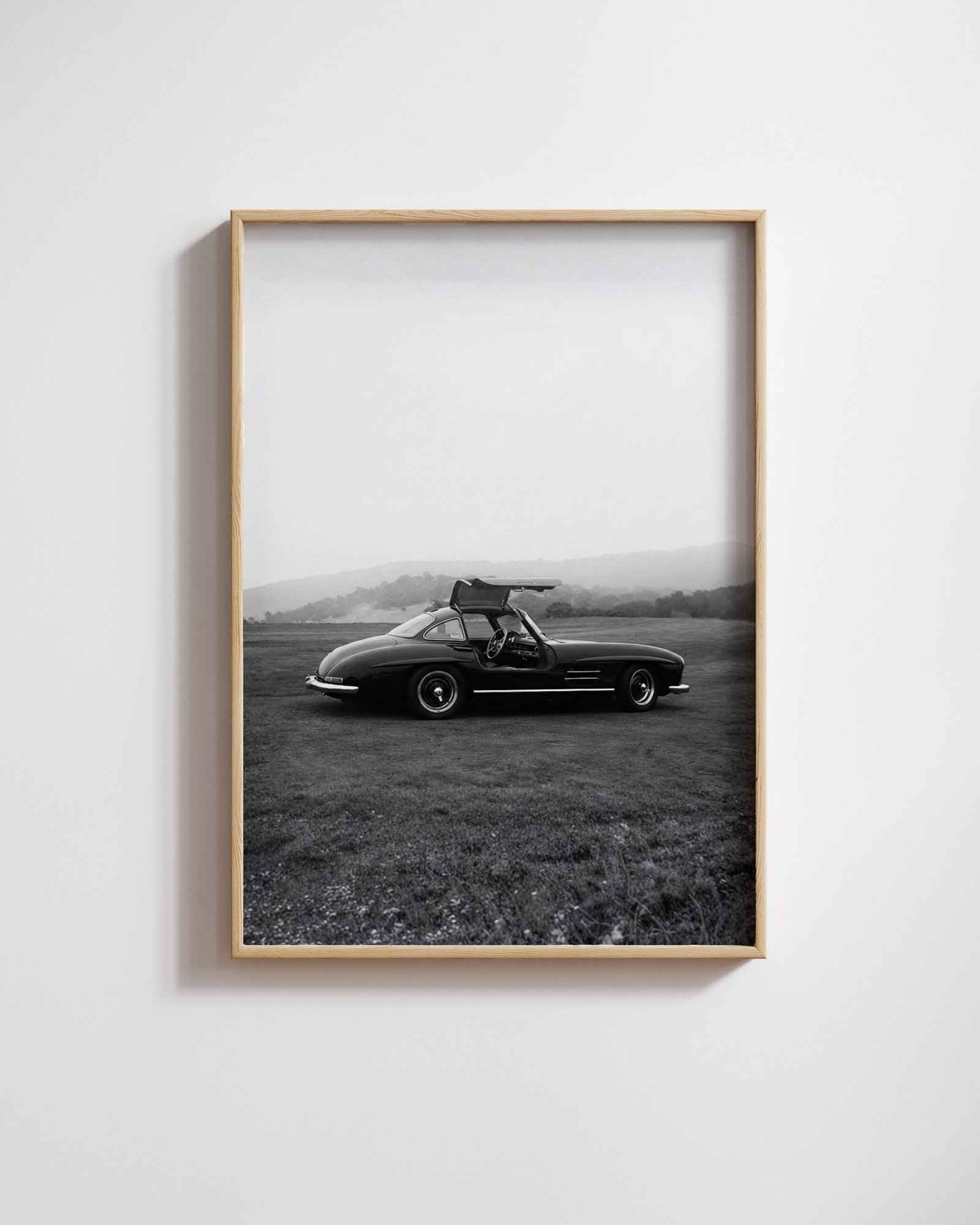
One door up
The single-door poster is the closer of the two. The car fills the frame, one door is raised, and the monochrome treatment does what monochrome does to chrome: it turns brightwork into line rather than colour.
This is the version that behaves like a product photograph in the best sense. Every curve is legible. The door is doing its job in the composition — it breaks the roofline and puts a diagonal into an otherwise very horizontal car. If you want the picture to be about the car, this is the one.
Both doors up
The two-door 300 SL wall art print puts the car in a field at dusk with both doors raised. The car is smaller in the frame, the light is lower, and the shape reads as a silhouette rather than as a set of surfaces.
It is the more atmospheric picture and the more demanding one. It wants a wider wall, and it wants to be seen from a little further back — close up, there is less detail to reward you. Hung well, it is the piece that a visitor who does not care about cars will still stop at.
Choosing between the two Mercedes 300 SL poster options
A short way to decide:
- You want the car. One door. Closer crop, more legible surfaces, more obviously a portrait of a machine.
- You want the mood. Two doors. Wider, quieter, more landscape than object.
- You have a narrow wall. One door.
- You have a broad wall and other monochrome work already up. Two doors will sit into that group more comfortably.
Neither picture carries a date or a place from us. We know what the car is because the shape identifies it; we do not know when or where the photograph was taken, and we do not print a caption that implies we do.

Why monochrome suits this car specifically
Some cars lose something in black and white. This one gains. The 300 SL’s identity is almost entirely in its section — the roofline, the wheel arch curve, the crease down the flank, the brightwork edging the wings. None of that depends on paint colour. Removing the colour removes the only variable that dates the picture to a particular restoration, and leaves the shape.
It is also worth knowing how to tell what you are looking at, because the 300 SL had two quite different bodies. The gullwing coupe ran from 1954 to 1957; the roadster that replaced it ran to 1963 and has conventional doors. In a photograph the giveaway is not only the door but the glass: the coupe’s side windows are fixed and do not roll down, so a car with a raised door and a sealed flank is the coupe. Both pieces here are the coupe.
It also makes the print easier to live with. A black-and-white frame joins whatever else is monochrome on the wall instead of announcing itself as automotive decor. If you want to go further into how tonal range behaves on a matte surface, we have written about that separately.
The engineering, if you want it
The full story of why those doors exist — and what the frame beneath them was for — is in our longer piece on why the gullwing doors had to open upwards. It is the article to read before you buy, because it changes what you notice in the picture: once you know the sill is the reason, the raised door stops looking theatrical and starts looking inevitable.
Both posters are made to order and ship worldwide at no extra cost, so there is no availability argument pushing you toward one. It is purely a question of which photograph you want on the wall.
Common questions
Why do the doors open upwards?
Because of what is underneath them. The 300 SL used a tubular frame that produced an unusually high, wide sill, and an upward-opening door was the only arrangement that let anybody climb over it. The shape everybody photographs is a structural consequence, not a styling decision.
Which 300 SL poster should I choose?
The one-door piece is the closer, more product-like study, and it is the one that reads as a car. The two-door piece in open country is more of a landscape with a car in it, and it wants a wider wall. If the door shape is the reason you want the picture, either works; if the setting matters, they are quite different pictures.
Is the coupe or the roadster in these pictures?
Both pieces show the gullwing coupe, which Wikipedia dates to 1954 to 1957. The roadster that followed it, from 1957, has conventional doors and is a different silhouette entirely.
Will a black-and-white car poster work in a living room?
More easily than a colour one. Stripped of paint colour, the 300 SL reads as a set of curves and a chrome line, and it will hang next to unrelated monochrome work without turning the wall into a car theme.


