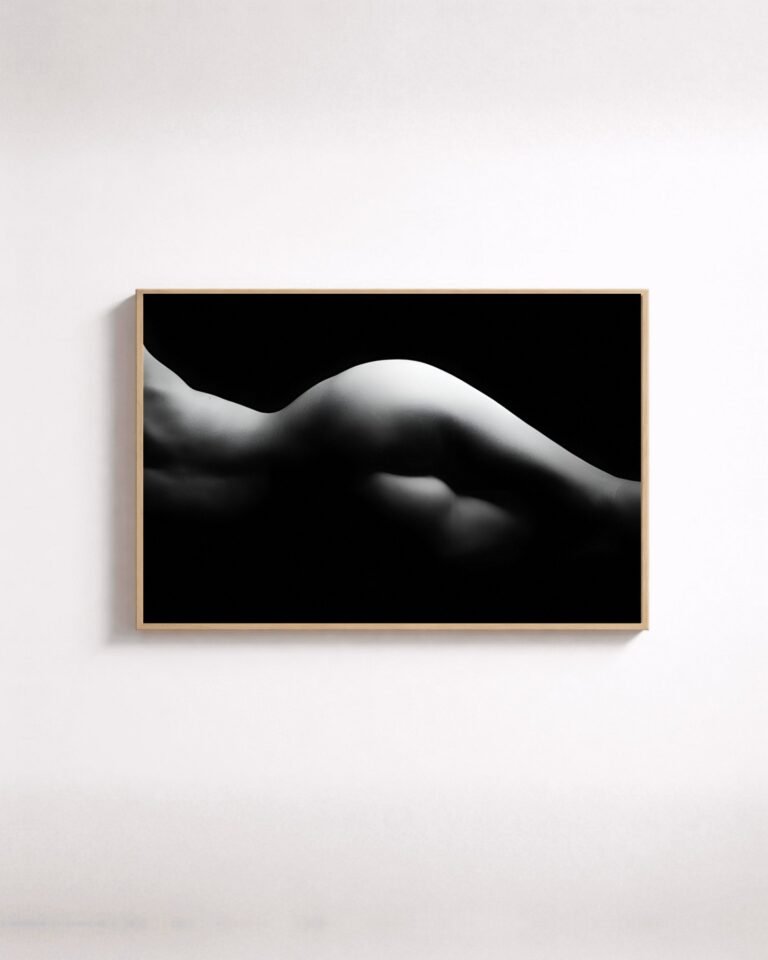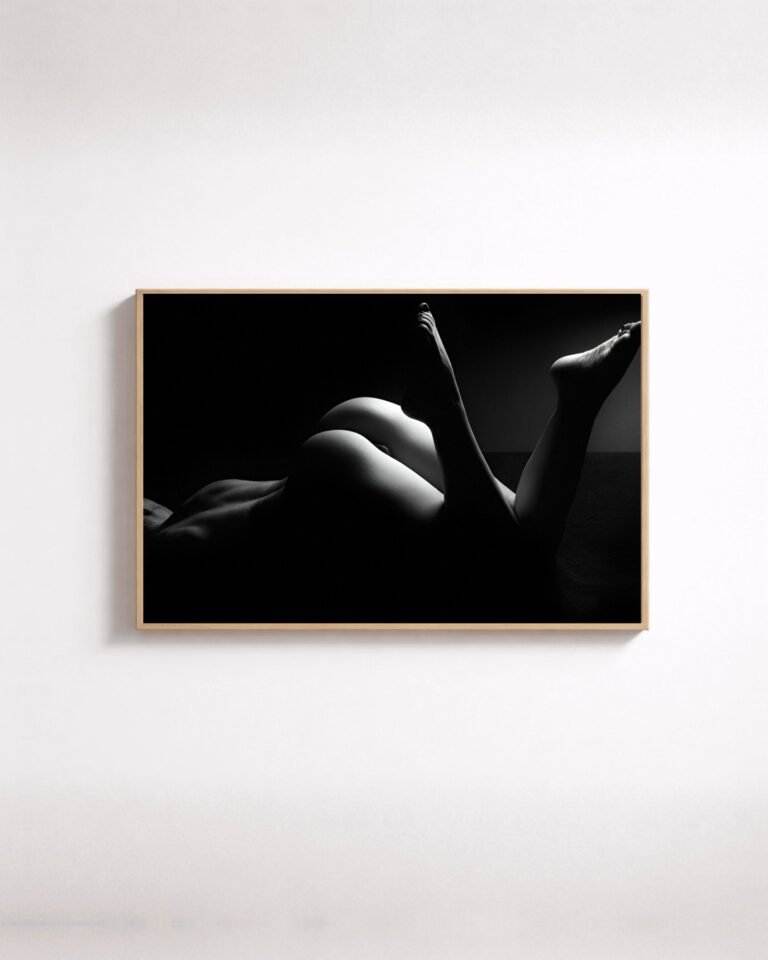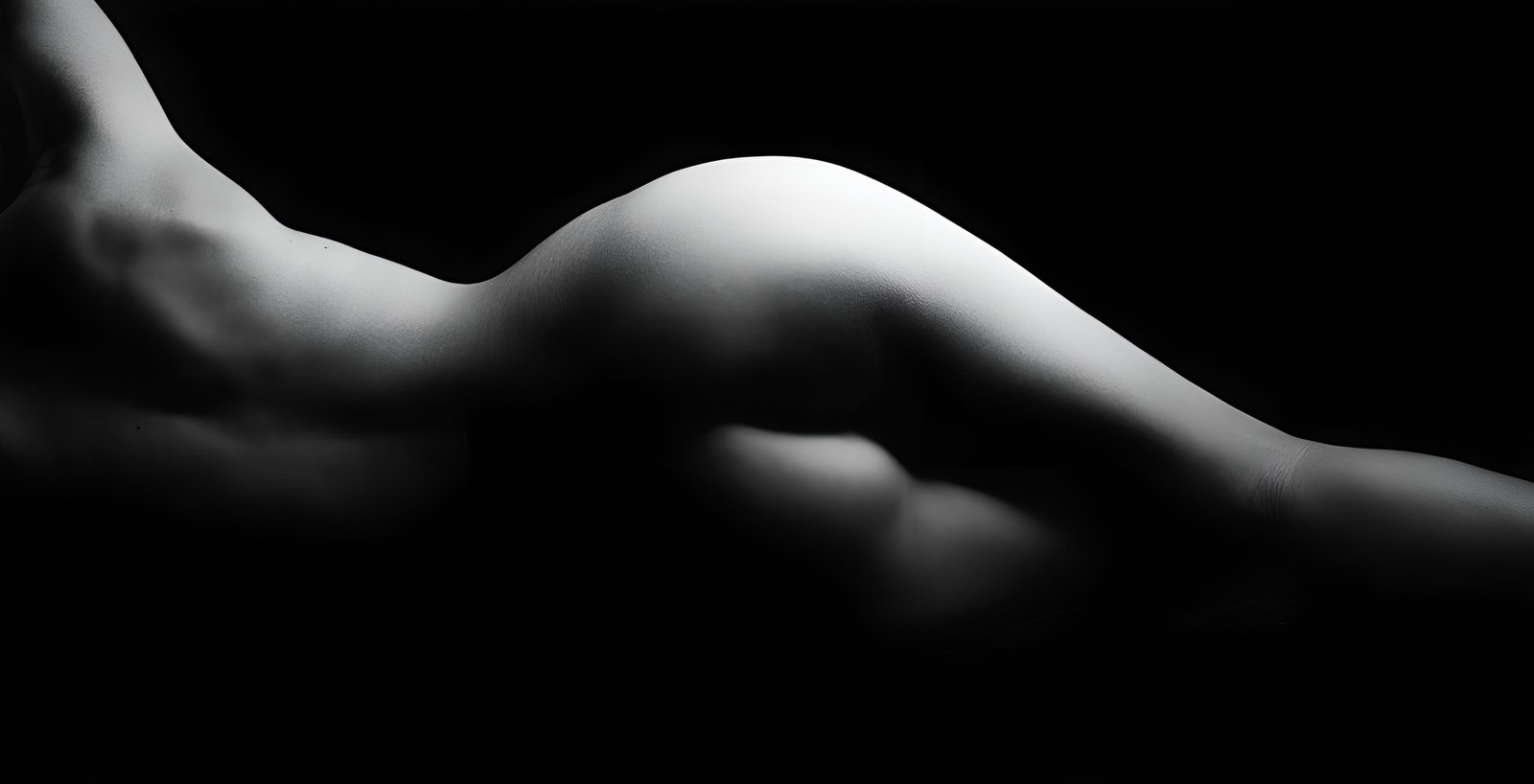
Squint at this photograph from across the room and you will not see a body at all. You will see a dune: one long bright ridge rising out of darkness, cresting, and falling away in a smooth diagonal to the edge of the frame. Only when you walk closer does the dune resolve into what it is — the curve of a woman’s waist flowing over her hip, her leg extending out of the picture. The photograph was designed to work at both distances, in both readings.
That double life is the point of our print Hips in Shadow. It is a bodyscape, the most abstract branch of figure photography, in which the body is cropped so tightly — no head, no hands, no room, no context of any kind — that it stops being a portrait and becomes terrain. What remains is a horizon line, a gradient of light, and the viewer’s own recognition arriving a half-second late.
Why photographers crop the body into landscape
The bodyscape is nearly a century old, and it began as an argument about looking. Photographers of the modernist era discovered that if you removed everything that identifies a person, the body became pure form — and pure form could be judged the way a landscape is judged, on line and tone alone. A waist became a valley. A hip became a hill catching first light. The erotic charge did not disappear; it went underground, into the viewer’s memory of what the shape actually is.
This print pushes that argument to its limit. Two thirds of the frame is black — not grey, not shadowed detail, but a deep, clean black that behaves like the night side of the dune. The lit curve occupies a single rising band across the middle, brightest at the crest of the hip where the light lands almost white, then dimming along the leg as it leaves. There is a second, fainter curve low in the darkness, like a reflection in still water. Composition textbooks call this economy. Photographers call it nerve: the willingness to leave almost everything out.
Abstraction with a pulse
What keeps the picture from being merely an abstract is the skin itself. At reading distance the surface is alive with fine detail — the grain of it, the faintest texture along the crest, the softness where light rolls over rather than strikes. A real dune is wind made visible. This one is breath made visible, and the difference is why guests stand in front of it longer than they expect to. They came to look at a shape. They stay because the shape is a person.
That is also the answer to the obvious question — is it appropriate for a shared room? Precisely because the crop is so complete, the print reads in company as form first. It has hung, in spirit, above sofas and beds in collectors’ homes for as long as the genre has existed, causing no more comment than a landscape would, and considerably more admiration.
Hanging a wide, dark print
The panoramic crop decides the placement for you: a long, low wall. Above a bed is the classic choice, the bright ridge echoing the horizontal of the headboard; above a low sofa is the second. Give it air — this is not a picture to crowd into a gallery wall, because its power is the amount of nothing around the something. A slim frame and a pale mount will hold the edge crisply on a light wall. Check your wall against the poster sizes chart before ordering; wide prints deceive the eye about scale until they are unrolled.
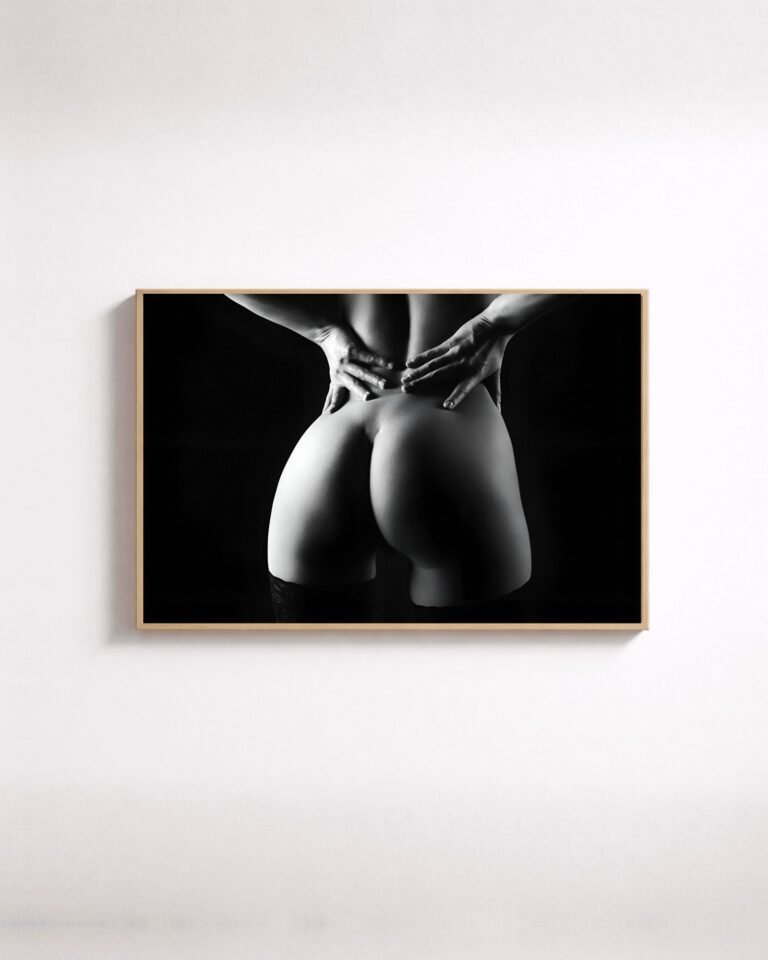
Within its own wave it completes a trio: the held stillness of Bare Back in Soft Light, the playfulness of Legs Against the Wall, and this, the landscape. Bought together they argue the whole case for the figure study in three frames. Bought alone, this one argues the quietest and strangest part of it — that a body, seen closely enough, becomes a place.
Preguntas frecuentes
Why call it a bodyscape?
Because the photograph crops the body the way a landscape photographer crops a dune: the curve from waist to hip rising out of black, in a wide panoramic frame, with no face and no context to make it a portrait of anyone. It is geography, not biography — the wide format is the whole idea.
Where does a panoramic print like this go?
Above a bed or a low sofa — long furniture wants long art. The panoramic sizes give the curve its horizon; hung centred over a headboard it behaves like a headboard's landscape, calm and entirely self-possessed.
Is the treatment explicit?
No. The study works by shadow and crop; what is shown is a curve and a fall of light. It sits in the collection's boudoir line — fine-art figure studies, age-gated on the site, printed and framed like everything else we make.
How is it printed?
Archival pigment giclée at 300 dpi on 200gsm FSC-certified matte paper, each size cropped from the master to its true proportions so the horizon of the curve stays where the photographer put it. Made to order in about 72 hours; free tracked shipping worldwide.