Ask anyone to picture four friends in the city and they will give you the famous version: four women in heels, mid-crossing, traffic politely frozen around them. It is a great image. It is also a lie of omission, because the crossing takes ten seconds, and the friendship takes place somewhere else entirely — indoors, at a table, in the hour when the shoes are off and the conversation finally starts.
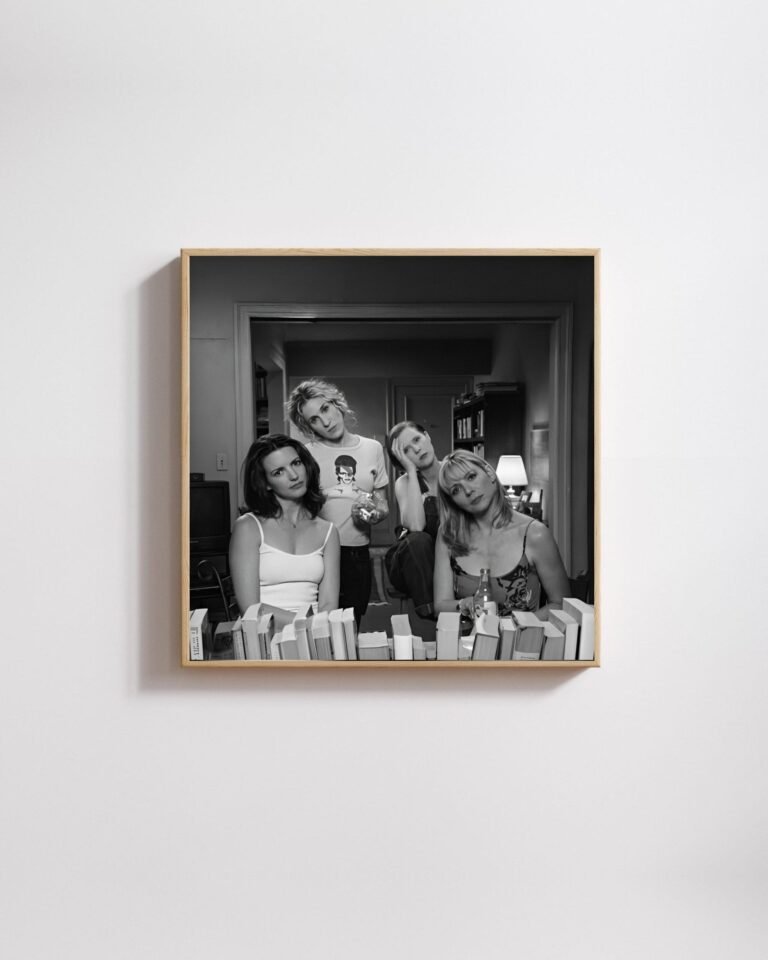
Our print Four Friends in the City is that hour: four women gathered in a lived-in apartment, framed by a doorway, a long wall of books stacked along the foreground like a barricade of reading. One stands in a graphic tee, bag in hand, head tilted at the camera. One rests her head on her hand with the patience of a woman who has heard this story before. Two sit in front, meeting the lens with expressions that are not quite smiles — the expressions friends wear when the photographer is also a friend, and no performance is required.
Four expressions, one arrangement
A group portrait succeeds or fails on whether the sitters are allowed to disagree with the camera, and here all four disagree differently. That spread of moods is the photograph’s truth and its charm: this is not a unit, it is a parliament. Every enduring friendship of four is exactly this — four temperaments held together by something stronger than temperament, photographed at the precise angle where you can see both the differences and the glue.
The setting testifies for them. These are not props; they are evidence. The stacked books, the lamp glowing in the back room, the television in the corner, the bottle on the table — the apartment of people who read, talk and stay up too late doing both. City friendship is mostly practised in rooms like this, one borrowed chair at a time, and the photograph honours the real venue instead of the glamorous crossing outside it.
Why everyone recognises it
Show this print to a room of women and the same thing happens: within seconds, each of them has assigned the four faces. I am her. She is so her. It is the surest sign a group portrait can give that it has stopped being about its sitters and become about its viewers — a mirror with four facets. The city in the title is deliberately unhelpful about which city. It is whichever one your four are in.
There is a tenderness, too, in the square crop and the soft indoor light, so different from the hard flash of the party photographs in this wave. This is the morning-after register: quieter, closer, funnier in a lower voice. The party prints show what friendship wears. This one shows what it is.
The books in the foreground are easy to overlook and worth a second look. They turn the bottom of the frame into a skyline of spines — a little city of print standing between the viewer and the women, as if the apartment’s reading had overflowed into the portrait itself. It is the most honest detail in the picture. These friendships ran on borrowed books and borrowed chairs, and the photograph, knowingly or not, has built its own foreground out of the evidence.
Living with it
Hang it where your own people gather — above the sofa where friends actually sit, on a landing, in the room that hosts the long talks. It is a warm, square print that starts conversations because it is, itself, a conversation. Sizes are set out on the poster sizes chart. It sits happily with the party trick, its louder sibling from the night before, and with the sunglasses editorial, for the one friend of the four who would absolutely hold a newspaper up to a camera.
Preguntas frecuentes
What is arranged in this photograph?
Four friends gathered in a city apartment — books stacked in the foreground, a lamp glowing behind them, four entirely different expressions aimed at the same camera. It is a portrait of friendship as arrangement: nobody is the star, and the square composition gives each of them equal billing.
Why a square print?
The frame was composed square, and the print keeps it. Square formats sit well in the middle of a wall arrangement or alone on a landing, and they leave the usual landscape-versus-portrait question moot. Each size in the range is cropped from the master to its true proportions, composed on the group.
Who buys this print?
People buying for the friend who has everything, and people furnishing a first proper apartment. It reads as warmth rather than décor — the rare wall piece that starts conversations instead of ending them.
What are the print specifications?
Archival pigment giclée at 300 dpi on 200gsm FSC-certified matte paper, made to order in about 72 hours. Shipping is free and tracked worldwide; framing in four finishes is available on the middle and larger sizes.