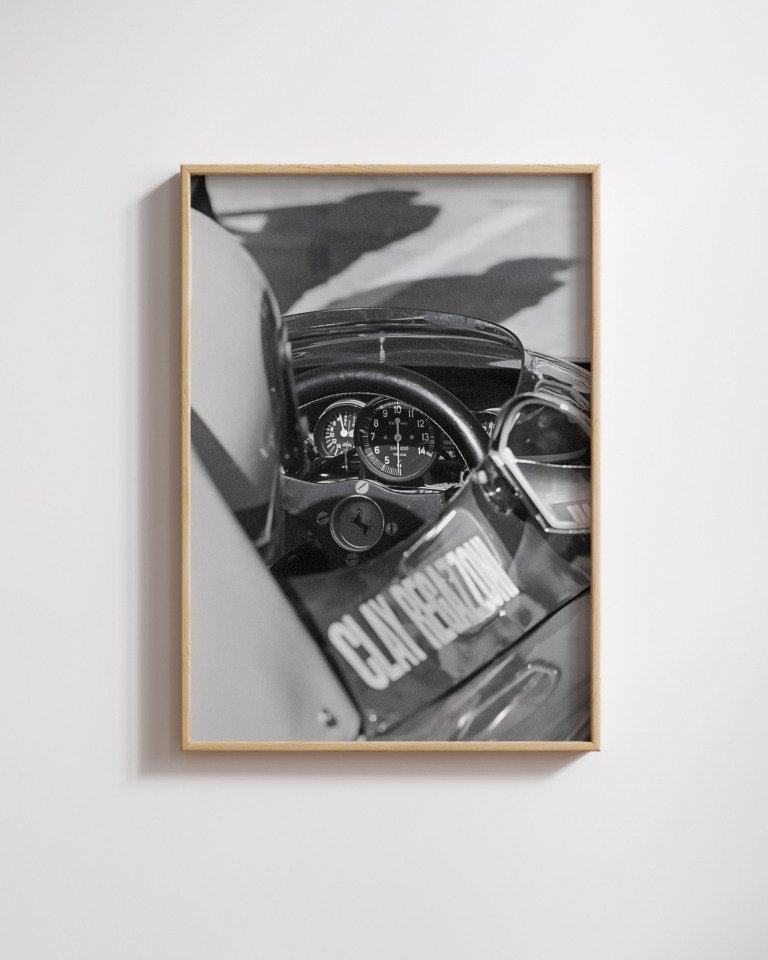
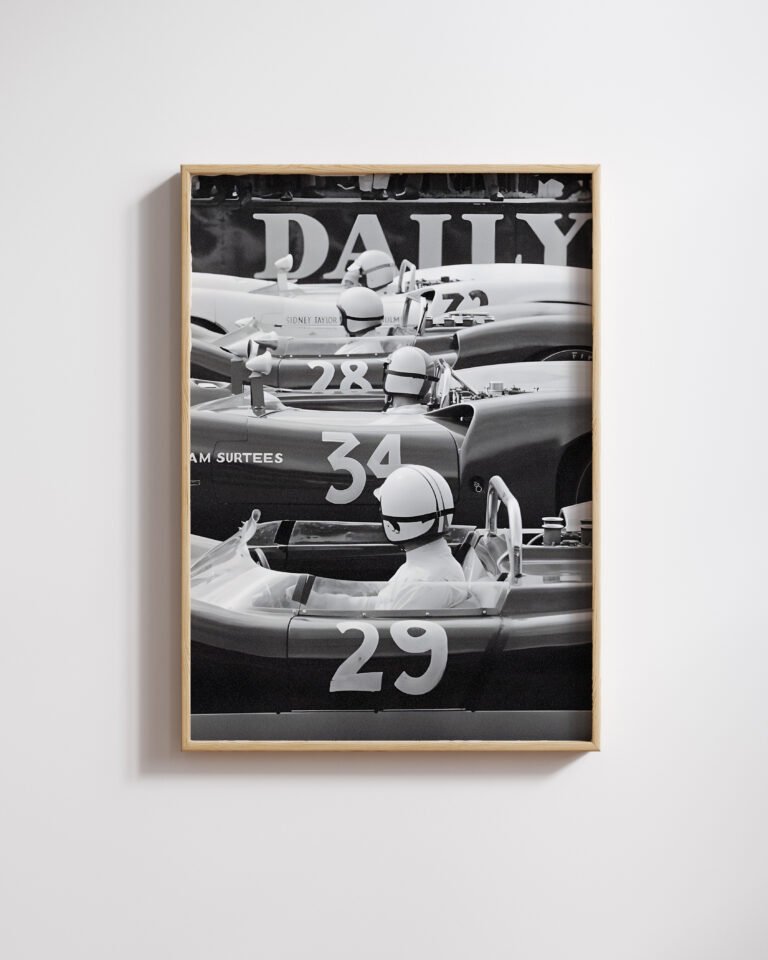
An Ayrton Senna print sounds like one decision and is really four. The catalogue holds four pieces and they answer completely different questions — one is about a car, one is about a face, one is about a circuit, and one is about a championship season. Buying the wrong one is not a matter of quality. It is a matter of having wanted a different picture.
The car: the Lotus 97T
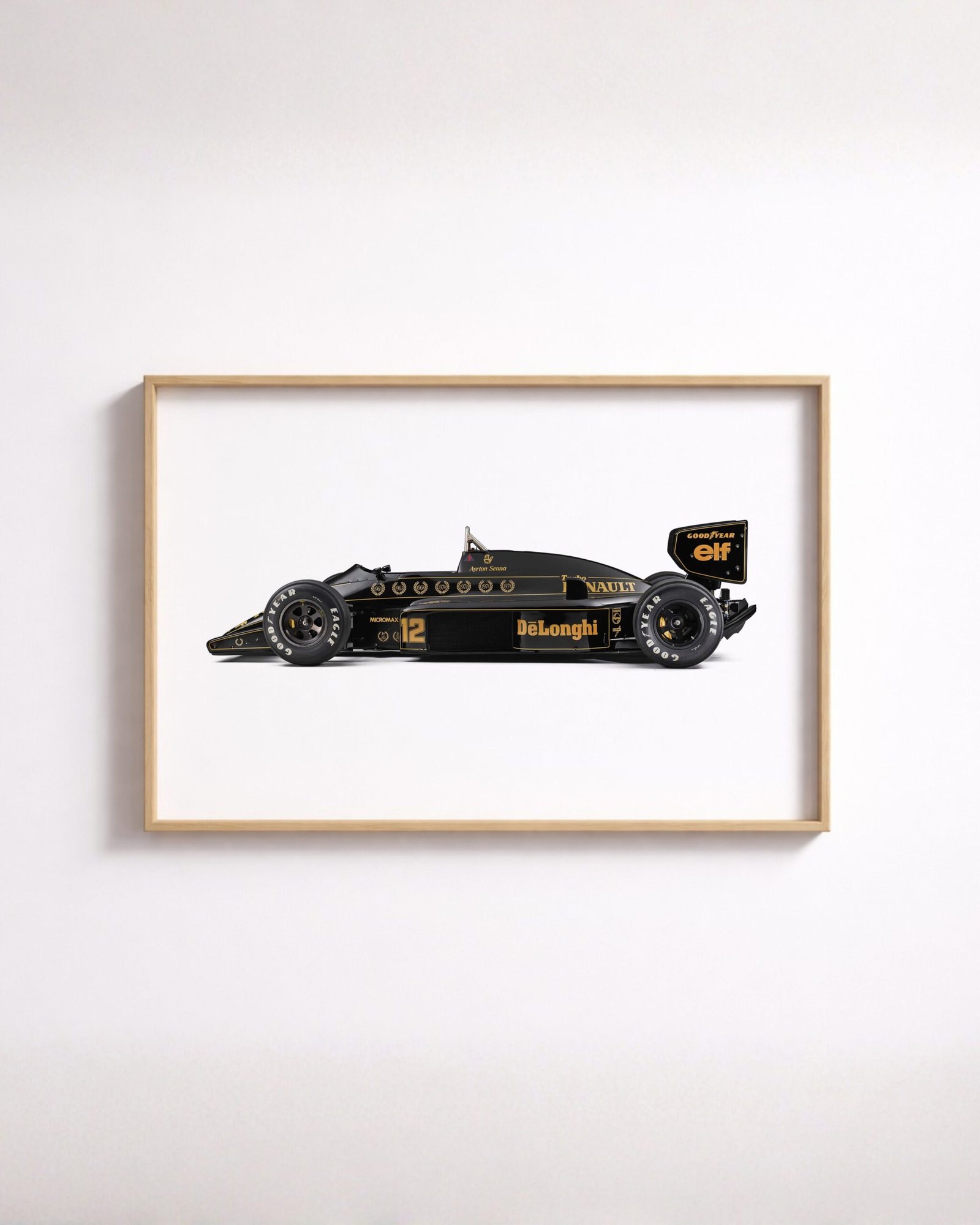
Start here if what you remember is a machine rather than a person. The Lotus 97T poster shows car number 12 in side profile against plain white, black and gold, nothing else in the frame at all.
That car matters for a specific reason. Wikipedia’s record of the 1985 Portuguese Grand Prix has it run at the Autodromo do Estoril on 21 April 1985, cold and overcast with rain falling from the start, and it has Senna taking pole position and winning — his first pole, his first win, and the first of what would be 41 Grand Prix victories. The 97T itself was designed by Gerard Ducarouge for that season and ran a 1,492 cc Renault V6; across 1985 it took eight poles and three wins.
We describe the colours as black and gold rather than naming the scheme. The sponsor was a tobacco brand, and tobacco branding does not go in our copy.
The face: the portrait
The Ayrton Senna portrait poster crops tight to a helmet: the eyes inside the visor aperture, sponsor decals running along the rim. There is no car, no circuit and no result in it.
This is the piece that behaves least like motorsport memorabilia. Hung on its own it reads as a photograph of a person, and it will sit next to unrelated black-and-white work without any of it looking like a themed wall. It is also the piece that wants to be close to the viewer. A tight crop hung high across a large room loses the only thing it has.
The circuit: Monaco
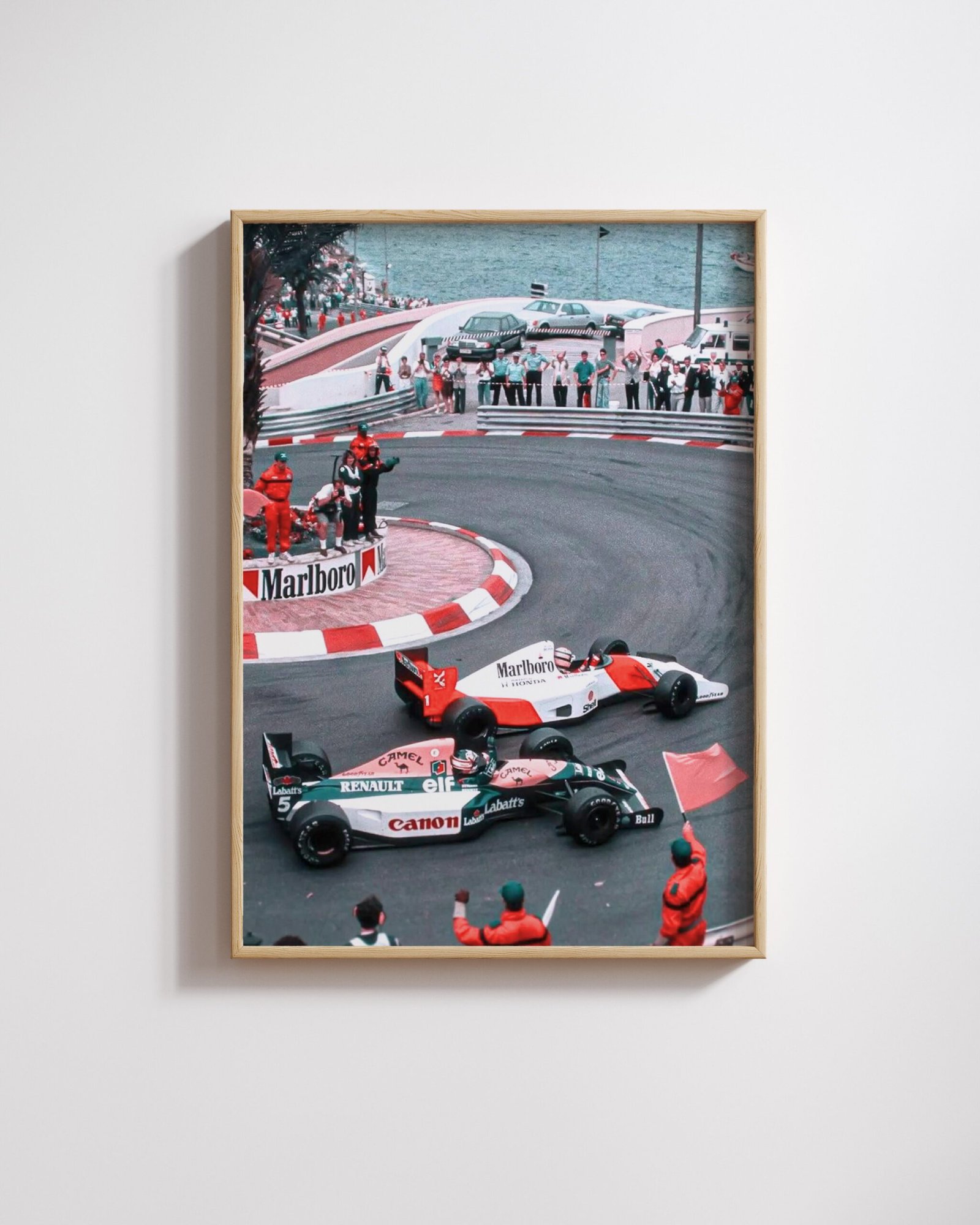
The Senna at Monaco wall art print is full colour and shows two cars cornering past spectators. It is the only one of the four in which the place is the subject rather than the machine.
Monaco is not an arbitrary choice. Formula1.com’s Hall of Fame entry records six wins there for him, and it also records the shape of the career: three seasons at Lotus from 1985, with 16 poles and six wins, then six seasons at McLaren from 1988, with 35 wins and three world championships. Sixty-five pole positions in total — a record, at the time it was set.
The season: 1991
The 1991 McLaren print is the fourth answer: full colour, a red-and-white car leaving the pit lane. 1991 is the third of the three championships, and by the account above it was the least dramatic of them — not close, just relentless.
It is worth knowing what it followed. The same Hall of Fame record has 1988 as the first of the three titles, in a season when McLaren-Honda won fifteen of the sixteen races and he took the championship by eight wins to his team mate’s seven. Set against that, 1991 is the picture of a driver who has stopped needing a rival to define him — which is either a good reason to choose this frame or a good reason to choose one of the earlier ones.
Colour is the practical difference. The two full-colour pieces are the loudest thing in any room they hang in. That is either exactly what you want above a desk, or exactly the reason to take one of the monochrome pieces instead.

Choosing an Ayrton Senna print by what it shows
Reduced to four sentences:
- You remember a car. Take the 97T. It is the most graphic of the four, it is the only one that will read correctly from across a room, and it is attached to a specific afternoon.
- You remember a person. Take the portrait, and hang it where somebody will stand close to it.
- You remember a place. Take Monaco, and give it a wall of its own.
- You remember a season. Take the 1991 car, for the same reason.
One thing none of these will do is tell you a date or a location we cannot support. The 97T piece is attached to a documented race because the car number and the livery identify it. The others are described by what is visible in the frame and nothing more, which is the standard we hold everything in the catalogue to.
Format and wall
The 97T and the 1991 car are landscape, and they suit a horizontal run — over a sofa, along a corridor, above a desk. The portrait is vertical and wants a narrower wall with something to anchor it. Working out which shape of wall you are filling before you choose the picture removes the most common regret, which is a frame that fits the room badly no matter how good the image is.
Everything is made to order and ships worldwide at no extra cost, which means there is no stock argument for choosing one over another. The only question is which of the four pictures you actually wanted.
For the race itself in more detail, we have written about that first win in 1985. For why the cars in these pictures look the way they do, there is the piece on how the rules kept redrawing them.
أسئلة شائعة
Which Ayrton Senna print is the right one to start with?
If you want the car, take the Lotus 97T piece - it is the machine that took his first pole and his first Grand Prix win. If you want the man, take the portrait. If you want the atmosphere of a circuit rather than a specific result, take the Monaco piece, and note that Formula1.com records six Monaco wins for him.
What made the 1985 Portuguese Grand Prix significant?
It was his first pole position and his first win, on 21 April 1985 at Estoril, in cold and wet conditions, and it was the first of 41 career Grand Prix victories. The car was number 12, a Lotus 97T.
Is the black-and-gold car in the print historically accurate?
The livery shown is the black-and-gold scheme the 1985 Team Lotus cars ran, with car number 12. We describe the colours rather than the sponsor, because the sponsor was a tobacco brand and we do not put tobacco branding in our copy.
Colour or monochrome?
It is mostly a decision about the wall, not the driver. The monochrome portrait behaves like any other black-and-white photograph and will hang beside unrelated work. The full-colour pieces are the loudest thing in any room they are in, which is either the point or the problem.