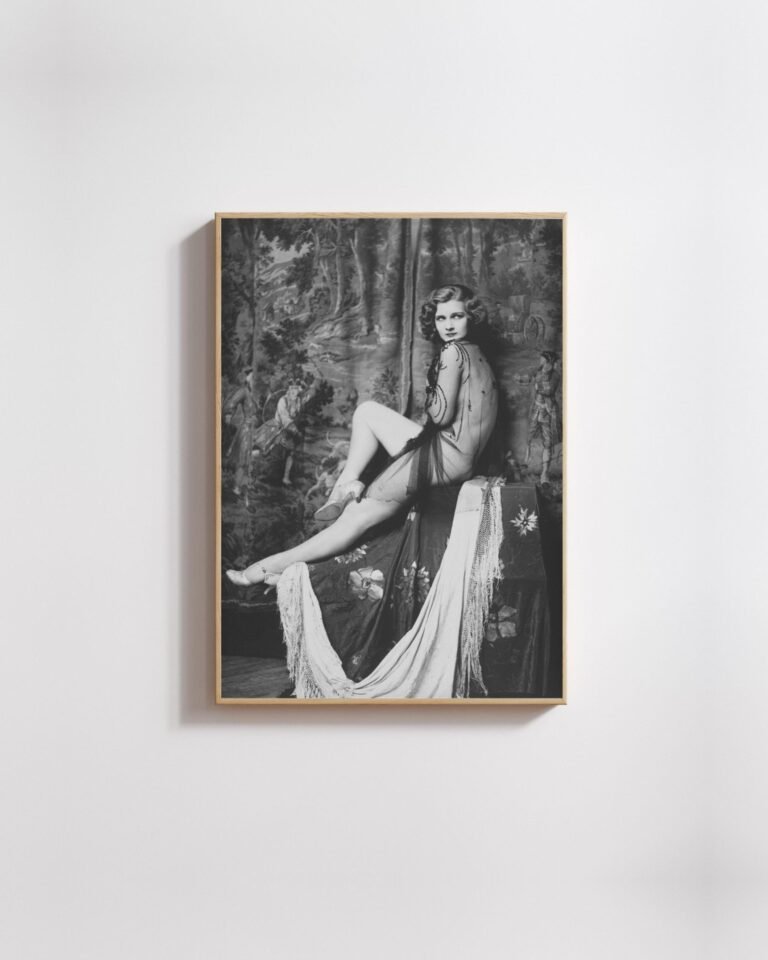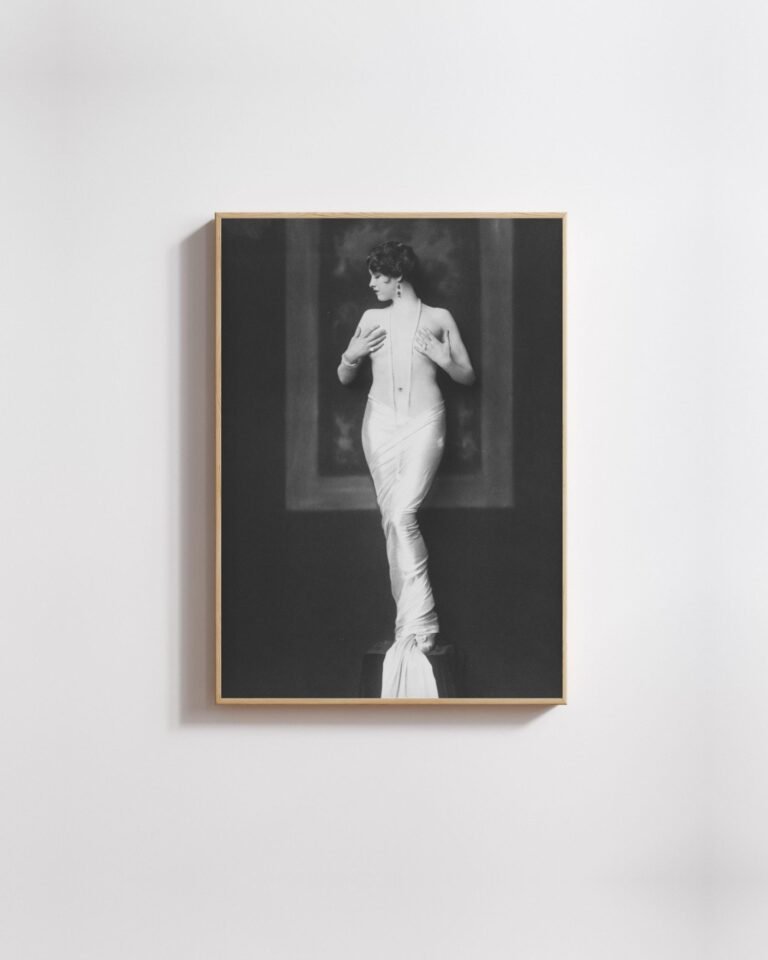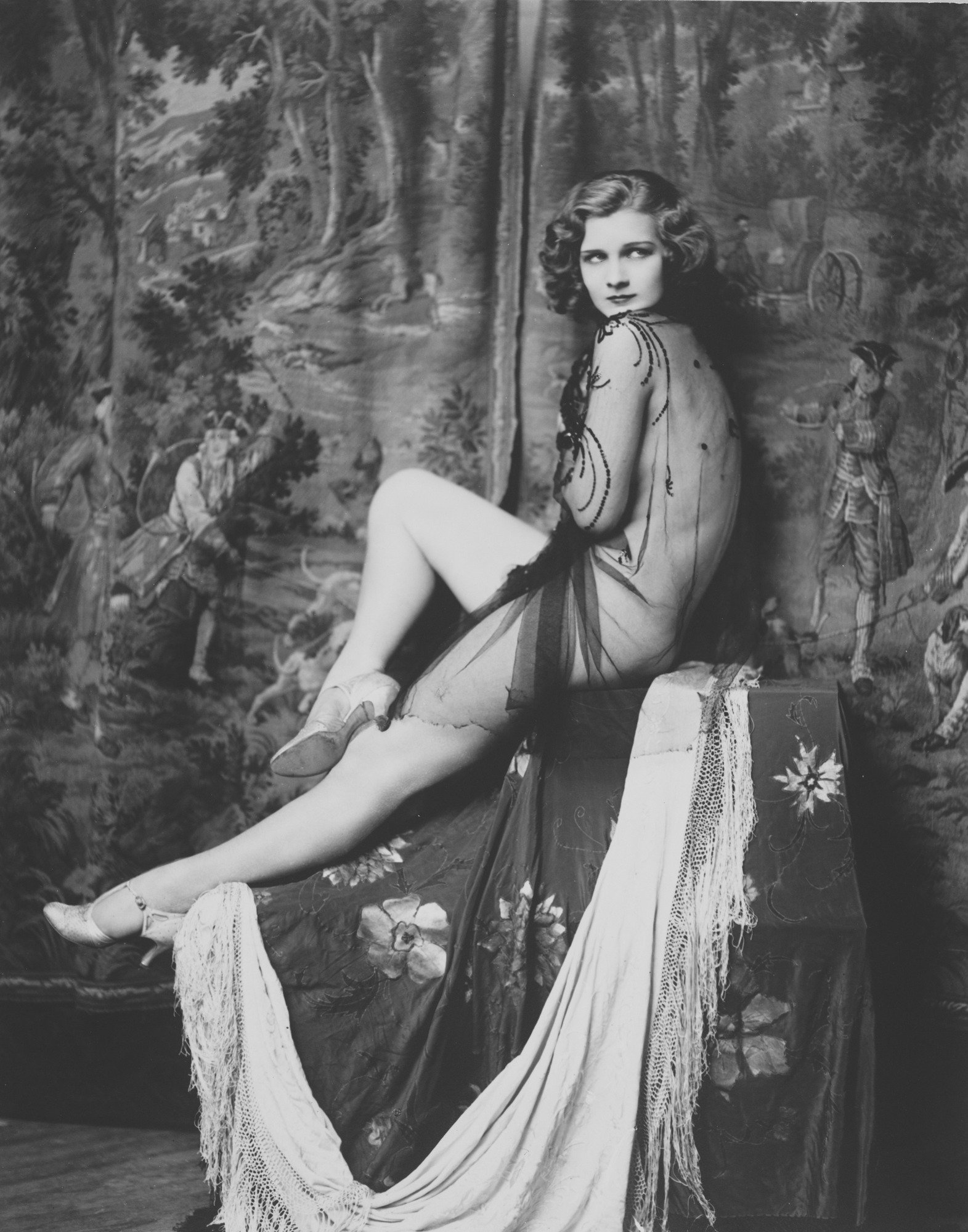
In the 1920s, the most glamorous room in New York theatre was not a stage. It was a photographer’s studio a few streets from Broadway, where the era’s defining glamour portraits were made: showgirls, dancers and young actresses posed against painted backdrops, wrapped in borrowed finery, and lit with a softness that turned publicity into portraiture. Our print Seated in the Tapestry Room is a perfect survivor of that room: a young sitter perched sideways on a draped bench, one leg folded and one extended, a sheer beaded wrap slipping at her shoulder, glancing back at the camera while a painted tapestry — huntsmen, hounds, a woodland idyll — fills the wall behind her.
The tapestry is the tell. The great theatrical studios kept a stock of painted cloths the way theatres keep scenery, and a good backdrop did half the sitting’s work: it gave the sitter a world to be in. Here the woven fiction of an old-world hunt plays against the modern girl in front of it — bobbed waves, heeled shoes, a look over the shoulder that is entirely of its decade — and the friction between the two is the photograph’s charm. She is not dressed for the hunt. She is dressed for the camera, and the tapestry is there to make the camera’s world larger than a studio.
The Ziegfeld-era portrait tradition
The Broadway revues of the era sold a particular idea of glamour: lavish, statuesque, a little unreal. Their performers were photographed relentlessly, and the studio portrait became the machinery of fame — images supplied to newspapers, magazines and lobby displays, each one expected to make a young woman in a chorus line read as a star. The best of these studios worked like portrait painters. Sittings were unhurried. Costumes were assembled from a wardrobe of wraps, shawls, feathers and beads kept for the purpose. Poses were rehearsed against the painted cloths until the sitter and the scenery composed.
What distinguishes the tradition, looking back, is its confidence that glamour was a craft rather than an accident. Nothing in this frame is candid: the fringed shawl is arranged to spill in a white diagonal to the floor, the bench is draped in floral fabric, the extended legs make a long line that the tapestry’s trees answer vertically. Even the sitter’s half-turned head is a studio formula — the over-the-shoulder glance, which lets a portrait be both offered and withheld. A century later the formulas still work, because they were never tricks. They were composition.
Living with the tapestry room
A portrait whose backdrop is itself a picture hangs unusually well among other pictures: it is a painting’s worth of incident in a photograph’s tones. It suits a dressing room, a landing, or a wall where framed photographs are already gathered — anywhere a little theatricality is a virtue rather than a risk. The print’s many mid-tones, from the tapestry’s foliage to the sheen of the wrap, reward the softness of matte paper and a frame that stays out of the way; the poster sizes chart shows every size against a standard wall.
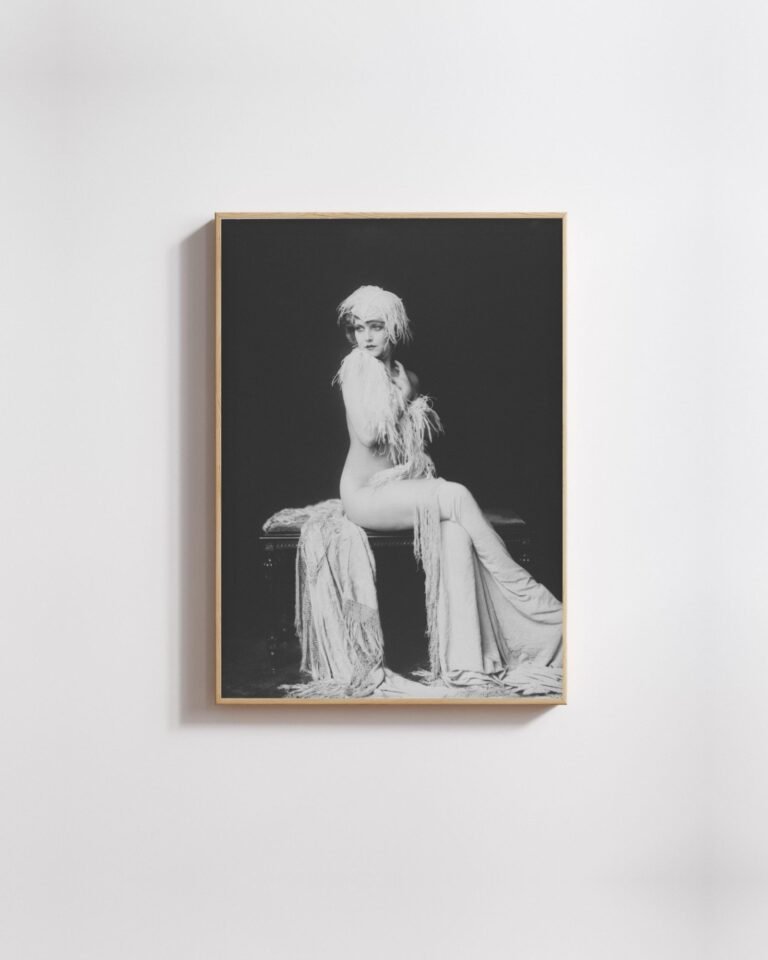
Within its own set, it is the storyteller: pair it with Platinum Study with Plume for the same studio working against darkness instead of scenery, or with Lace in Profile, the set’s quietest frame. And it converses happily across the store with The Muse and the Roadster — another sitter, another decade, the same understanding that a portrait is something built, not found.
Photograph: Alfred Cheney Johnston; Library of Congress, Prints & Photographs Division — No known restrictions on publication. Source: the holding archive.
أسئلة شائعة
What kind of photograph is this?
A 1920s studio portrait from the great age of theatrical glamour photography: a sitter in a sheer beaded wrap, seated before a painted tapestry backdrop, arranged like a painting because that is what the era's portraitists were trained to make. Broadway's stars were photographed this way — the studio as theatre, the sitter as its leading light.
Why do these studio portraits look more like paintings than photographs?
Because they were lit and composed by people who had learned from painting: painted backdrops, arranged drapery, light sculpted rather than aimed. The camera was simply the fastest brush in the room. Reproduced at 300 dpi on matte paper, that painterly softness is the print's whole character.
Where does it hang?
Dressing rooms and collector walls — it is a connoisseur's piece, from a set of 1920s studio studies in the collection that share paper, sizes and treatment, so the set hangs as a salon row if you want it to.
What are the practical details?
Archival pigment giclée at 300 dpi on 200gsm FSC-certified matte paper, made to order in about 72 hours, shipped free and tracked worldwide. Framing in black, white, natural or dark wood, with an optional white mat, on the middle and larger sizes.