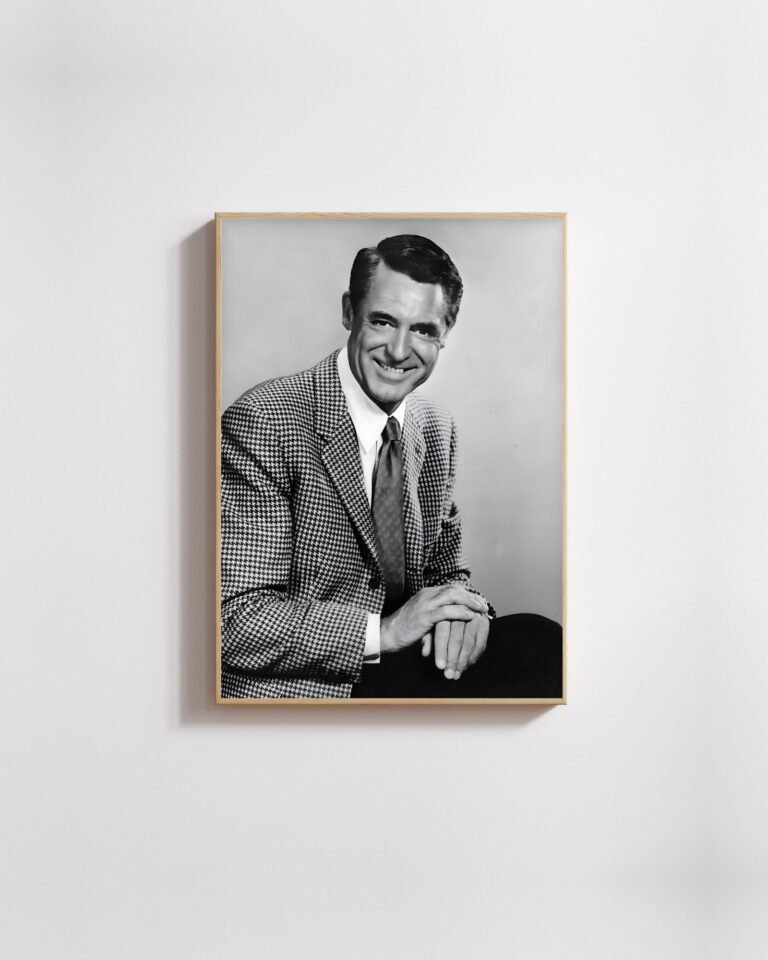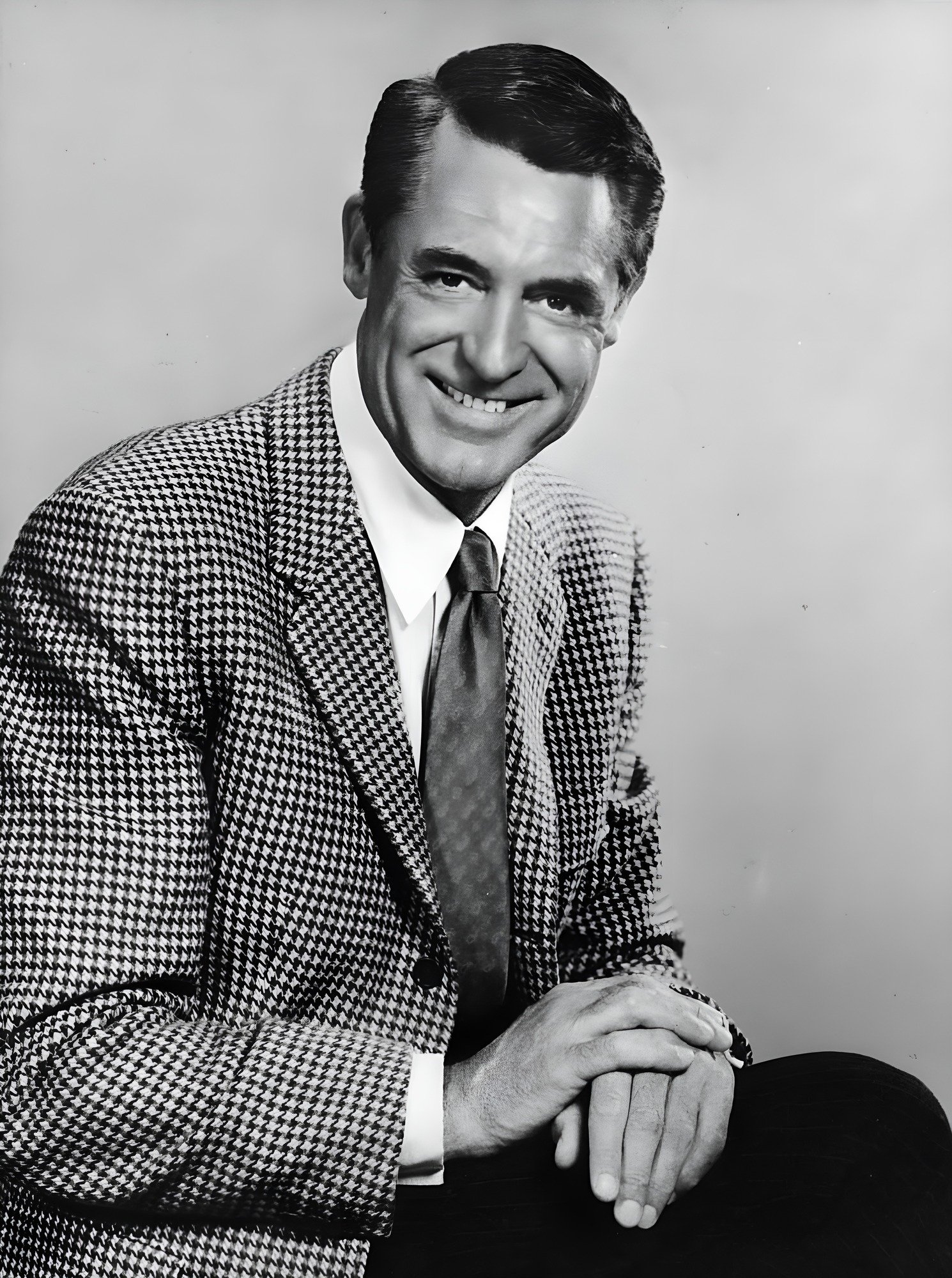
There was a time when every great newspaper kept a portrait studio of its own, and the famous, passing through the city, were expected to sit for it. The sittings were quick, the negatives were filed, and the prints went out to illustrate a thousand stories — but the studios’ best photographers treated the routine assignment as portraiture proper, and occasionally the routine produced a definitive image. Our print Studio Portrait in Evening Dress, 1958 is one of those: a leading man of the era photographed in 1958, seated at an angle in an impeccably tailored checked jacket, white shirt and dark tie, hands loosely clasped over one knee, smiling with an ease that no amount of direction can manufacture.
The photograph’s subject was, by 1958, the most practised sitter in the world — a star of three decades’ standing whose screen persona was elegance itself, and whose off-screen reputation rested on looking exactly as well as he did on it. Newspaper photographers shot him whenever he passed through, and the files bulged with competent frames. This one survives because it caught the persona at rest: not mid-anecdote, not squinting into a premiere’s flashbulbs, but settled, tailored and entirely at ease in a chair in a working studio, as if elegance were a habit rather than an effort — which, in his case, was the whole story.
The newspaper studio era
The great metropolitan dailies of the mid-twentieth century maintained photographic departments that were small academies. Their portraitists learned to work in minutes, with hot lights and large cameras, producing a negative that would survive the halftone screen of newsprint — which demanded strong modelling, clean backgrounds and faces that read at column width. Within those constraints a house style formed: the plain ground, the three-quarter turn, the hands given something calm to do. It is a style so associated with the era that a single frame can date a wall.
The tailoring deserves its own sentence. The checked jacket, cut long and soft, the shirt’s immaculate collar, the tie’s plain dark fall: in 1958 this was the uniform of a particular idea of masculinity, equal parts boardroom and yacht club, and the portrait wears it like a thesis. Menswear historians still cite the era’s leading men as evidence that fit, not fashion, is what survives — and in a frame like this, nearly seventy years on, the argument is difficult to answer.
On the wall
This is the definitive mid-century portrait, and it hangs the way portraits of its period were meant to: alone, at eye level, in a room with some formality about it — a study, a dressing room, a home office. Its grey scale is gentle and broad, kind to matte paper, and the checked pattern of the jacket gives the frame a texture that keeps it alive at distance. The poster sizes chart shows the sizes against a standard wall.
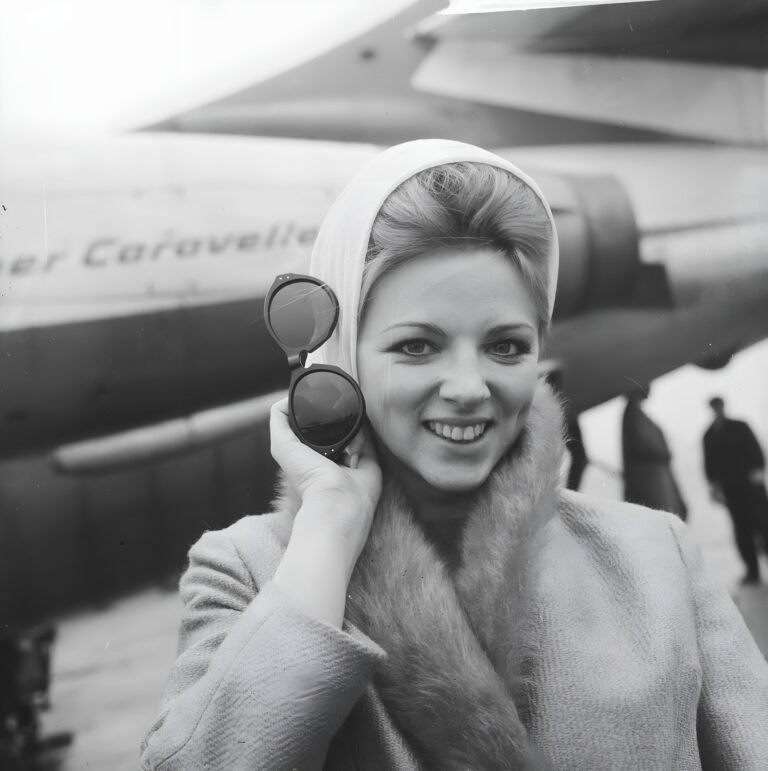
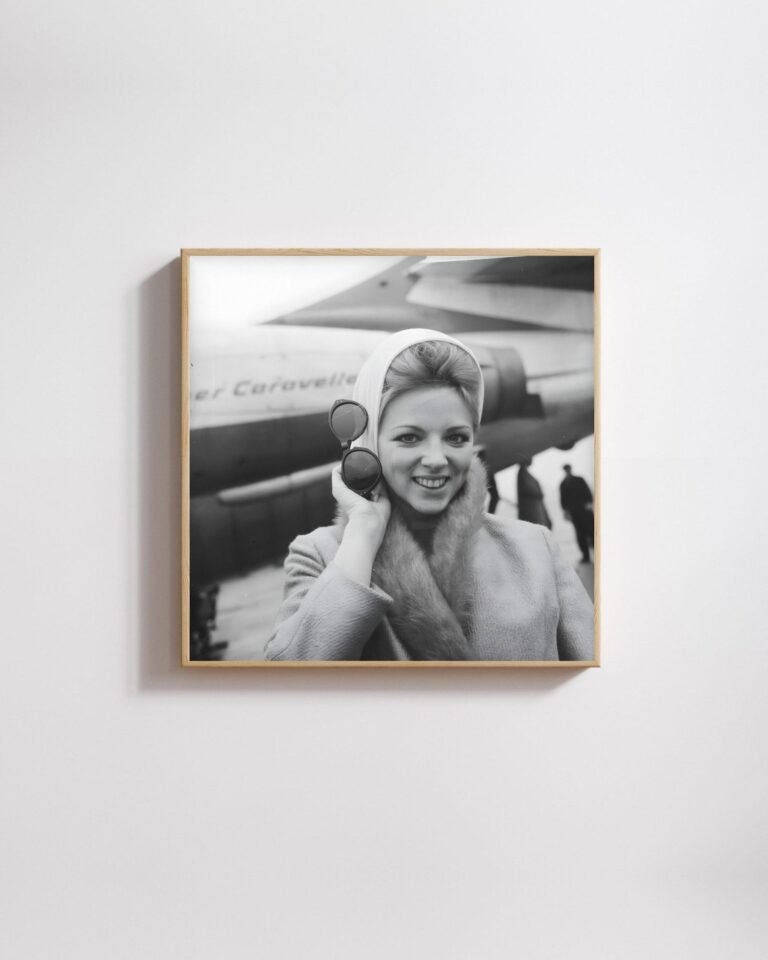
Its companions are the store’s other portraits of the composed decades: Arrival in Fur, 1965, the female counterpart seven years later — a star arriving by air, fur collar up, smiling into the same species of camera — and The Muse and the Roadster, where the era’s ease meets the machine it loved. Together they describe a world in which being photographed was a skill, and these three had mastered it.
The sitting’s photographer was the dean of that newspaper world — a portraitist whose studio received presidents, prizefighters and film stars with the same unhurried competence, and whose colour work for the paper’s Sunday magazine helped define how America pictured its famous. That this gentle black and white frame, made between bigger assignments, survives as one of his most loved portraits says something about both men: the sitter who made ease look easy, and the photographer who knew to simply let him.
Photograph: Harry Warnecke, New York Daily News — Public domain. Source: the holding archive.
أسئلة شائعة
Who is sitting for this portrait?
A leading man of the 1950s, photographed by a newspaper studio in 1958: seated, smiling, impeccably tailored in a checked jacket, entirely at ease. This is mid-century portraiture at its most professional — the sitter's charm was his trade, and the studio's job was to make it look effortless. It does.
What makes 1950s studio portraiture distinct?
Ease. The previous decades stood their sitters up and lit them like statuary; the fifties sat them down, loosened the jacket and let them smile. The photograph is a record of that change in manners — formality kept, stiffness dismissed.
Where does it hang?
Studies, dressing rooms and home offices — rooms with a mid-century grain to them. It is the most companionable of the cinema portraits, the one that behaves like a friend of the house.
What are the order details?
Archival giclée on 200gsm FSC-certified matte at 300 dpi, fifteen sizes from 13×18 cm to A0, made to order in about 72 hours. Free tracked shipping worldwide; four frame finishes with an optional white mat.