A black and white BMW car poster sounds like a single decision and is really a choice between two very different photographs of the same generation of car. One crops to the nose until the car is almost abstract. The other puts a whole E30 in a landscape. They want different walls, and one of them is considerably easier to live with than the other.
The shape is a rulebook
Before choosing between the pictures, it is worth knowing why this car looks the way it does, because it changes what you notice in both frames.
Wikipedia’s record of the BMW M3 is unusually plain about it: the E30 M3 was built to satisfy Deutsche Tourenwagen Meisterschaft and Group A touring rules, which required a total of 5,000 of the base model to be built plus a further 500 evolution specials. It was presented at the 1985 Frankfurt Motor Show and produced from March 1986 to June 1991, and total production came to 17,970 cars.
That requirement comes from the regulations themselves. Group A was introduced by the FIA in 1982 to replace Group 2 as the modified touring car category, and before 1993 the initial production requirement for homologation was 5,000 cars.
So every visible difference between an M3 and an ordinary E30 — the flared arches, the raised boot, the wider track — exists because a racing department needed those shapes to be legal, and legality meant building five thousand road cars first. The detail that gives it away is smaller than any of those: on the M3 the windscreen was glued in, rather than framed with a rubber and piping as on other E30 models. A road car does not need a bonded screen. A stiff racing shell does.
The arches are not styling. They are the minimum production run of a rule, cast in steel five thousand times.
The close-up
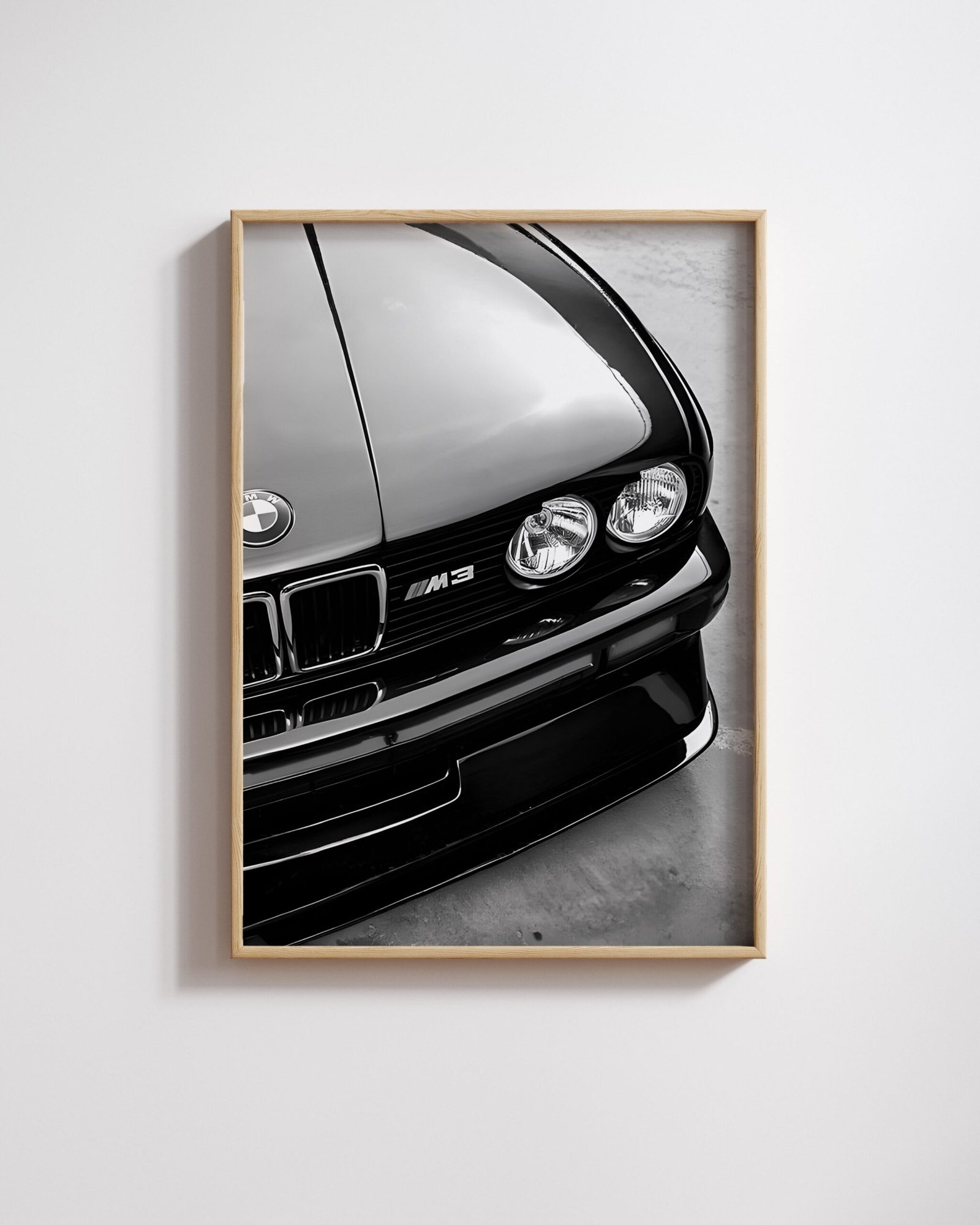
The black and white E30 M3 poster crops hard to the front: bonnet, badge, headlights, and very little else. At that distance the car stops being a car and becomes a set of rectangles and two circles, which is exactly what makes it hang well.
A tightly cropped detail is the most forgiving kind of car picture. It does not need a themed room, it does not compete with other work on the wall, and it does not date the way a full-car shot does — there is no background, no road surface and no weather to place it. It is the piece we would put in an office or a hallway.
The whole car
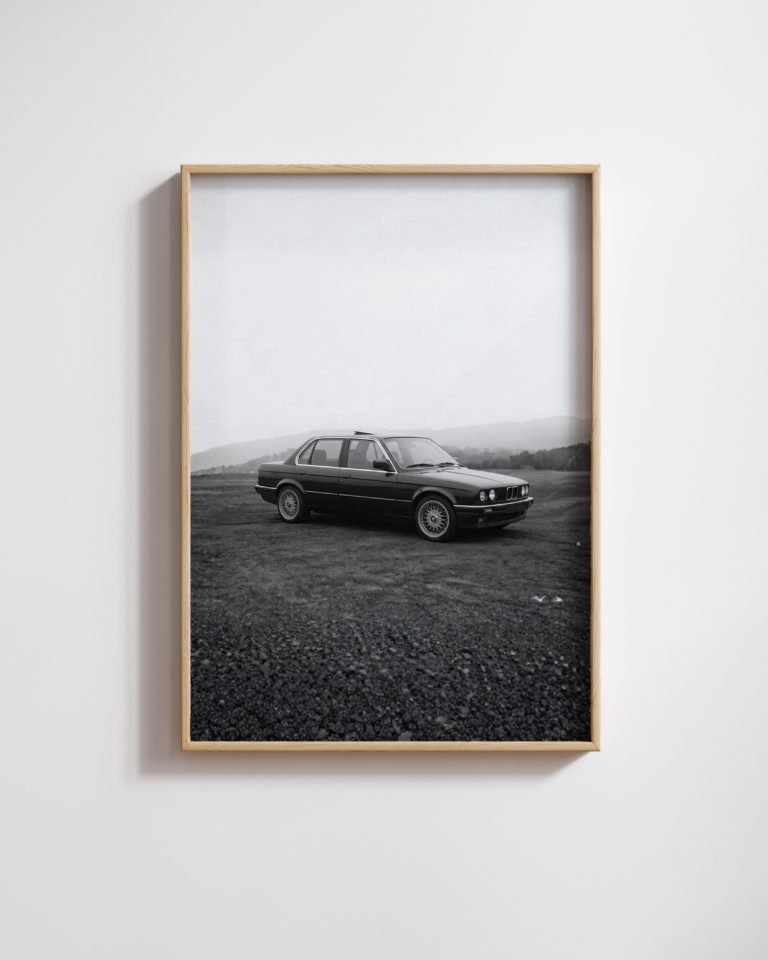
The E30 sedan poster is the opposite decision: a black car parked on a gravel lot with misty hills behind it. There is weather in this picture, and ground, and distance.
It is the better photograph of the two and the harder one to place. A full car in a landscape reads as a scene, and a scene needs room around it — a wide wall, a plain surface, nothing else competing. Hung small, the car shrinks to a model on a shelf and the hills take over. Hung well, it is the piece a visitor stops at.
Choosing a black and white BMW car poster
The short version:
- Narrow wall, mixed company, an office or a corridor. Take the close-up. It is geometry, and geometry gets on with everything.
- Wide wall, plain surface, a room where one picture is meant to lead. Take the sedan in the hills, and print it large enough that the car holds its own against the landscape.
- Buying both. They work as a pair precisely because one is a detail and the other is a scene. Hang the detail to the side, not in the middle.
Both are genuinely composed for monochrome rather than converted after the fact, which matters more than it sounds. A colour photograph desaturated tends to go muddy in the mid-tones; a picture built around tone keeps its separation.

What we do not claim
We can identify the E30 M3 from its shape, and we do. We cannot tell you the model year of either car in these photographs, or where or when they were taken, and we will not put a caption on a picture that implies otherwise. Where the evidence in the frame runs out, the description stops.
Size and paper
Size is the thing people get wrong with car pictures, in both directions. A whole car printed small becomes a toy. A tight detail printed very large becomes wallpaper — interesting texture, no subject. Match the size to how much of the car is in the frame, not to how much wall you have.
Monochrome also asks more of the paper than colour does, because everything that goes wrong happens in the greys. We have written about how tonal range behaves on a matte surface if you want that detail before choosing.
For the full story of why a racing department had to build five thousand road cars, there is our longer piece on the homologation rules — it is the article that makes the arches in both of these pictures look inevitable rather than decorative. Everything is made to order and ships worldwide at no extra charge.
أسئلة شائعة
Why does the E30 M3 look different from an ordinary E30?
Because a rulebook made it. Wikipedia records that the car was built to satisfy DTM and Group A touring regulations, which required 5,000 of the base model plus 500 evolution specials. The flared arches, the boxy stance and even the glued-in windscreen are consequences of building a road car whose purpose was to make a race car legal.
Which of the two BMW posters is the safer choice?
The close-up. It crops to the bonnet, badge and headlights, which reduces the car to geometry and makes it easy to hang beside unrelated work. The full-car landscape is a stronger picture but a more specific one.
Are both of them genuinely black and white?
Yes. One is a high-contrast close-up of the nose, the other is a black E30 sedan on gravel below misty hills. Neither is a colour photograph converted as an afterthought - both are composed around tone.
How big should a car poster be?
Bigger than people expect for the full-car shot and smaller than they expect for the close-up. A whole car in a small frame becomes a toy; a tightly cropped detail printed very large becomes wallpaper. Match the print size to how much of the subject is in the frame.