There was a brief, bright window in American cinema — roughly five years — when the films showed grown-ups behaving like grown-ups. They drank in public, dressed for dinner, flirted without a chaperone in the plot, and occasionally got away with all of it. Then the rulebook was enforced, the hemlines and the storylines were tidied, and the window closed for thirty years. The photographs from inside that window have a charge the later ones never quite recovered.
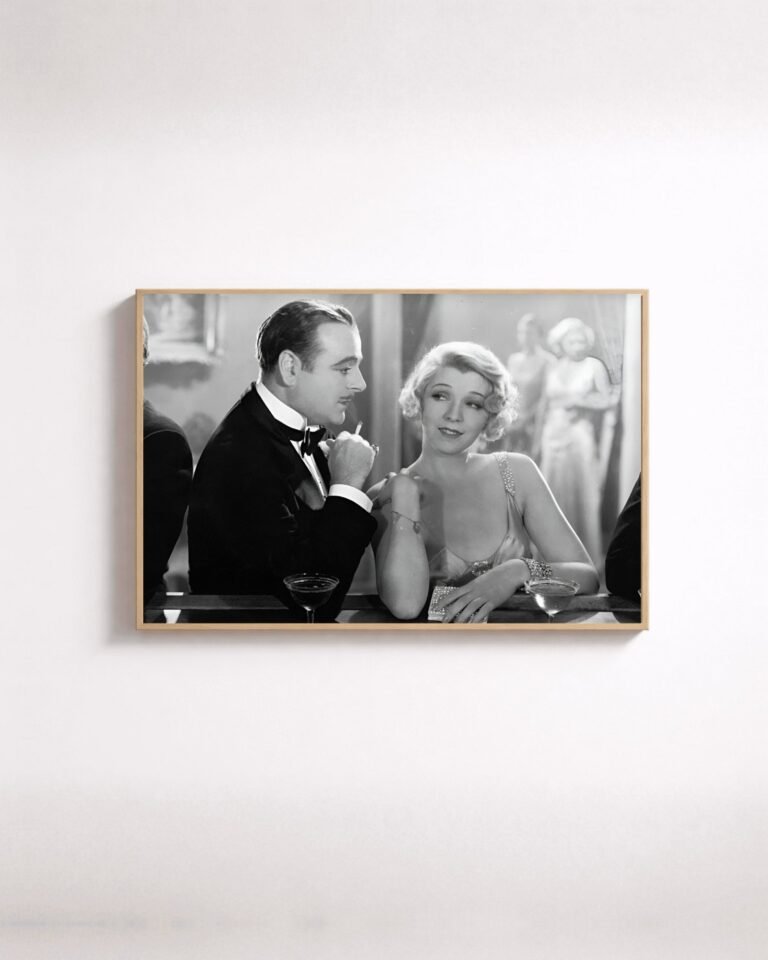
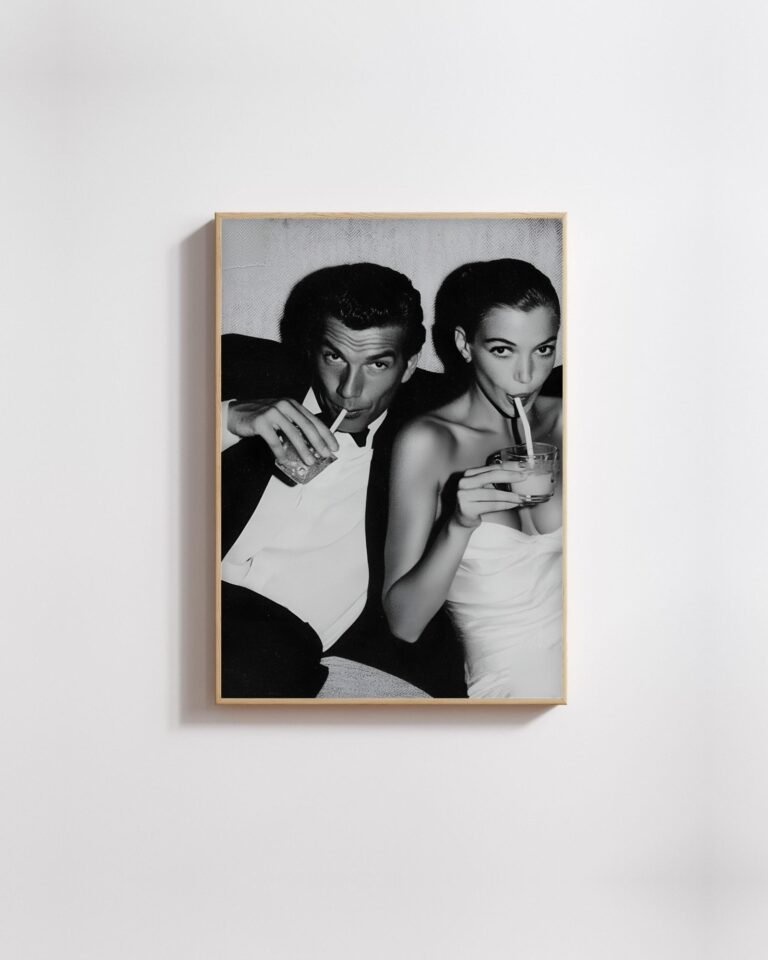
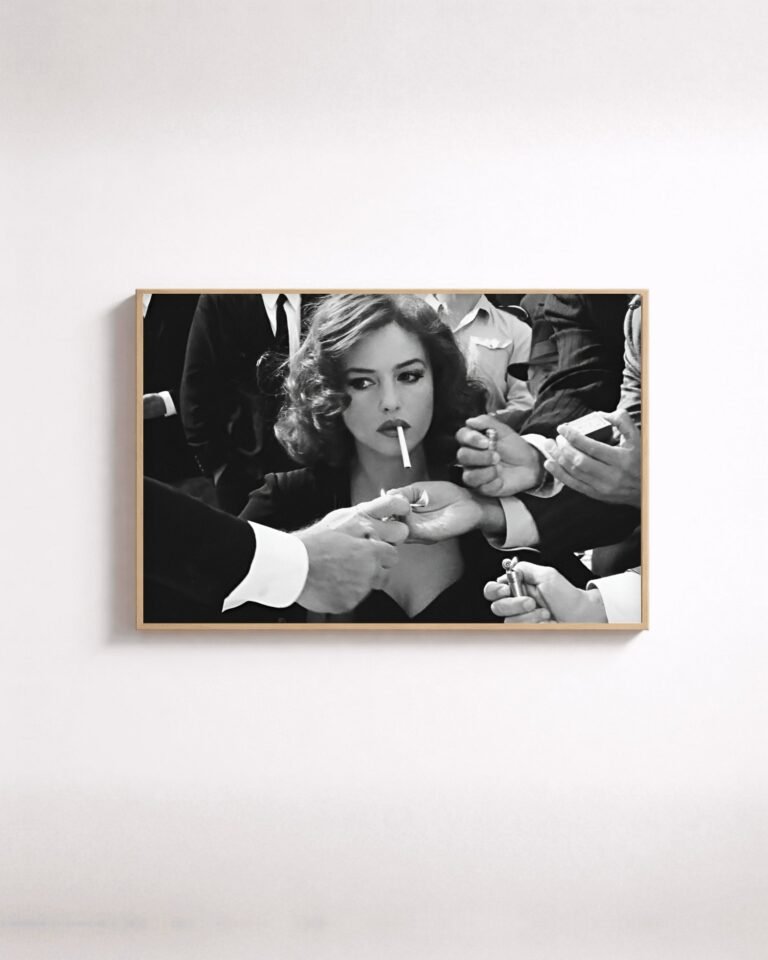
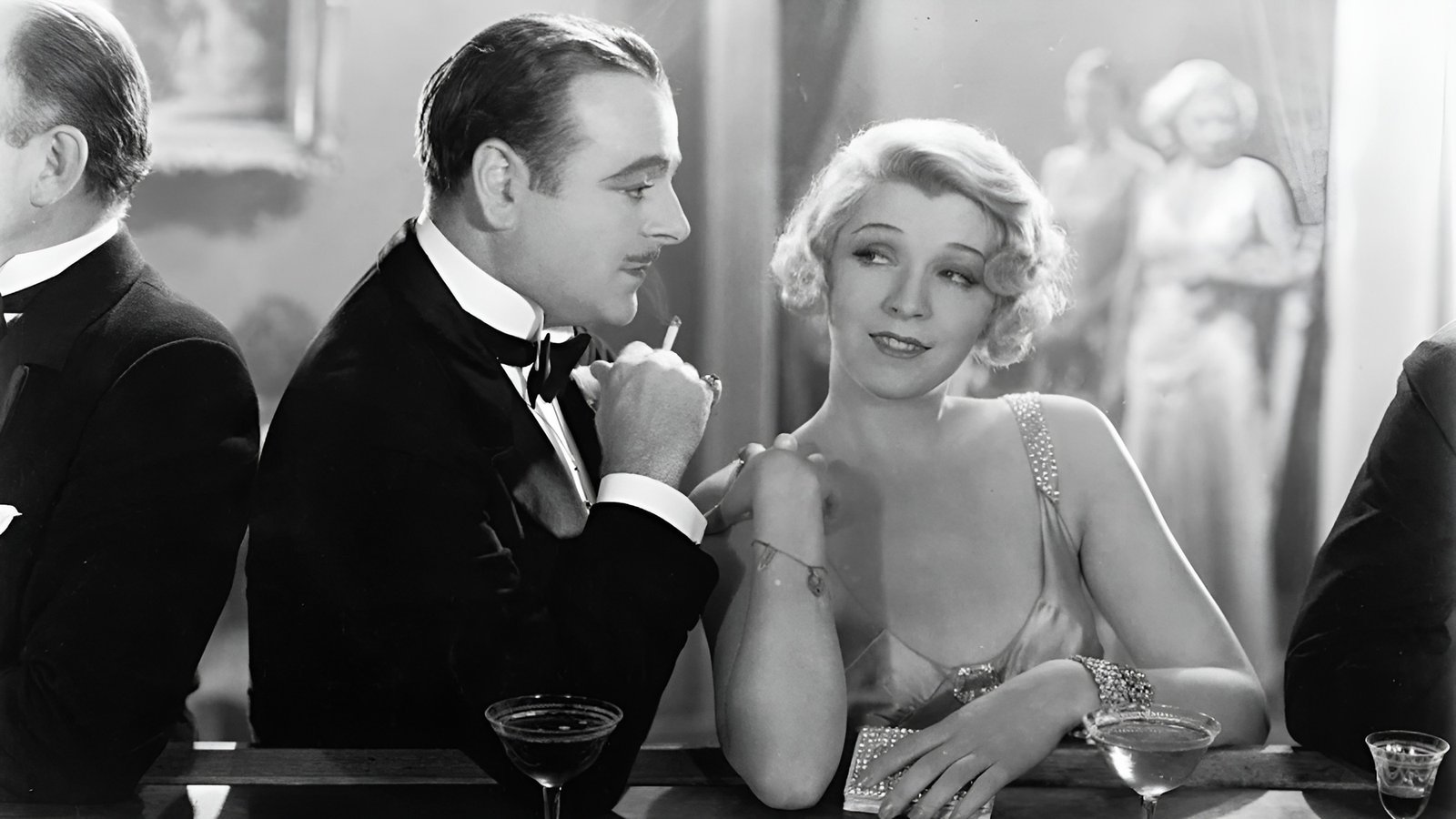
Our print The Pre-Code Bar sits squarely inside it. A man in evening dress has turned on his bar stool, cigarette in hand, saying something at close range. The woman beside him — platinum waves, a beaded dress with jewelled straps, a bracelet like a chandelier — leans on the bar and listens with the expression of someone deciding, not swooning. Two martini glasses stand in the foreground like punctuation. Behind them, soft as ghosts, other couples are having the same evening at a safer distance.
Five years of honesty
The industry had adopted a production code in 1930, on paper, and then largely ignored it while the Depression made audiences hungry for exactly the glamour and misbehaviour the code forbade. Studios competed in sophistication: cocktails were mixed on screen in real time, dialogue ran double meanings at speed, and the women in these films were written as adults with jobs, pasts and opinions. Enforcement, when it finally arrived in the summer of 1934, changed the grammar of American film for a generation. Which is why frames like this one read now as documents from a small, vivid republic that existed between two stricter regimes.
The still itself is pure studio craft. The lighting is the soft, pearly glamour style the big lots perfected for their stars: key light high and diffused, faces modelled like sculpture, the background allowed to fall away into smoke and suggestion. Notice how the composition is built on a diagonal of attention — his profile turned in, her face turned out towards us — so the photograph tells you the whole negotiation in one glance. She is looking at the camera. She is, in every sense, the one in charge of the scene.
The bar as a stage
Bars in these films were never just bars. They were the one public room where the classes and the sexes could meet on equal terms, where a plot could be advanced entirely in talk, and where the costume department could justify its finest work: his white waistcoat and gardenia, her beaded gown catching light with every small movement. The martini glass became a prop with its own choreography — held, raised, set down as a full stop. Even the cigarette smoke was directed, drifting through the backlight on cue.
It is worth remembering that all of this sophistication was manufactured for an audience counting its coins. The glamour was not a reflection of the audience’s life; it was a loan of somebody else’s, two hours at a time. That, perhaps, is why the still has kept its power. It does not document 1932. It documents what 1932 dreamed about, in a bar that never existed, between two people who are acting — and the dream, being better lit, has outlasted the reality.
Hanging the small hours
This is a frame made for low light, and it behaves best where the evening actually happens: over a bar cart, in a listening room, at the end of a hall lit by a single lamp. Its long, narrow 16:9 shape suits it to the space above a sideboard or a bedhead, anywhere a wide glance fits better than a tall one. It is offered at 21×29.7 cm; the poster sizes chart sets that size against a standard wall if you want to check the fit.
Pair it with its backlot sibling, Paris built in Hollywood, and the two stills argue the same point from opposite sides of the camera. For the store’s later, editorial take on the same chemistry, there is the muse and the roadster — and for the full dress rehearsal of glamour against machinery, the white wedge and the woman in black. The bar, the street, the bonnet: three sets, one long evening.
أسئلة شائعة
What does 'pre-code' mean?
The brief, free years of early sound cinema before the censors tidied everything away — roughly 1930 to 1934, when films could be frank about desire, money and martinis. This frame is from that world: a man in a tuxedo and a woman in a beaded dress over drinks at a smoky bar, photographed with an ease the following decades were not allowed.
Why does the frame look so unguarded?
Because pre-code photography trusted adults. Nobody is posing a moral; the two of them are simply mid-evening, mid-conversation, mid-second-drink. Reproduced matte and grain-forward, it keeps that candour at wall scale.
Where should it hang?
Where the evening happens: a home bar, a listening room, a late-hour corner of a living room. It is also the collection's most natural housewarming print for anyone with a cocktail cabinet.
What sizes and frames are offered?
Fifteen sizes from 13×18 cm to A0; framing in black, white, natural or dark wood with an optional white mat on sizes from 27×35 to 70×100 cm. Made to order in about 72 hours and shipped free, tracked, worldwide.