How high to hang a picture above a sofa gets two different answers. The eye-level rule says centre the piece around 145 to 152 cm (57 to 60 in) from the floor. The furniture rule says leave 15 to 25 cm (6 to 10 in) of clear wall between the top of the sofa and the bottom of the frame. Most of the time nobody notices that these are two separate instructions. Occasionally they disagree by a hand’s width, and the picture looks wrong no matter which one you followed.

The 57-to-60-inch rule, and the museum that never published it
Search for the “museum standard” of 57 inches and it gets attributed to curators, to galleries, to MoMA specifically, always with confidence and never with a citation. We went looking for the actual source — a museum guide, a gallery association’s hanging standard, anything issued by a body with the authority to call itself a standard. We did not find one. The number exists inside decorating and picture-framing content, each site citing the last one, and nowhere else.
That does not make it worthless. Average adult eye height genuinely sits close to that mark, which is presumably how the figure got started. But it is a convention passed hand to hand, not a published rule, and it is worth knowing the difference before you measure a wall against it.
The number that does have a document behind it
One real institutional figure exists, and it comes from an unexpected place: accessibility guidance, not art hanging. The Smithsonian Guidelines for Accessible Exhibition Design names 137 cm (54 in) as the optimum centreline for wall content viewed by both seated and standing visitors, and describes 122 to 167.5 cm (48 to 67 in) as a comfortable range for everyone. It was written for exhibition labels, not paintings — but it is the only hanging-height figure in this whole subject that traces back to a document with an issuing body’s name on it, which makes it worth more than the number every decorating site repeats.
The furniture rule, and where it disagrees with the eye-level rule
The second convention works from the sofa rather than the floor: leave 15 to 25 cm (6 to 10 in) of clear wall between the top of the sofa back and the bottom of the frame. It is also a convention rather than a standard — no design body publishes it either — but it answers a real question the eye-level rule ignores: a picture centred at a fixed height can still crowd a tall sofa or float awkwardly over a low one.
The two rules were never designed to agree with each other, and the arithmetic shows exactly when they do and do not. Sofa backs typically run 76 to 97 cm (30 to 38 in) from the floor to the top of the cushion, depending on the style — a low mid-century profile at one end, a tall tuxedo back at the other. Combine that range with a 20 cm (8 in) gap, the midpoint of the furniture-rule range, and a print height from this catalogue’s own size ladder, and here is what lands where.
| Sofa back height | Print height | Bottom edge of frame | Centre of print | Reads as |
|---|---|---|---|---|
| 76 cm (30 in), low | 84.1 cm (33.1 in) — A1 | 96 cm (37.8 in) | 138 cm (54.4 in) | Matches the Smithsonian centreline almost exactly; below the popular 57–60 in figure |
| 76 cm (30 in), low | 50 cm (19.7 in) — 40×50 | 96 cm (37.8 in) | 121 cm (47.6 in) | Below the Smithsonian comfort floor of 122 cm (48 in) — reads as hung too low |
| 86 cm (34 in), standard | 84.1 cm (33.1 in) — A1 | 106 cm (41.7 in) | 148 cm (58.3 in) | Inside both the popular 57–60 in band and the Smithsonian comfort range |
| 86 cm (34 in), standard | 50 cm (19.7 in) — 40×50 | 106 cm (41.7 in) | 131 cm (51.6 in) | Inside the Smithsonian range; below the popular 57–60 in figure |
| 97 cm (38 in), tall/tuxedo | 84.1 cm (33.1 in) — A1 | 117 cm (46.1 in) | 159 cm (62.6 in) | Above the popular 57–60 in figure; still inside the Smithsonian comfort ceiling of 167.5 cm (67 in) |
Read down that last column and the pattern is the point: a low sofa with a small print can genuinely hang too low by the one sourced measure available, no matter how faithfully you applied the furniture-clearance gap. A standard sofa with a large print satisfies both conventions at once. A tall sofa with a large print will read as “too high” to anyone repeating the 57-to-60-inch line, while still sitting inside the only range with a document behind it. Neither rule is wrong. They are answering different questions, and your sofa decides which one matters more.
How high to hang a picture above a sofa, for your own room
- Measure the back height of your own sofa, floor to the top of the cushion — not the arm, not a scatter cushion piled on top.
- Add a gap of 15 to 25 cm (6 to 10 in). Go toward the smaller end for a room people sit in and look up from; toward the larger end for a room people mostly walk through.
- Add half the print’s height — the sheet height for the size you are considering, not the size of the room it will hang in — to find the centre.
- Check it against 122 to 167.5 cm (48 to 67 in). That is the one range with an actual document behind it. If your number falls outside it, the print is probably the wrong size for that wall before it is the wrong height.
The full run of sheet heights, by size, is in the Montclair size guide, alongside the difference between the nominal inch label on a size and the sheet’s actual dimensions — a 27×35 cm sheet is sold as an “11×14 in” but does not measure 11 by 14 inches, and that distinction matters for this arithmetic too.
A pair or a trio changes the arithmetic, not the principle
Hang two or three prints instead of one and the method does not change — only the height you are measuring changes meaning. Treat the group as a single rectangle: the combined height of the frames (they should match), plus whatever gap you have left between them, is the “print height” in the steps above. A trio of 40x50s with a 5 cm (2 in) gap between each behaves, for hanging-height purposes, exactly like one print 50 cm tall. What changes is the width the group covers, which is a sizing question rather than a height one — the size guide covers that side of it directly, including how the widest single sheet in this catalogue, A0 at 118.9 cm (46.8 in), compares with a genuinely wide three-seat sofa.
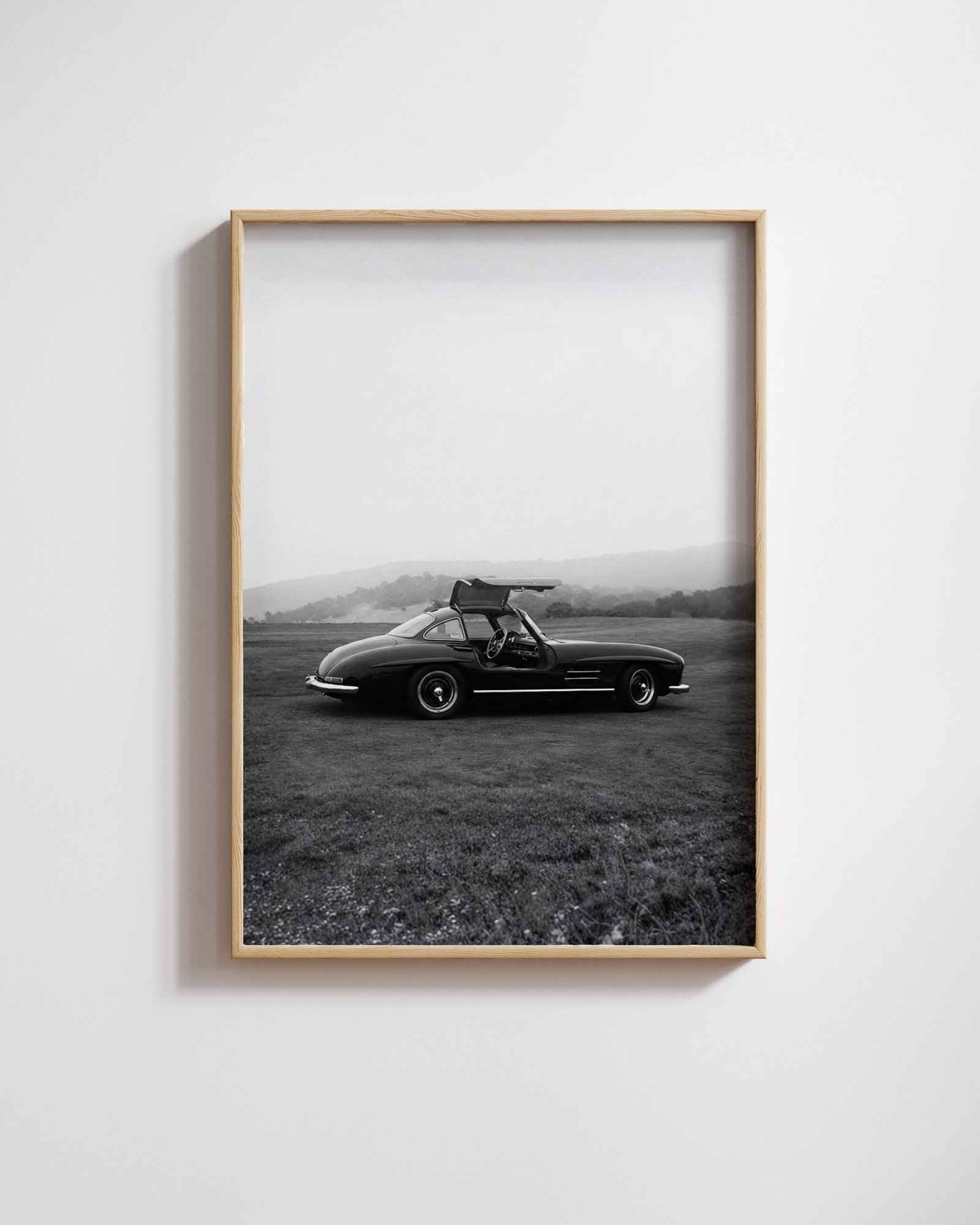
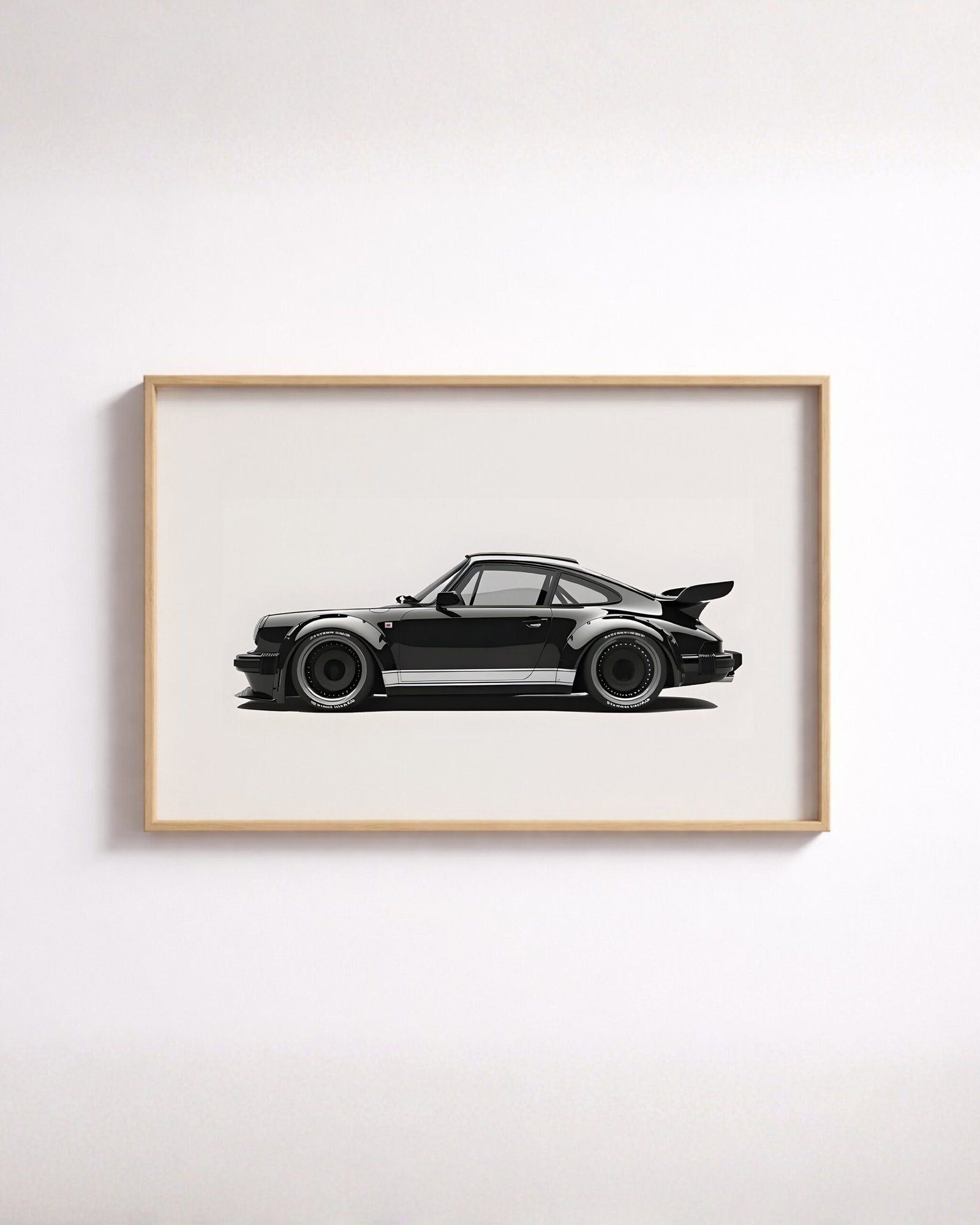
Two of the sizes in that worked table — the Porsche 911 Turbo (930) poster at A1, and the Mercedes 300 SL Gullwing poster at 60×90 — are large enough to sit inside the comfort range across most sofa heights, which is one reason a large print above a sofa is usually the easier choice to get right. For the print itself arriving in a tube rather than a frame, framed or rolled covers what changes about hanging it either way. For hanging height on the other wall people ask about — how high to hang art above a bed works through the same arithmetic against bed dimensions instead of a sofa.
Common questions
How high should the centre of a picture be above a sofa?
There is no single correct number. The only published institutional figure — Smithsonian accessibility guidance, written for wall labels rather than art — names 137 cm (54 in) as comfortable for most viewers, within a range of 122 to 167.5 cm (48 to 67 in). Where your own print lands inside that range depends on your sofa's back height and the print's own height, worked out below.
Is the 57-inch 'museum standard' real?
No single museum, gallery body or curatorial publication appears to issue it. It is a widely repeated decorating convention, not a documented rule, and it is close enough to genuine average eye height to work as a rough starting point — just not as a fact to cite.
How much space should there be between the sofa and the frame?
Convention holds 15 to 25 cm (6 to 10 in) of clear wall between the top of the sofa back and the bottom of the frame. Like the eye-level figure, this is decorating practice rather than a published standard — treat it as a starting range, not a rule.
What if my sofa is unusually low or unusually tall?
Run the arithmetic in this article with your own sofa's back height. A low sofa with a small print can land below the Smithsonian comfort floor; a tall sofa with a large print can land above the popular 57-to-60-inch figure while still sitting inside that comfort range.