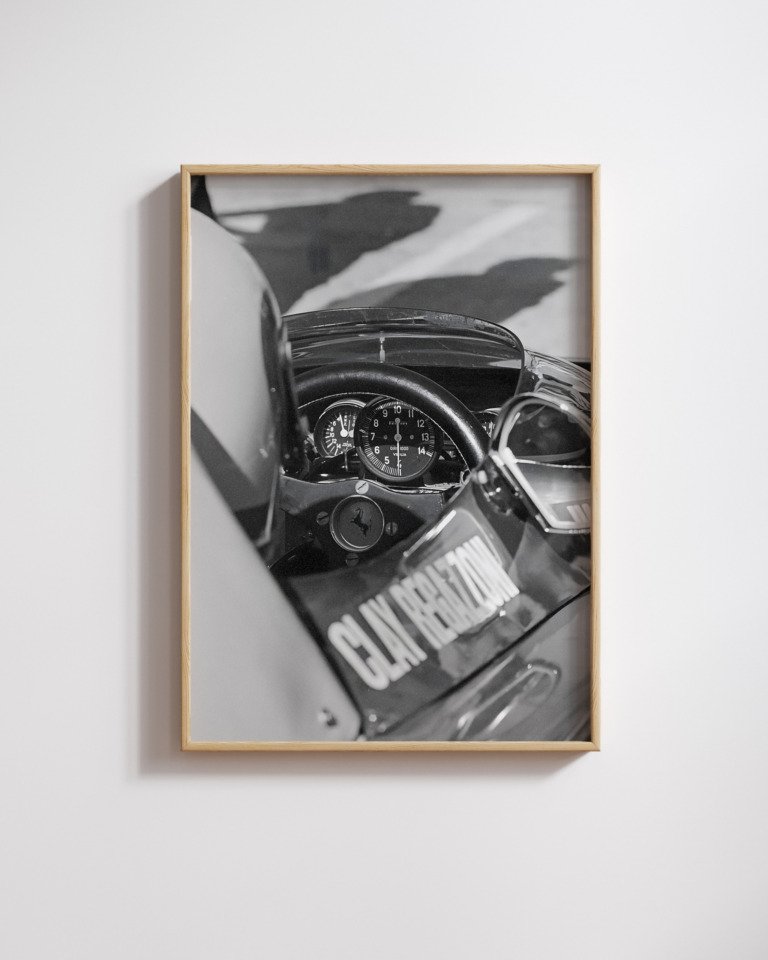
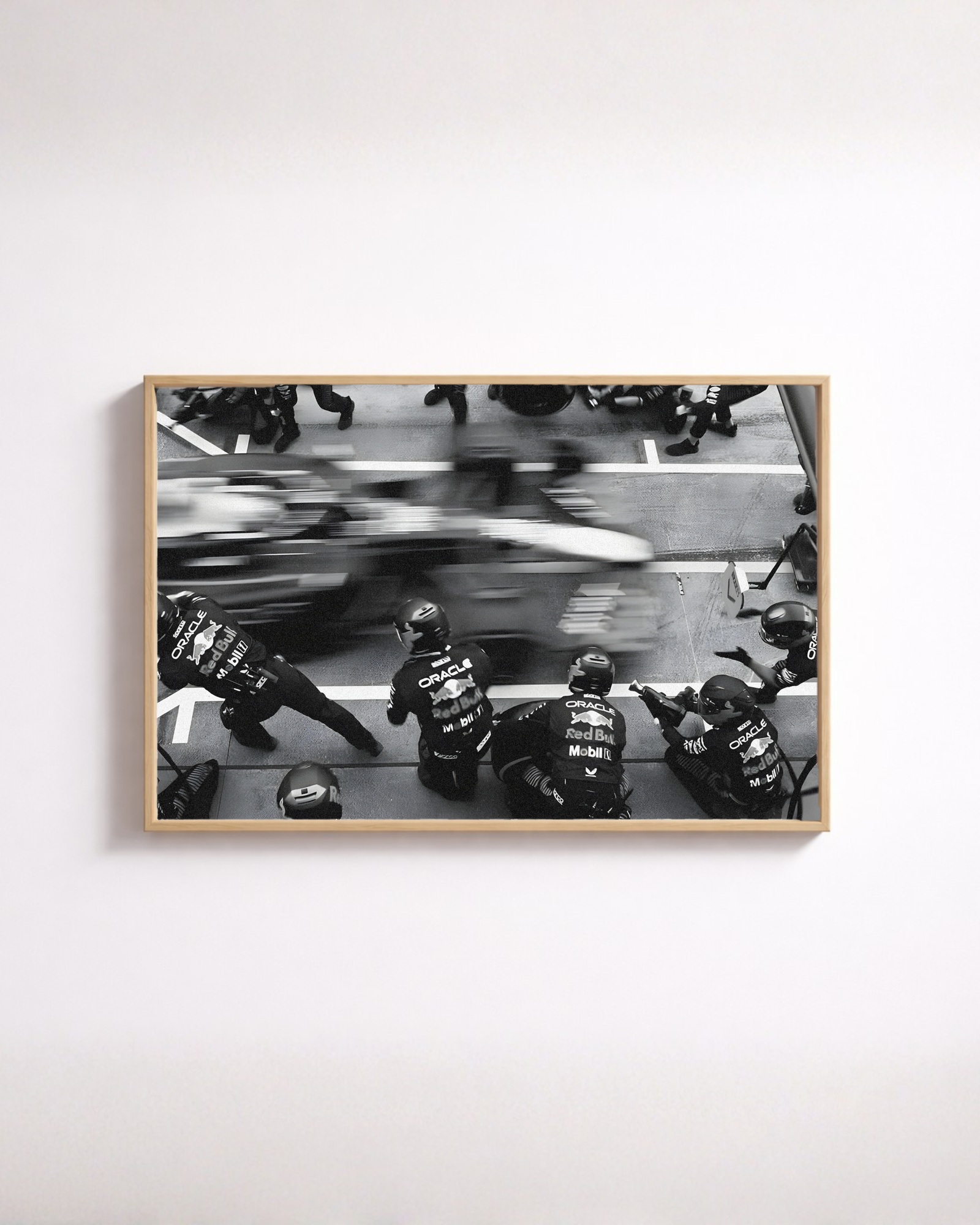
Vintage F1 wall art is one of the easiest things to like and one of the hardest things to place. A black-and-white frame of open-wheel cars reads instantly as old racing and then stops telling you anything. Which decade? Which kind of car? The picture will answer, if you know which three details to read, and all three of them changed inside a single season.
1968 is the hinge
If you want one year to hang the whole question on, take 1968. Wikipedia’s history of Formula One puts three separate changes in that one season, and each of them is visible in a photograph from across a room.
The first is wings. Colin Chapman fitted modest front wings and a spoiler to a Lotus 49B at the Monaco Grand Prix that year. Weeks later, at the Belgian Grand Prix, Brabham and Ferrari went considerably further with full-width wings mounted on struts high above the driver’s head. By the end of the season most of the field had them. They were also, immediately, dangerous: struts and mountings collapsed, and after both Lotus cars broke their wing struts and crashed at the 1969 Spanish Grand Prix the FIA banned wings outright for the next race.
The second is the helmet. The same season is when the full-face helmet arrives, with Dan Gurney the first driver to wear one, at the German Grand Prix. Before that, a driver’s face is visible. After it, increasingly, it is not.
The third is paint. Sponsor liveries reach Formula One in 1968 as well, and the older convention they replaced was national racing colour — a car’s paint told you what country it was entered from, not who was paying for it.
Reading the car
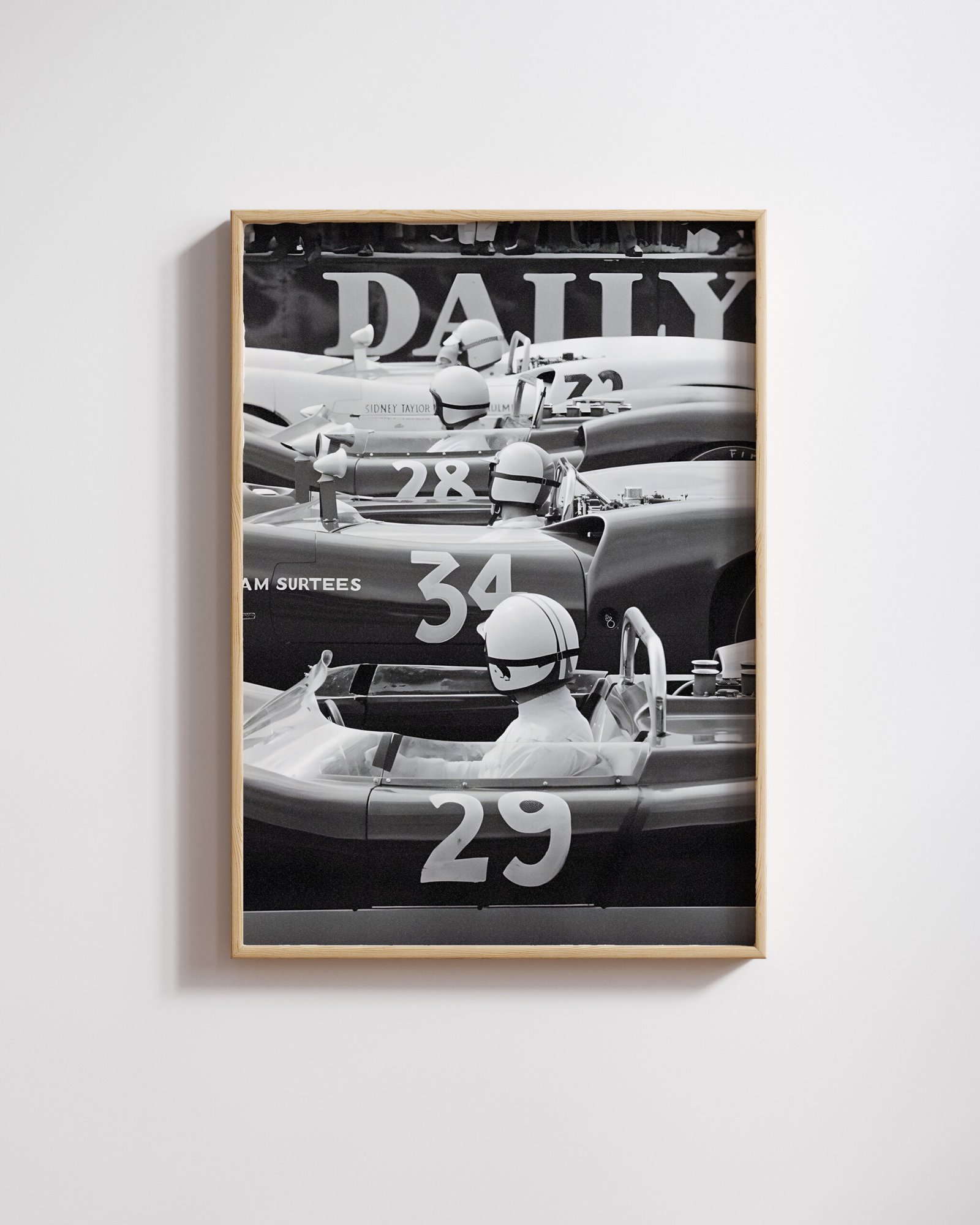
Work outwards from the bodywork. A car with exposed wheels, a cigar-shaped body and nothing above the rear axle is pre-wing. A car with a wing on tall struts is a snapshot of a window barely a season wide. A car with wings blended into the body, and sidepods running alongside the driver, is later — and if the sidepods look like they are trying to seal themselves to the road, you are in the ground-effect period.
Formula 1’s own account of how the rule book was rewritten describes ground effect dominating aerodynamic development in the late 1970s and early 1980s, and then the regulators closing it down: skirts banned and a mandatory 6 cm ground clearance imposed in 1981, and eventually a requirement for flat bottoms between the inside tangent of the tyres. We are not going to put a year on that last rule here, because the source we read does not state one plainly and we would be guessing.
A wing tells you the decade. A helmet tells you the driver could still be recognised. The paint tells you who was paying.
Reading the people
The second half of racing imagery has no car in it. Pit crews in shirtsleeves, timekeepers with stopwatches, a driver leaning on a wall. These photographs date themselves through clothing rather than engineering, and they tend to survive better on a domestic wall, because a viewer who does not care about motorsport still sees people.
It is worth being blunt about one thing here. We can tell you what is in the frame and what those details usually mean. We do not know when or where any photograph in this catalogue was taken, and we are not going to invent a caption that says otherwise. Where a piece has a subject we can name, we name it. Where it does not, it gets described and left alone.
The vintage F1 wall art in this catalogue
Three pieces sit squarely in this territory, and they are three different answers.
The classic motorsport poster of open-wheel cars is the pure version: exposed wheels, slim bodywork, white helmets, no aerodynamic clutter anywhere in the frame. If you want the era stated rather than suggested, this is the one, and it is the piece that reads correctly from the other side of a room.
The pit lane kiss poster is the human half. A helmeted driver, a woman in a headscarf, and a moment that would not happen in a modern pit lane. It carries the period without needing you to know a single thing about the cars, which is why it works in a hallway rather than a garage.
The vintage pit crew poster splits the difference: shot from above, a crew working around a car that has been pulled into motion blur. It is the most graphic of the three — the composition is nearly abstract until you resolve what the shapes are.

Hanging it
Monochrome racing photographs behave like photographs, not like memorabilia. They will hang next to anything else black and white without arguing, and they do not need a themed room to make sense. The colour pieces in the catalogue are a different proposition: they want space, and they want to be the loudest thing on the wall.
One practical note. The two landscape pieces above want a horizontal run — above a sofa, along a hallway — while the portrait-format work wants a narrower wall. Deciding that before you choose the image saves the more common mistake, which is buying the picture you like and then hanging it somewhere the shape fights.
If you want the engineering story rather than the photographs, we have written about how the rule book kept redrawing the shape of the car. And if you want a single race rather than an era, the 1985 Portuguese Grand Prix is the one we have covered in most detail.
Häufige Fragen
What counts as vintage F1 wall art?
There is no official cut-off. In practice a picture reads as vintage when the car has exposed wheels and little or no aerodynamic bodywork, when the driver is wearing an open-face helmet, and when the car is painted in a national racing colour rather than a sponsor scheme. All three of those started changing in 1968.
How can I date a Formula 1 photograph myself?
Look at the wings first, because they arrived suddenly. Wikipedia's history of Formula One records front wings and a spoiler appearing on a Lotus 49B at Monaco in 1968 and full-width strut-mounted wings at the Belgian Grand Prix weeks later. Then look at the helmet: the full-face helmet also enters the sport in 1968. A car with no wings and a driver with an open face is very likely to predate that season.
Do you know when your own racing photographs were taken?
No, and we will not guess. We can describe what is in the frame - the shape of the cars, the helmets, the clothes - and we can tell you what those details usually mean. We do not have a date or a location on record for the images in the catalogue, so we do not print one.
Does vintage F1 wall art work outside a garage?
The monochrome pieces do, because they read as photographs before they read as motorsport. A high-contrast black-and-white frame sits comfortably in a hallway or an office next to anything else monochrome. Full-colour racing imagery is louder and wants a wall of its own.