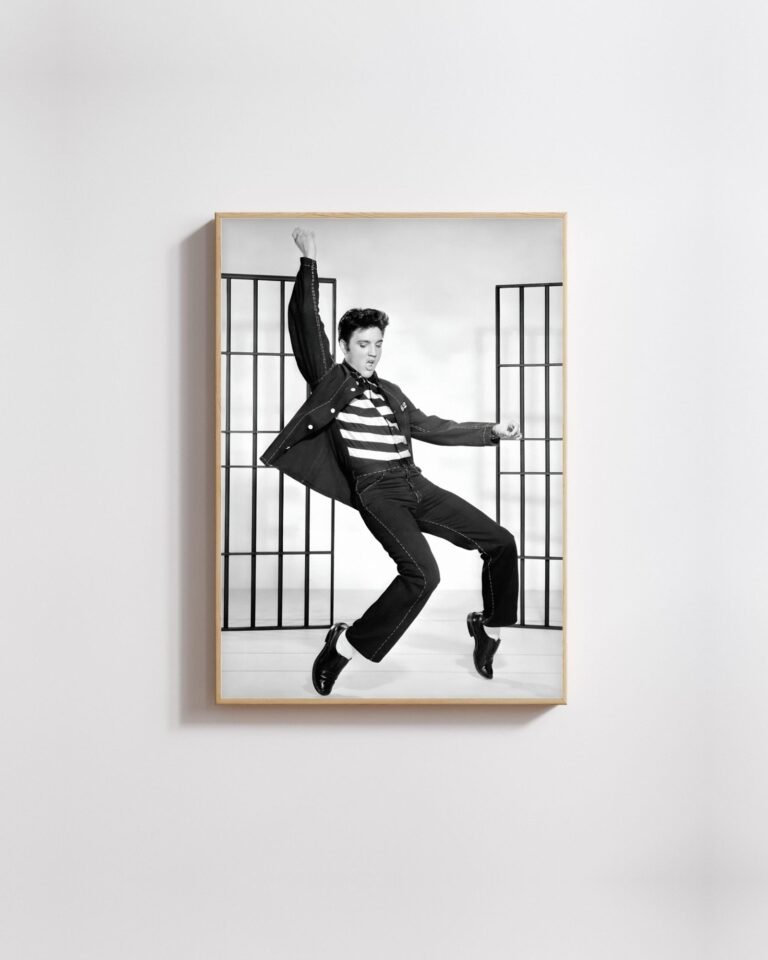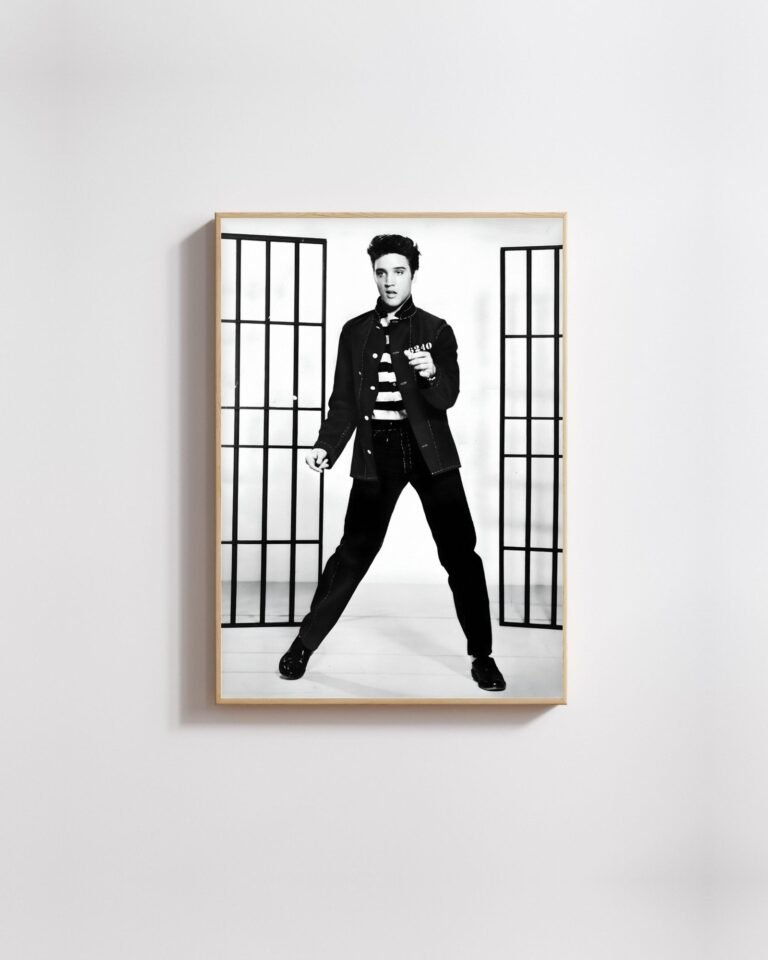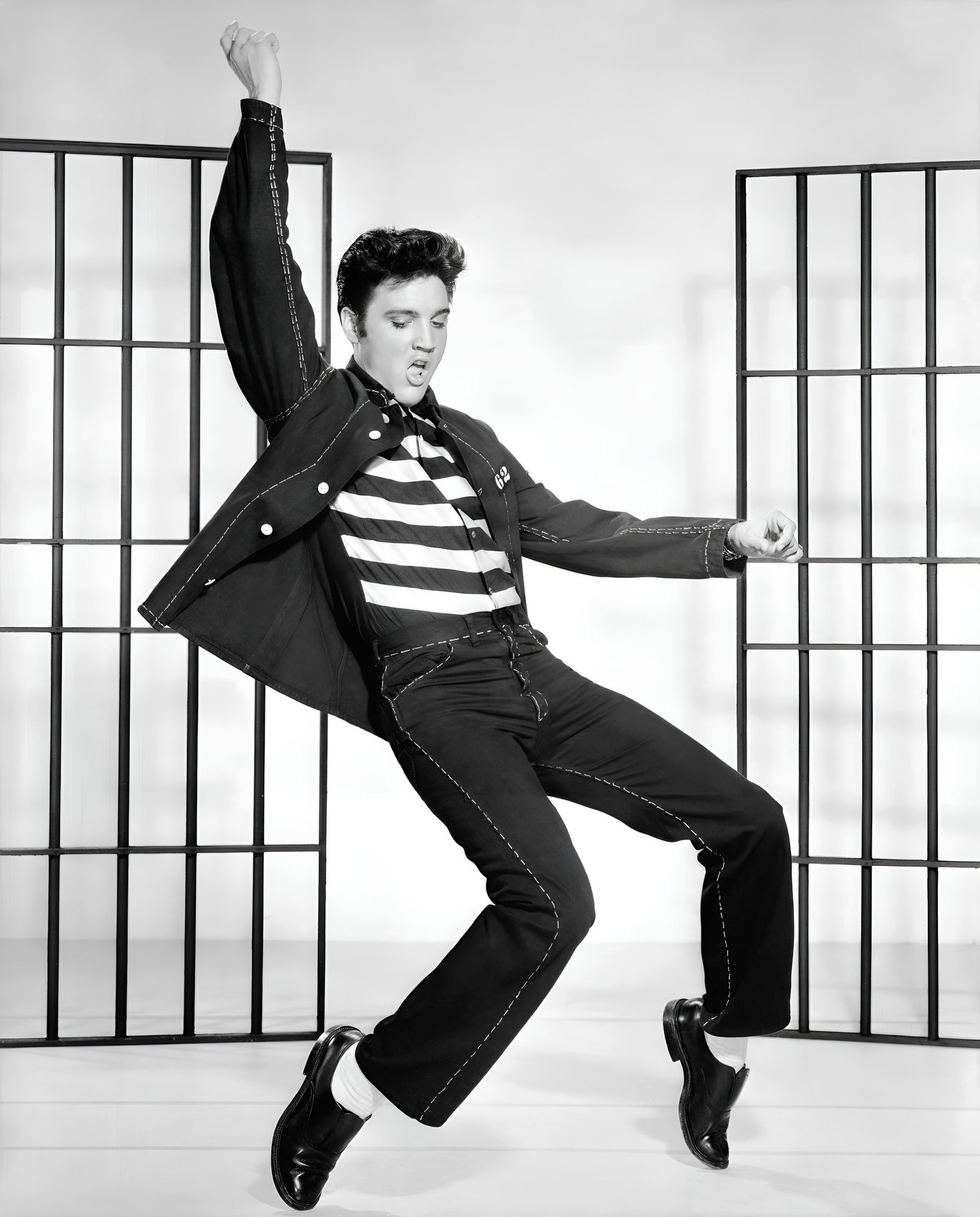
Before it was a song anyone could hum, it was a set: a row of stylised cell bars, a bare white stage, and a young singer in a striped shirt rehearsing a dance that the choreographers of the old screen musicals would study for years. Our print The Jailhouse Dance, 1957 is a publicity frame from that production — the singer caught at the top of the number’s great leap, one fist punched to the sky, knees bent, mouth open mid-lyric, the black bars drawn behind him like the lines of a comic strip. It is arguably the most energetic still photograph of the 1950s.
The number it advertises broke the rules of its genre. Screen dance before 1957 was largely borrowed from the stage: chorus lines, ballrooms, tap routines performed to the camera. This production staged its big number like something between athletics and mime — dancers sliding down poles, using the cell-block set as apparatus, moving with a loose, street-corner physicality that owed more to the singer’s own instincts than to any choreographer’s training. The young star had insisted on shaping the routine himself, and the result looked like nothing the musical had produced: less performed than unleashed.
The publicity still as an art form
Frames like this one were the work of studio unit photographers, the unsung image-makers of the studio system. Their brief was practical — produce stills that newspapers could print, exhibitors could paste in lobbies and magazines could build covers from — and the best of them treated the brief as a licence. A unit still had to stop a reader mid-page, so it learned the grammar of the poster: one figure, one gesture, a graphic ground. Here the ground is the bars themselves, verticals and horizontals in pure black, against which the striped shirt reads as a second, smaller set of bars worn by the man escaping them.
It worked beyond the studio’s hopes. The stills from this production escaped the film’s publicity and entered the general culture — dormitory walls, magazine retrospectives, the visual shorthand by which the whole decade is now summarised. The leap became a logo for an idea: youth, rhythm and cheerful defiance, in a striped shirt. That is the fate only a handful of publicity photographs ever achieve, to be remembered longer than the plot they were made to sell.
On the wall
Few photographs carry this much upward energy, and the print uses it: it lifts hallways, music rooms and stair walls, anywhere a picture is met in motion. The graphic black of the bars is a built-in frame, so the print asks little of its own framing — plain, dark or pale, it holds. The poster sizes chart shows the sizes against a standard wall.
Its indispensable companion hangs one thought away: The Jailhouse Portrait, 1957, from the same production and the same set — the same singer standing his ground, pointing down the lens, all the leap’s energy held in a stare. For a wider conversation about the era’s composed cool, pair either with The White Wedge and the Woman in Black. Motion, attitude, and the decade that taught the world both.
The frame’s legal story is as remarkable as its leap. Studio publicity photographs of the period were distributed without the copyright notices the law then required, and so the stills entered the public domain — free for anyone to print, which is one reason they spread so far and so fast in the first place. The image that taught a generation to move now belongs, fittingly, to the generation’s grandchildren as much as to anyone: a piece of the common inheritance, mid-air forever.
Photograph: MGM unit publicity, 1957 — Public domain (photograph). Source: the holding archive.
أسئلة شائعة
What is happening in this frame?
A young singer caught mid-leap in a 1957 dance number — both feet off the ground, one fist raised, stylised cell bars behind him. The number stopped its film dead and started a dance craze; this is the leap itself, frozen at the top, all energy and no landing.
Why does this single frame read so clearly?
Because the choreography was built from shapes. The raised fist, the kicked legs, the bars as backdrop — the whole number was designed to be read in silhouette, which is why its stills have outlived almost everything else shot that year. On paper, the leap holds forever.
Where does it hang?
Music rooms, hallways, collector walls — anywhere a wall is allowed to move. It is the twin of the portrait frame from the same production; hung together, leap and stare, they are the complete story of that performance.
What are the specifications?
Archival pigment giclée at 300 dpi on 200gsm FSC-certified matte paper, fifteen sizes from 13×18 cm to A0. Made to order in about 72 hours; free tracked shipping worldwide; framing in four finishes on the middle and larger sizes.