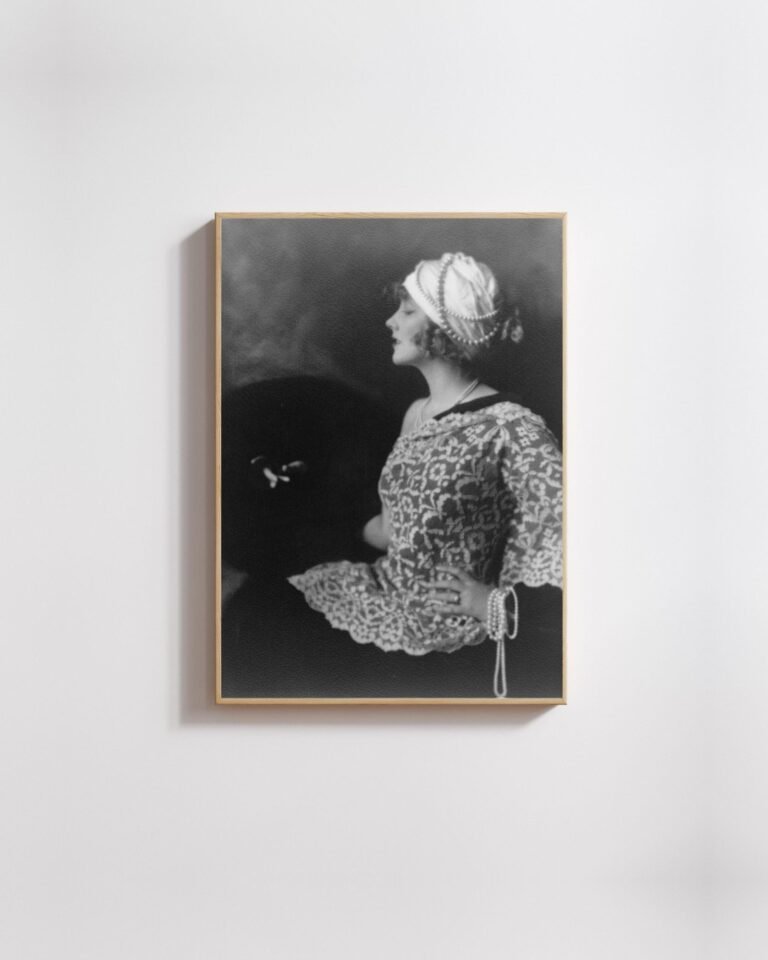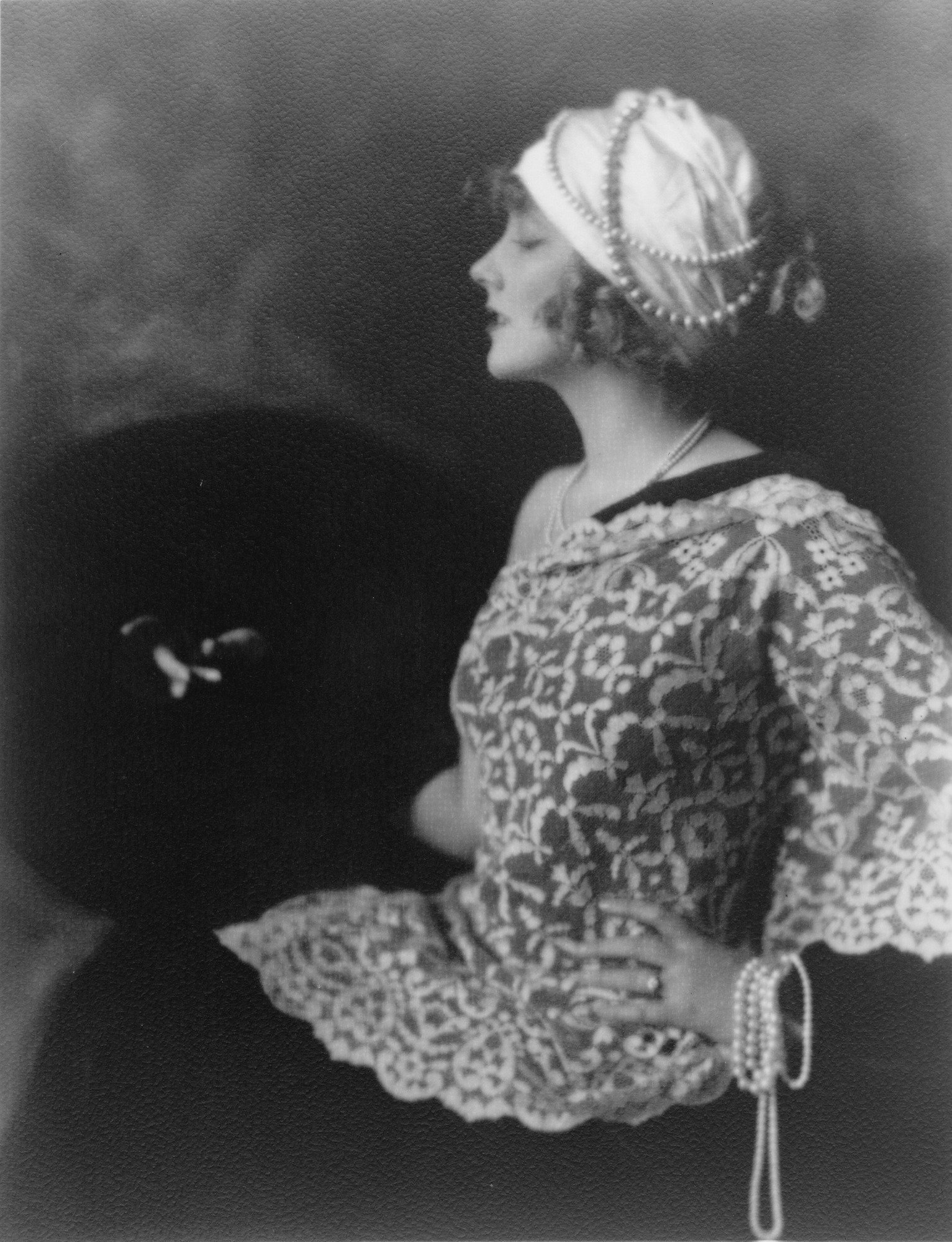
Of all the frames in the 1920s studio set, this is the one that asks to be looked at quietly. Our print Lace in Profile shows a sitter in strict profile, eyes closed, her head bound in a pale cap strung with pearls, a deep shawl of floral lace across her shoulders whose scalloped edge falls from one hand. Strands of pearls loop at her wrist. The light is soft and comes from the side, and the whole photograph seems to be holding its breath — a portrait not of a performer performing, but of a person at rest inside the performance’s costume.
Profile portraits are the oldest kind there is; coins and cameos carried them for millennia before photography existed. The profile gives the viewer everything and nothing — the full architecture of a face, with the personality withheld behind a closed eye. The theatrical studios, whose business was personality, rarely risked it. When they did, as here, the results have a gravity the smiling publicity frames never reach: this could be a memorial portrait, or a saint in a side chapel, as easily as a showgirl between engagements.
Light through fabric
The lace is the photograph’s real subject, and it is doing something technically lovely. A floral lace shawl, lit from the side, is neither opaque nor transparent: the pattern holds the light where the threads are dense and lets it through where they open, so the shawl becomes a screen on which light itself is patterned. Against the dark ground, that screen glows with a delicacy no painted backdrop could imitate. The pearl-strung cap repeats the lesson in miniature — each bead a small, complete highlight — and the loops of pearls at the wrist trail the eye down to where the lace’s edge breaks into scallops over her hand.
Sittings of this kind were the studio’s quiet luxury. There is no scenery to arrange, no costume change, no audience of assistants: a sitter, a shawl from the wardrobe, and a photographer working close with a large-format camera whose negative could resolve every thread. The intimacy shows. It is the set’s smallest-scale image and, thread for thread, its most finely made.
Where it belongs
Profile portraits belong where faces have always belonged in a house: the bedroom, the dressing table wall, the reading corner — rooms where a picture is lived with at arm’s length rather than glanced at from a doorway. This one rewards closeness more than any other in the set, because its substance is detail. Hung at eye level with a simple frame and a pale mount to lift it from the wall after dark, it has the stillness of an object in a case. The poster sizes chart shows the full range of sizes against a standard wall.
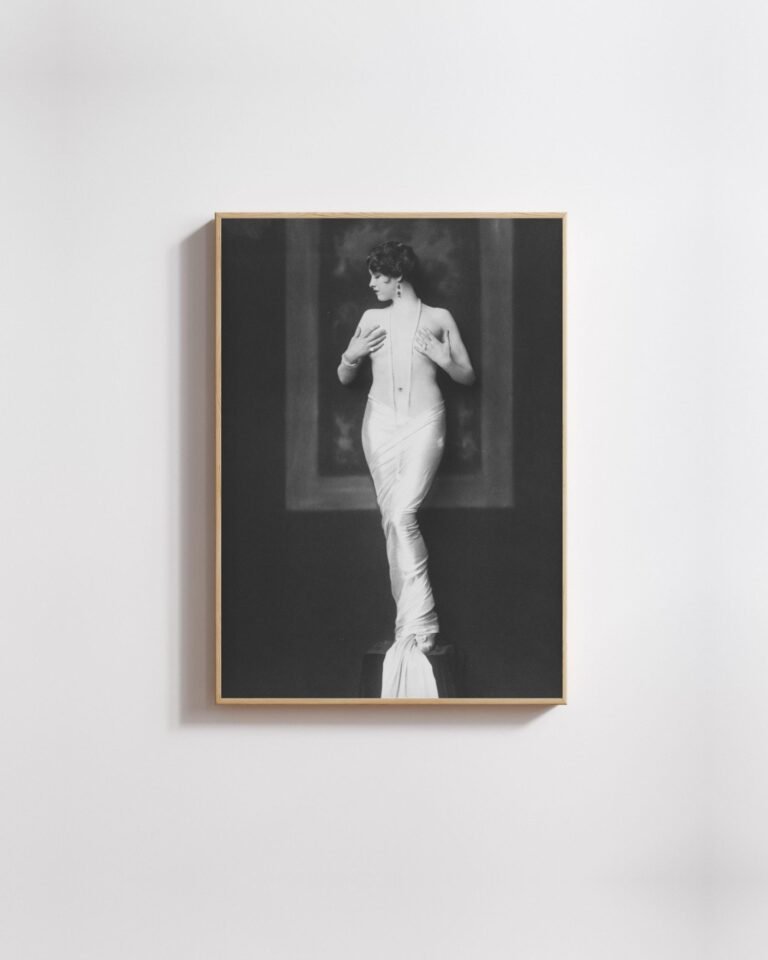
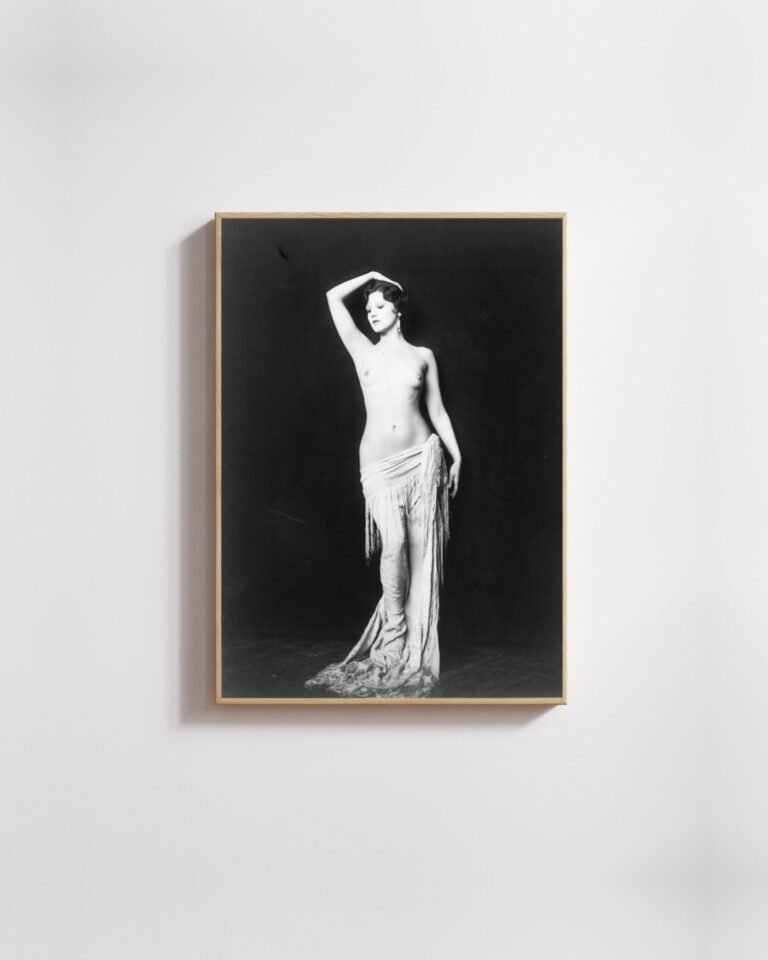
For companions, look first within the studio set: Seated in the Tapestry Room offers the studio’s other world, scenery restored, and The Sheer Gown carries the same restraint to full length. Together the three make a small history of how the era’s greatest glamour studio behaved when it stopped selling and started simply looking.
It is fitting that the frame rests today in the national library’s prints and photographs division, among the permanent records of the country’s portraiture. The studio that made it was selling glamour by the sitting; what it left behind, in plates like this one, was a school of American portrait photography — and the lace profile is its quietest lesson: that a closed eye, a strict profile and a shawl full of light could say more than any smile the publicity department ever ordered.
Photograph: Alfred Cheney Johnston; Library of Congress, Prints & Photographs Division — No known restrictions on publication. Source: the holding archive.
أسئلة شائعة
What is she wearing on her head?
A pearl-strung cap, over an embroidered lace shawl — a 1920s sitter in profile, eyes closed, in the quietest frame of the studio set. Where the other studies perform, this one rests; the portraitists of the era saved their softest light for exactly this mood.
Why are her eyes closed?
Because the photograph is about texture rather than encounter: lace against skin, pearls against hair, a face at peace inside its own arrangement. Closed eyes take the portrait out of conversation and into contemplation — which is why it suits the rooms it suits.
Where does it hang?
Bedrooms, dressing rooms and reading corners — quiet rooms, at reading distance. It is the gentlest piece in the boudoir collection and the one most often chosen for a private wall rather than a public one.
What are the practical details?
Archival pigment giclée at 300 dpi on 200gsm FSC-certified matte paper, fifteen sizes from 13×18 cm to A0. Made to order in about 72 hours; free tracked shipping worldwide; framing in four finishes on the middle and larger sizes.