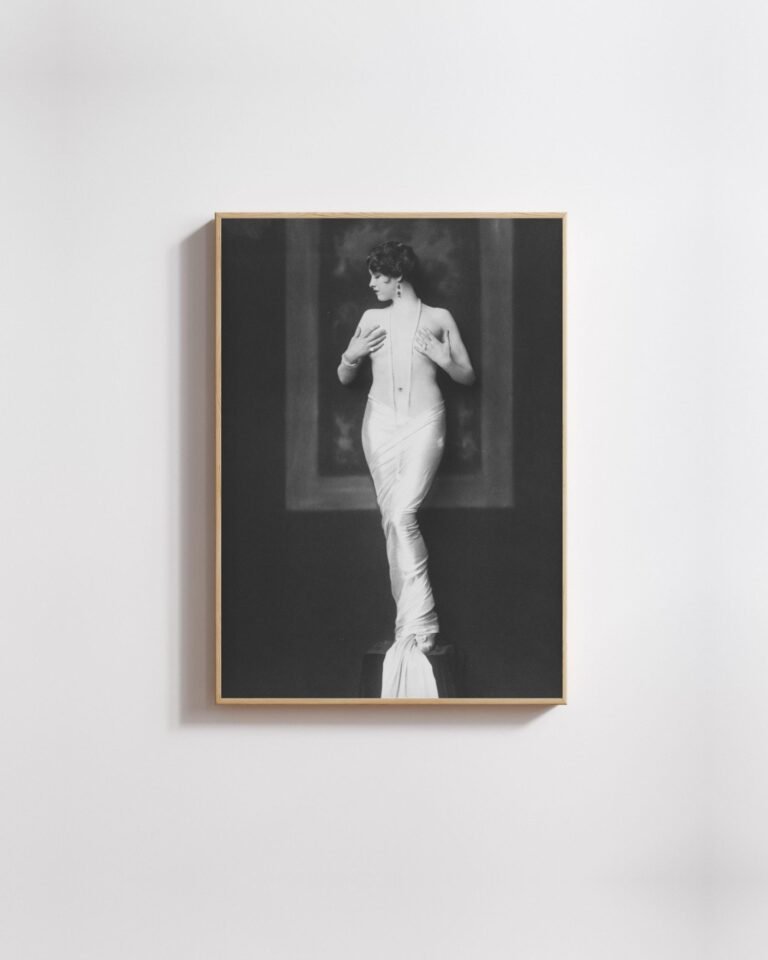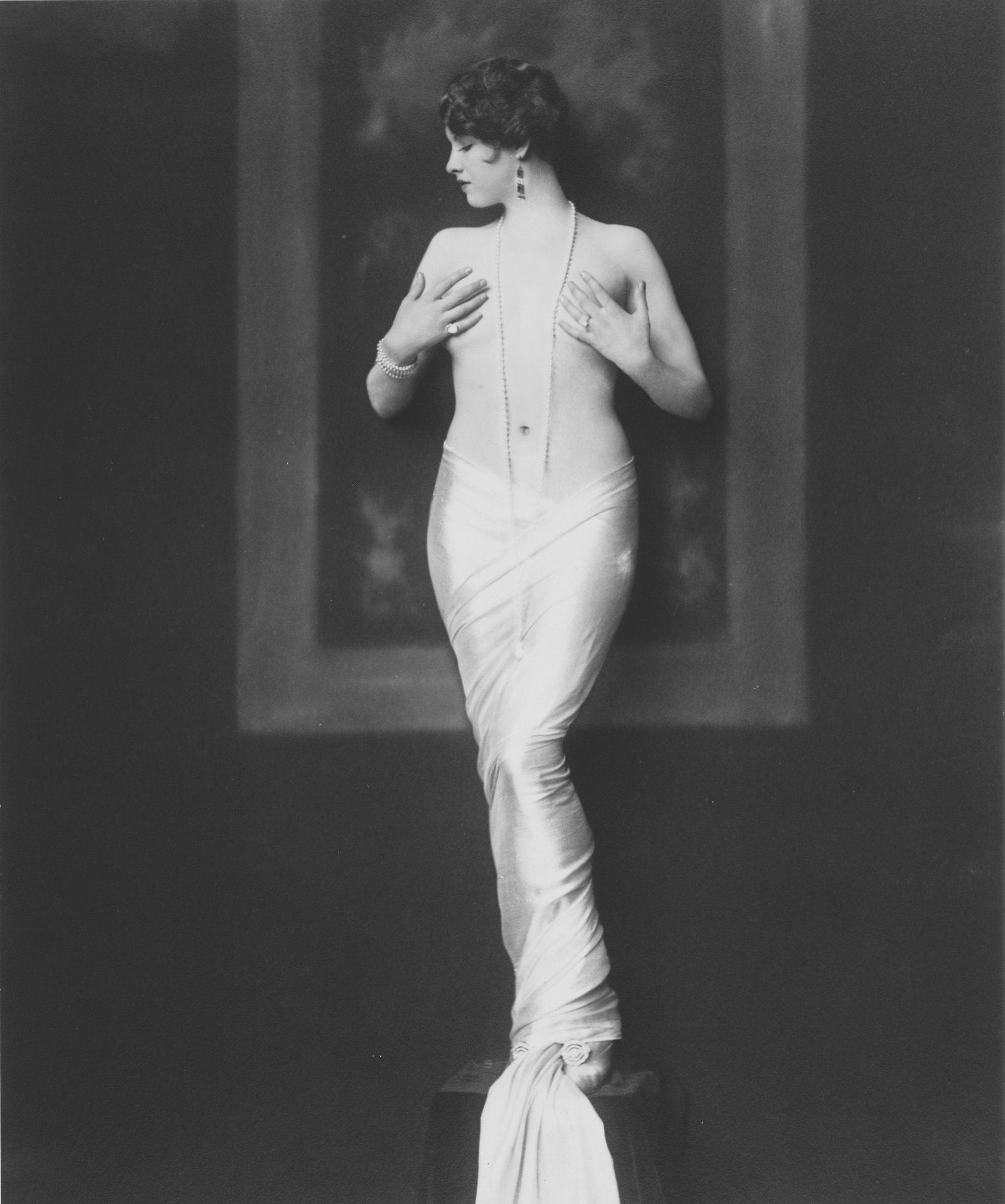
Some photographs are remembered because they caught a moment. This one is remembered because it caught a pose so complete that the moment became permanent. Our print The Sheer Gown shows a sitter of the great 1920s theatrical studio standing full-length against darkness: head turned in strict profile, hands held lightly to her chest, a single long strand of pearls falling to her waist, and pale silk wound around her hips and legs in a long spiral that pools at her bare feet. It is the most reproduced frame its studio ever made — and a century on, it is not hard to see why.
The first thing to understand is that the image is a statue study in photographic form. The pose descends from classical sculpture by way of the nineteenth-century academy: the figure arranged as a single unbroken line from head to ankle, the drapery doing what drapery has done since marble — leading the eye downward and giving the composition its rhythm. The studio that made it specialised in exactly this translation, bringing the language of the life-drawing room into theatrical publicity and producing, almost by accident, fine art.
Why this frame outlived the rest
The studio made thousands of portraits, and most of them did their work and vanished into newspaper morgues and lobby-card stock. This one kept being chosen — reprinted, collected, exhibited — until it became the image by which the whole tradition is now introduced. Part of the reason is technical: the large-format negative holds an extraordinary tonal range, from the bright spiral of silk to the near-black surround, and the sitter is lit with a sculptor’s logic, modelling rather than flattening. Part is the figure’s composure. She does not perform for the camera; her gaze is directed out of the frame entirely, and the hands at her chest make a gesture that is modest and monumental at once.
And part of it is the economy of the thing. Pearls, silk, darkness: the photograph contains three elements and wastes none. The long pearl strand is the only jewellery, and it draws the one vertical line that the silk’s spiral keeps crossing. Even the small pedestal beneath her feet reads as a plinth. Strip the image of its date and it could be a gallery piece from any of three centuries — which is, in the end, what it became.
Hanging a gallery piece
This is a print to hang the way galleries hang: alone on its wall, or with generous air, in a room that is chosen rather than passed through — a bedroom, a dressing room, a bathroom with a long wall. Its darkness is deep but its figure is luminous, so it holds a wall at distance and rewards approach; the silk’s winding highlights are the detail to be near. A plain frame and a pale mount suit it best. The poster sizes chart shows every size against a standard wall.
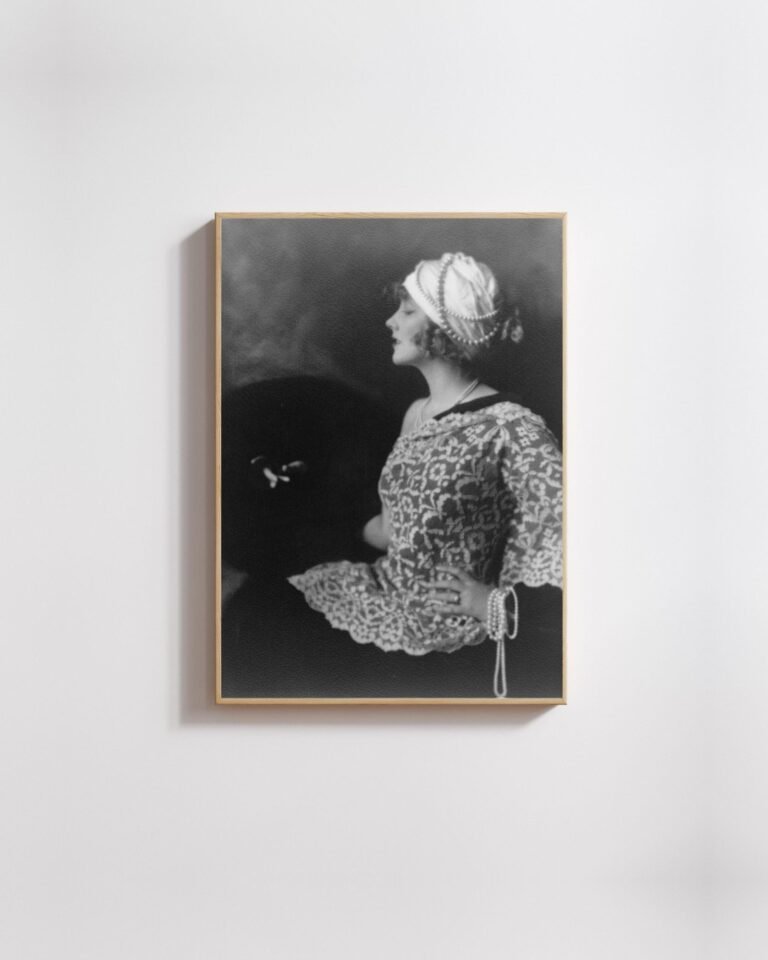
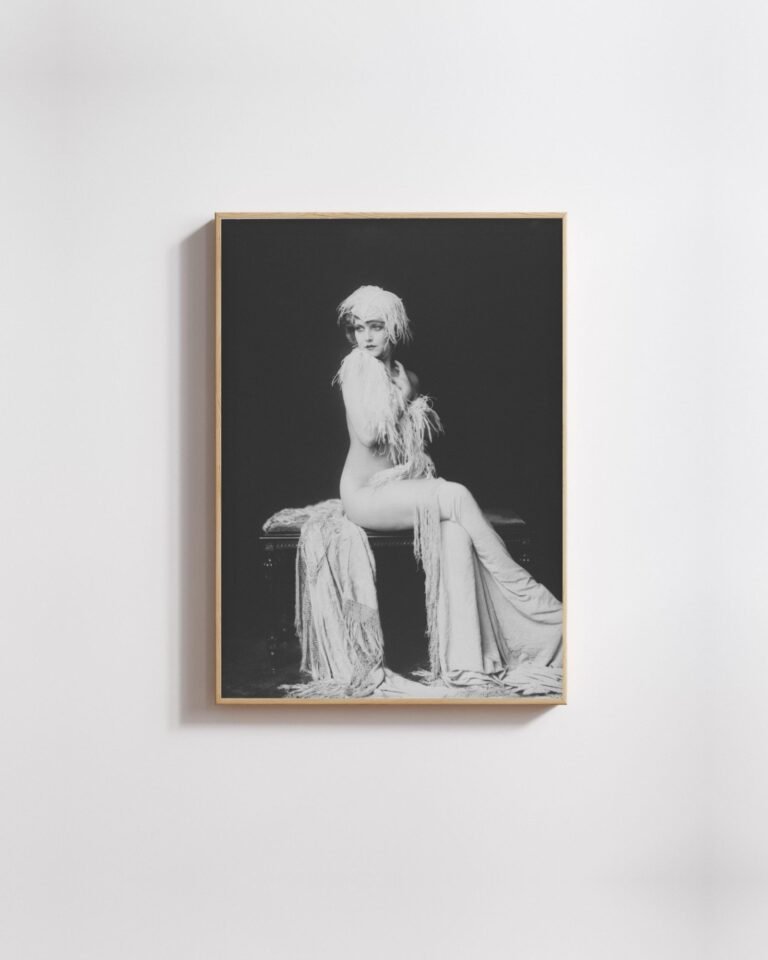
Within the studio set, its closest relatives are Full-Length Study, Arm Raised, which shares the classical language and the black ground, and Lace in Profile, the set’s other study in restraint. Collectors of the store’s editorial frames will also find its echo in The Muse and the Roadster — proof that the composed, statuesque portrait did not die with the twenties; it simply changed its clothes.
That the frame is held today by the national library’s prints and photographs division, catalogued among the permanent records of American photography, settles the argument about what it is. Publicity it may have been in 1920-something; art is what the archive, the exhibitions and a century of reprinting have agreed to call it since. The print on your wall is simply the latest, and most private, of its exhibitions.
Photograph: Alfred Cheney Johnston; Library of Congress, Prints & Photographs Division — No known restrictions on publication. Source: the holding archive.
أسئلة شائعة
What is she wearing in this study?
Almost nothing, arranged like sculpture: a long strand of pearls and pale silk wound to the ankles, lit against darkness like marble. The 1920s studio photographers who made frames like this were producing figure studies for artists and collectors — closer to a statue study than to a pin-up, and the print keeps that intention.
How is a study like this acceptable as wall art?
Because it was made as art the first time. These studio plates were exhibited, collected and used as artists' references in their own decade. The treatment is light and line, the mood reverent, and the site keeps the boudoir line behind an age gate — but the register is gallery throughout.
Where does it hang?
Bedrooms and dressing rooms, at a scale that suits contemplation — the middle sizes are the connoisseurs' choice. It is the centrepiece of the 1920s studio set; the other four studies arrange around it naturally.
What are the specifications?
Archival pigment giclée at 300 dpi on 200gsm FSC-certified matte paper, fifteen sizes from 13×18 cm to A0. Made to order in about 72 hours; free tracked shipping worldwide; framing in four finishes on the middle and larger sizes.