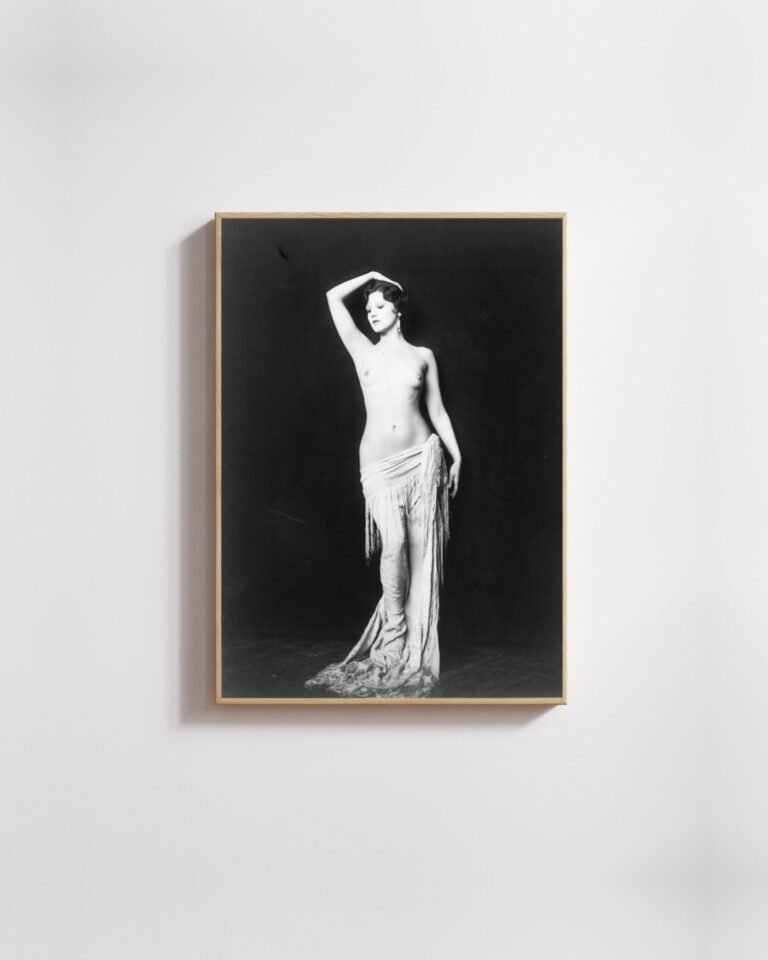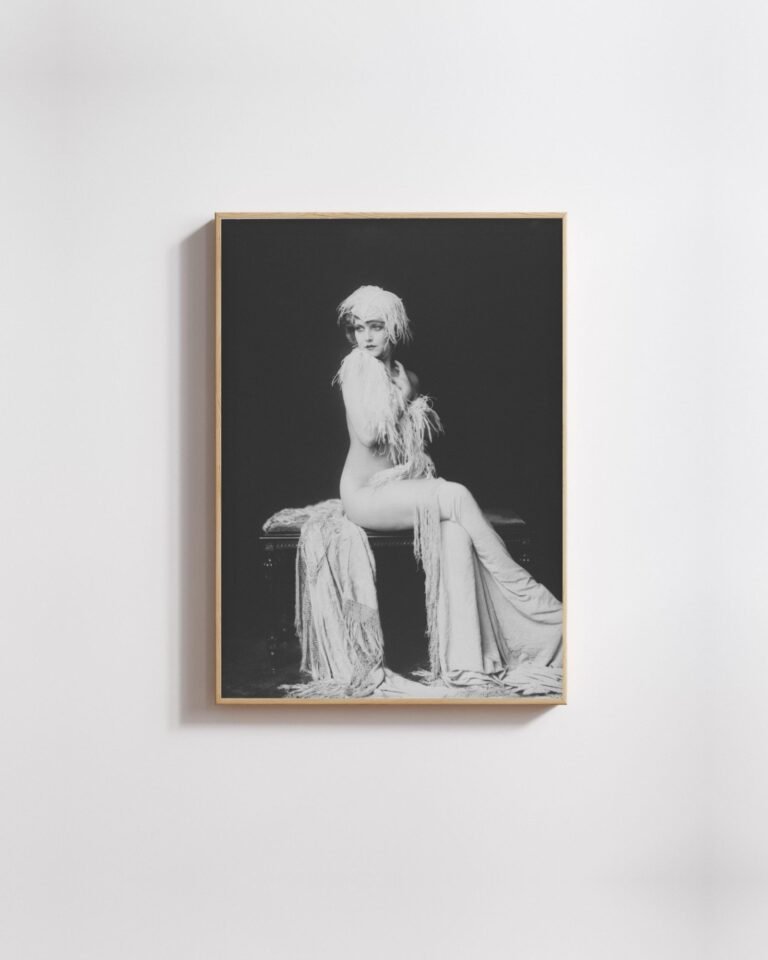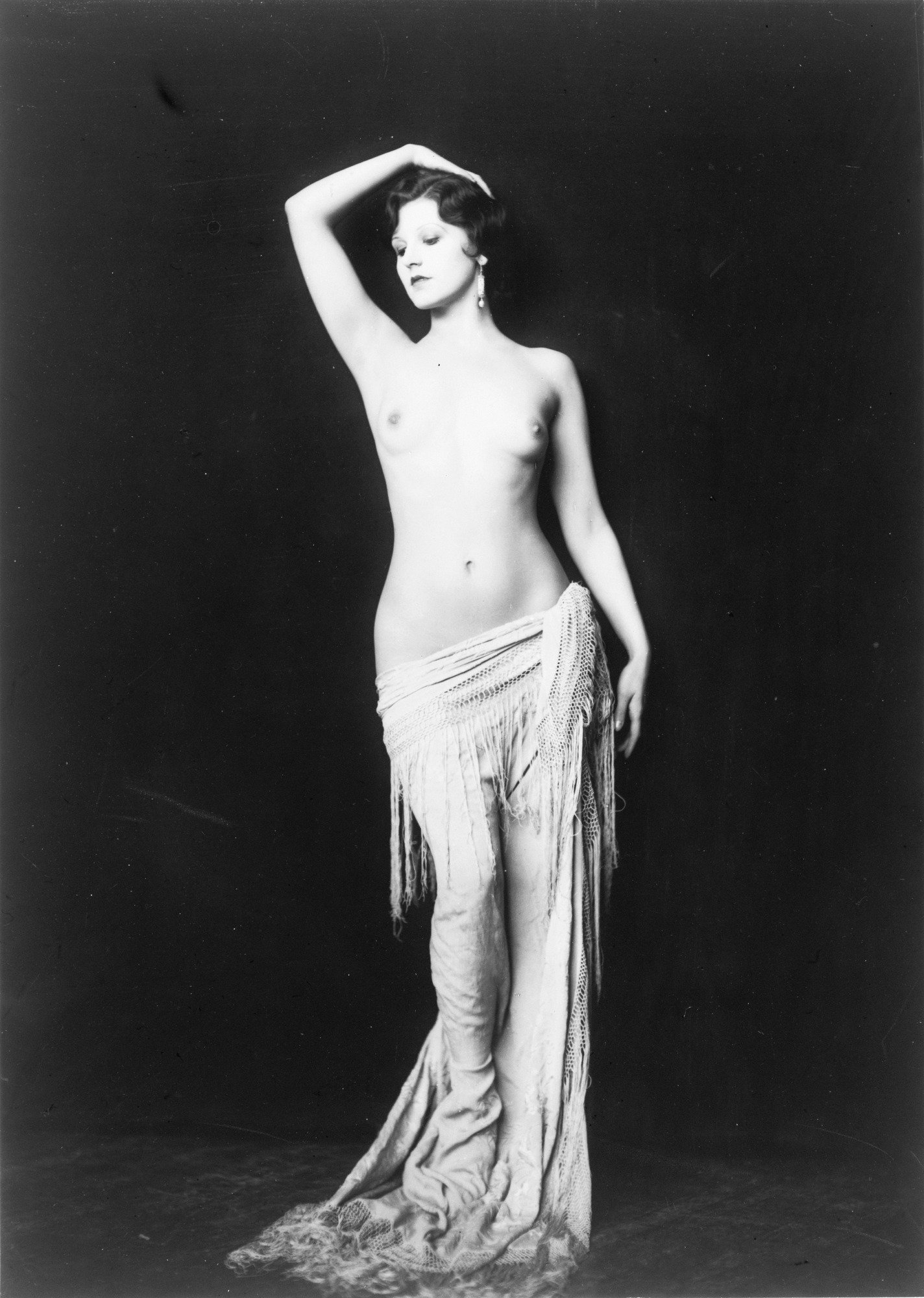
One arm raised and curved over the head, the other fallen at the side, eyes lowered, weight settled into a long, quiet line — the pose is two thousand years old, and the sitter in our print Full-Length Study, Arm Raised holds it the way the antique statues held it, as if it were the most natural way in the world to stand. The frame comes from the great 1920s theatrical studio, but almost nothing in it belongs to the twenties except the film: a black backdrop, a fringed and crocheted shawl wound at the hips and trailing to the floor, a single drop earring, and the pose that art schools had been teaching from plaster casts for centuries.
That continuity was deliberate. The theatrical glamour studios saw themselves as heirs to the portrait painters and, behind them, to classical sculpture. A performer who came in for publicity photographs might leave with a frame that quoted antiquity outright — because the studios’ clients were not only selling tickets; they were manufacturing the idea that Broadway glamour had lineage. The raised arm, borrowed from statues of Venus and from a hundred academy life studies, was the quickest way to say it.
The academy pose in a working studio
The pose has a practical virtue that sculptors understood and photographers rediscovered: it lengthens everything. The raised arm extends the figure’s line past the head, opens the torso to the light, and creates the long diagonal that organises the whole composition — answered here by the shawl’s train, which runs the eye back down to the floor and closes the circuit. Against the black void there is nothing to interrupt that circuit. The photograph becomes a piece of calligraphy written with a standing figure.
It is also worth noticing what the frame itself admits: the negative’s border is part of the surviving record, a reminder that this was a working studio’s plate, made to be printed, cropped and published — and yet the image inside it is as composed as anything in a museum. That doubleness is the charm of the whole set. These were commercial sittings, charged by the session and destined for newspapers, which happened to be conducted at the level of art.
Living with the classical line
The figure’s long vertical makes the print a natural for the walls other pictures struggle with: the narrow panel beside a door, the end of a landing, the space above a low chest in a bedroom. It is a calm image — the calmest in the set, after the lace profile — and it suits rooms kept quiet. Give it a simple frame and a little air, and it reads as sculpture that happens to be flat. The poster sizes chart sets out the sizes against a standard wall; the frame’s generous black field means even the smaller sizes hold a wall.
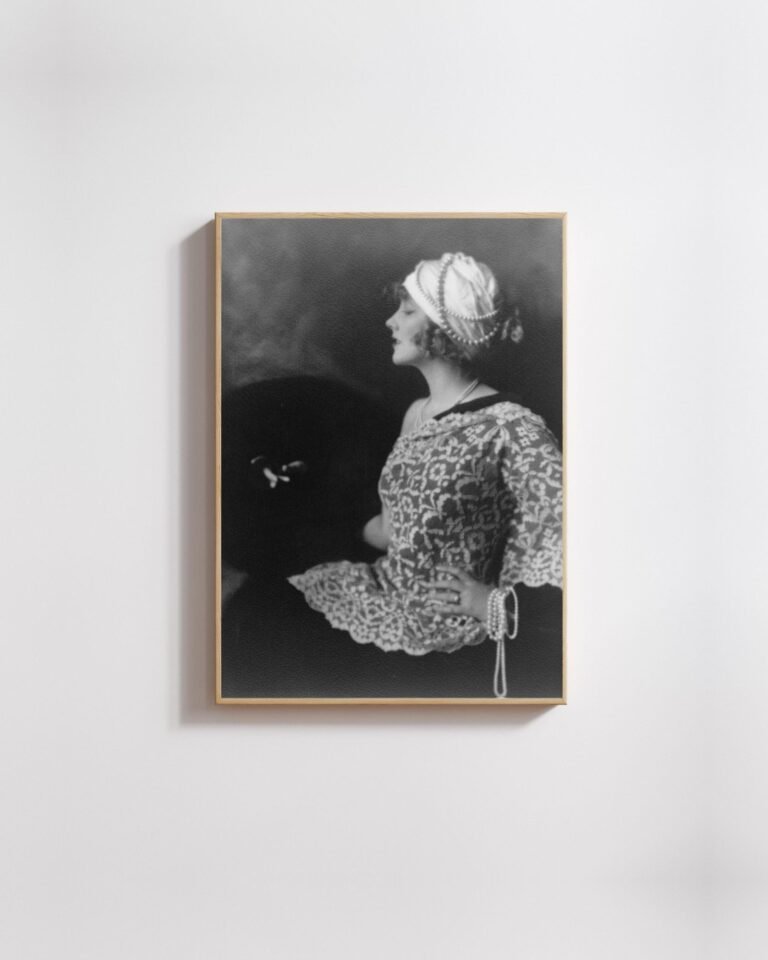
Its siblings complete the studio’s argument from three sides: The Sheer Gown takes the same classical language and adds the spiral of silk that made it famous; Platinum Study with Plume trades the academy for pure theatre. Hung as a pair or a trio on one wall, the three frames show a single studio thinking — about line, about light, and about how much antiquity a modern girl could carry.
The survival of the negative — border, plate number and all — is part of the gift. The national archive that holds the studio’s legacy preserved not just the image but the evidence of its making, and that evidence has become part of how the work is loved: proof that this serene, classical figure began life as one plate among thousands in a working commercial studio, and outlasted nearly all of them on merit alone.
Photograph: Alfred Cheney Johnston; Library of Congress, Prints & Photographs Division — No known restrictions on publication. Source: the holding archive.
Häufige Fragen
What pose is this?
The pose of the antique statue: a full-length 1920s studio study in the classical manner, one arm raised overhead, a fringed shawl at the hips, the figure lit against darkness. The era's portraitists borrowed openly from classical sculpture, and their sitters were posed the way museums pose marble.
Why full-length?
Because the line runs the whole height of the body, and cropping it would break the sculpture of it. Full-length studies are the most demanding of the set — every proportion is on show — and this one holds from raised hand to ankle without a weak passage.
Where does a full-length figure hang?
Where it can be seen whole: a bedroom wall, the end of a dressing room, a calm wall with vertical room to spare. Portrait sizes in the middle and upper range do it justice; the optional white mat in a dark frame is the gallery treatment.
How is it made?
Archival pigment giclée at 300 dpi on 200gsm FSC-certified matte paper, made to order in about 72 hours and shipped free, tracked, worldwide. Each size is a true crop from the master, composed on the figure.